- FERC’s approval of PJM’s Expedited Interconnection Track is worth publishing because the useful signal is not simply that the grid operator wants faster studies.
- The underlying facts are specific.
- That matters because it changes where the bottleneck sits.
- Section
- Energy
- Read time
- 5 min read
- Data included
- What PJM’s expedited track actually prioritizes
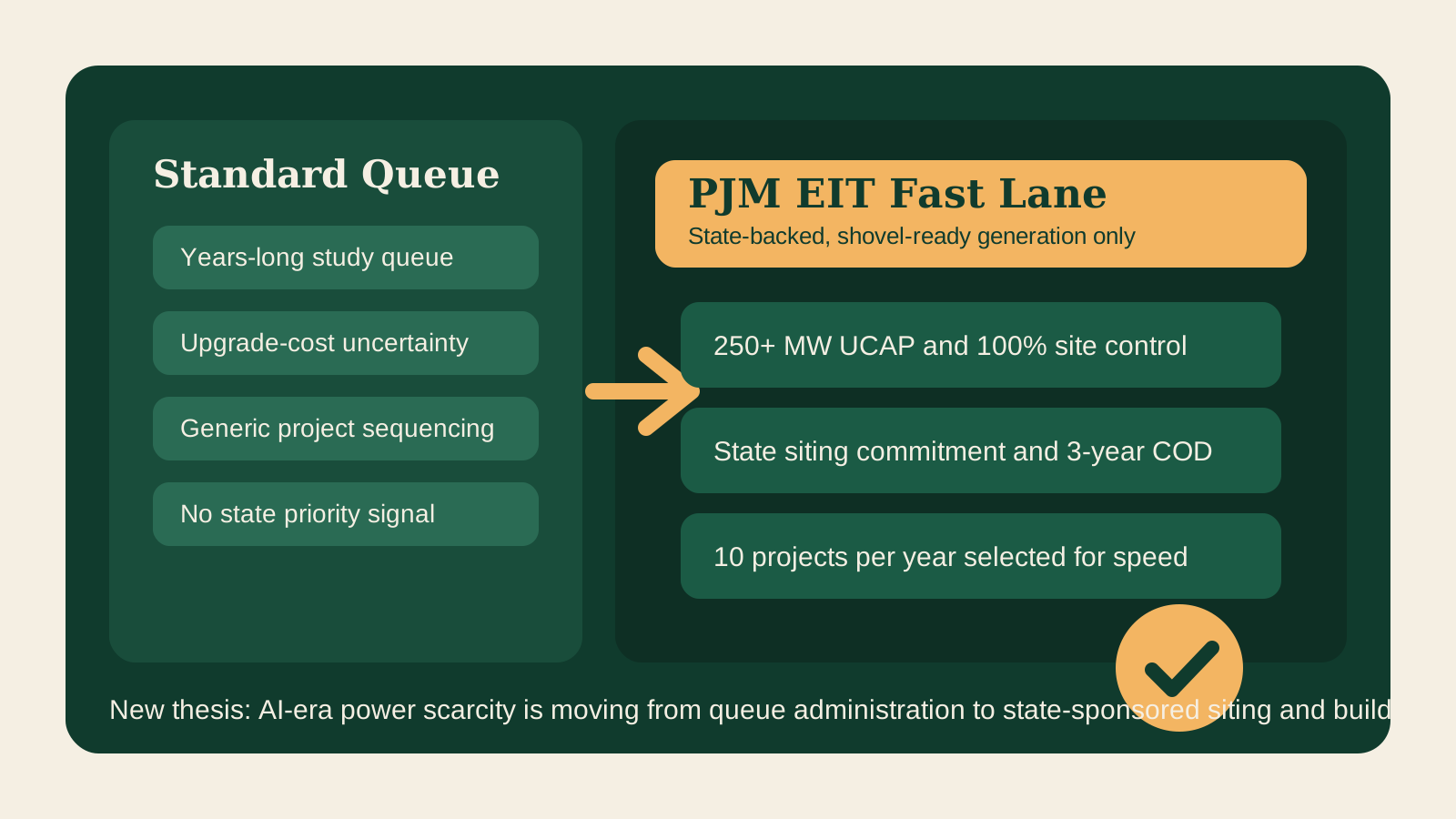
What PJM’s expedited track actually prioritizes
The fast lane is not for generic queue relief. It is designed for a small number of large projects that can prove both electrical value and real-world build readiness.
| EIT requirement | What it screens for | Why it matters now | Grid Report read-through |
|---|---|---|---|
| 250+ MW UCAP | Large accredited capacity additions rather than small speculative projects | PJM is trying to close a resource adequacy gap tied to rapid load growth. | The track is aimed at reliability-scale supply, not general queue cleanup. |
| Primary siting authority support | State willingness to move the project through siting and permitting | Generation speed is now constrained by political and regulatory execution, not only engineering studies. | State sponsorship is becoming part of the supply-selection mechanism. |
| Commercial operation within three years | Projects that can plausibly affect near-term auction and reliability timelines | AI-driven demand pressure is immediate, so PJM needs resources that arrive soon. | Schedule credibility is now a core part of project value. |
| 100% site control and no milestone extension | Reduced development optionality and fewer speculative placeholders | PJM wants projects that can actually convert urgency into steel in the ground. | The fast lane rewards execution certainty over paper pipelines. |
Source context: PJM’s March 2026 filing explanation, FERC Commissioner Rosner’s June 9, 2026 concurrence, and PJM’s June 10, 2026 approval summary.
FERC’s approval of PJM’s Expedited Interconnection Track is worth publishing because the useful signal is not simply that the grid operator wants faster studies. The stronger signal is that AI-era load growth is forcing PJM to create a privileged supply lane for very large generation projects, and access to that lane now depends as much on state siting support as on grid paperwork.
The underlying facts are specific. PJM’s March 2 explanation of the filing says the temporary Expedited Interconnection Track is an alternate path for advanced projects of significant size, with eligibility tied to at least 250 megawatts of accredited unforced capacity, support from the project’s primary siting authority, commercial operation within three years, 100% site control for related facilities, and a waiver of the usual one-year milestone extension. Commissioner David Rosner’s June 9 concurrence says the accepted process will advance up to 20 shovel-ready generation projects over the next two years.
PJM’s new fast lane does not just reward big generation projects. It rewards the projects whose states are willing to help turn reliability urgency into actual permitting speed.
That matters because it changes where the bottleneck sits. The normal queue story is that projects wait for studies, upgrades, and sequence priority. PJM’s new structure says the most urgent resources can move outside that rhythm, but only if they arrive with real-world execution proof already attached. In practice that means land control, tighter schedule discipline, and a state willing to signal that the project should be moved faster through siting and permitting.
The original Grid Report angle is that AI power shortage inside PJM is becoming a state-siting fast-lane story. If a data-center boom is pushing reliability stress high enough that PJM and FERC need a special track for supply, then the scarce permission layer is no longer only interconnection engineering. It is whether governors, commissions, and local permitting systems are willing to sponsor specific projects that can close the capacity gap on time.
This clears the duplicate block against the site’s recent PJM coverage. The spring-heat story was about shoulder-season operating strain. The BYONG article was about large loads mitigating curtailment risk by bringing their own generation. The PJM governance piece was about market design and decision rights. This story is different because it focuses on a new queue architecture for supply, where state sponsorship becomes part of the admission test.
For operators, the implication is practical. Large-load developers in PJM cannot assume that more urgency inside the market automatically means faster power in the field. The projects most likely to move now are the ones paired with state-level execution capacity: siting support, permitting coordination, land control, and a credible three-year construction path. That favors developers, utilities, and sponsors who can assemble a full state-backed build package instead of just a good interconnection application.
For investors and infrastructure watchers, the read-through is that future AI power winners in PJM may increasingly be selected by a hybrid of market need and political execution. If EIT becomes the template, the value will not sit only with the cheapest megawatt. It will sit with the project that can prove deliverability, permitting speed, and state sponsorship before the next auction and reliability deadlines arrive.
The search case is strong because the article answers a live, specific question that generic fast-track rewrites will miss: what did FERC actually approve, and why does it change the AI power buildout story in PJM? Readers searching for PJM expedited interconnection track, FERC fast-track generation, AI data center power in PJM, or state siting support for large generation get a concrete operator thesis instead of a recycled queue headline.
Sources
PJM Inside Lines, “PJM Files Price Collar, Expedited Interconnection as Part of Large Load Plan,” published March 2, 2026: https://insidelines.pjm.com/pjm-files-price-collar-expedited-interconnection-as-part-of-large-load-plan/
Federal Energy Regulatory Commission, Commissioner Rosner’s concurrence to the order accepting tariff revisions re PJM Interconnection under ER26-1563, published June 9, 2026: https://www.ferc.gov/news-events/news/commissioner-rosners-concurrence-order-accepting-tariff-revisions-re-pjm-0
PJM Inside Lines, “FERC OKs Temporary Process To Fast-Track Large Capacity Projects,” published June 10, 2026: https://insidelines.pjm.com/ferc-oks-temporary-process-to-fast-track-large-capacity-projects/
By Nawaz Lalani
The Grid Report is written by Nawaz Lalani and focuses on source-backed coverage of AI infrastructure, grid power demand, automation systems, and market signals.
Follow the signal, not just the headline.
Get the daily Grid brief for source-backed coverage on AI power demand, infrastructure timing, automation, and market signals.