- FERC’s June 5 notice for a PJM governance conference is worth publishing because the useful signal is not that regulators booked another day on the calendar.
- The official facts are specific.
- The agenda shows where FERC thinks the friction may sit.
- Section
- Markets
- Read time
- 5 min read
- Why this page exists
- The Grid Report publishes operator-grade coverage on AI, power, infrastructure, automation, and markets.
FERC’s June 5 notice for a PJM governance conference is worth publishing because the useful signal is not that regulators booked another day on the calendar. The stronger signal is that governance itself is now being treated as an infrastructure problem. When a regulator starts asking whether board authority, filing rights, committee structure, and stakeholder voting are slowing down a regional grid operator’s response to real-world stress, the market-design layer has clearly become part of the AI infrastructure story.
The official facts are specific. FERC said it will hold a Chairman- and Commissioner-led technical conference on July 23, 2026 focused on PJM’s governance and stakeholder processes. The notice says the goal is to identify concrete, actionable reforms that would improve PJM’s ability to address operational and market needs in a timely and efficient manner. That framing matters because it treats PJM’s internal decision machinery as something that may now be constraining system response.
The useful June 5 signal is that PJM governance is no longer back-office procedure. It is becoming part of the market bottleneck around AI-era power growth.
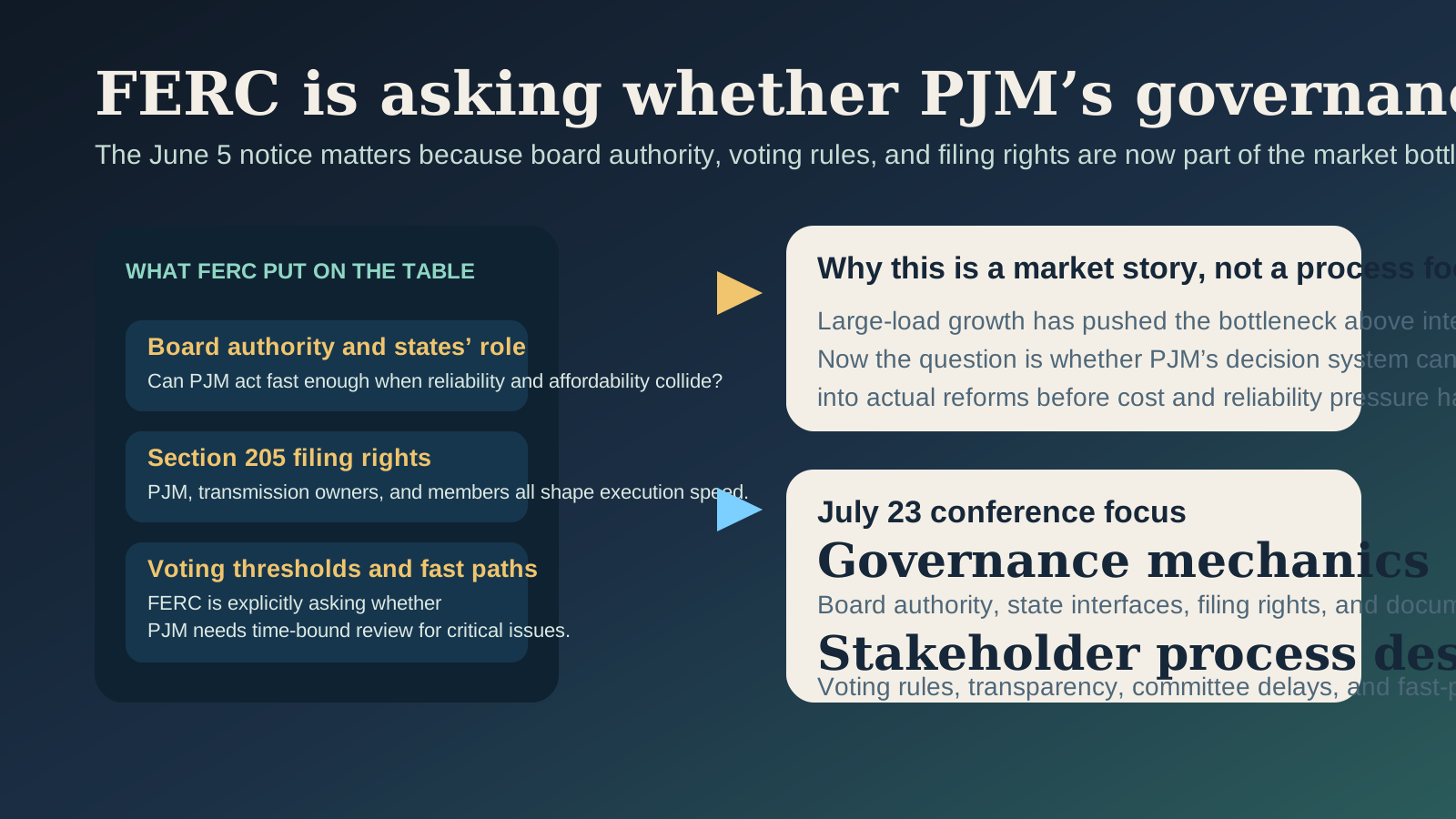
The agenda shows where FERC thinks the friction may sit. Panel one asks about board authority, the role of states, the division of Federal Power Act section 205 filing rights among PJM, transmission owners, and the Members Committee, and whether PJM’s governing documents impede timely decision-making. In plain English, that means FERC is not only asking what PJM should do. It is asking whether PJM is structurally able to do it fast enough.
Panel two pushes even further into execution mechanics. FERC asks whether sector-weighted voting and existing thresholds strike the right balance, what transparency reforms would improve decision quality, whether committee structures routinely contribute to delay, and whether fast-path or time-bound review procedures should be used more often on high-importance topics. That is a live question for a grid where market reform, generation investment, and large-load integration are increasingly interacting on compressed timelines.
This clears the duplicate block against the site’s recent PJM and FERC stories because the thesis is different. The May and early June pieces focused on large-load rules, BYONG-style interconnection paths, and cost-allocation mechanics. This story is about the control system above those rules. It asks whether PJM’s institutional plumbing is itself becoming a bottleneck as power demand, political pressure, and capital urgency rise together.
The timing also matters. In April, FERC said it would act by June 2026 on the national large-load interconnection docket, explicitly tying that work to rising demand from data centers and other large consumers. In May, PJM launched its own market-reform push with a paper on generation investment and reliability. The June 5 governance notice is best read as part of that same escalation: the pressure is no longer only about power plants or queue rules, but about whether the institution can make decisions at the speed the situation now requires.
For operators, developers, and investors, the practical read-through is that governance risk is becoming economic risk. If PJM cannot move quickly on reforms, then assumptions around energization timing, capacity procurement, bilateral structures, and consumer-cost politics all get harder to underwrite. In that sense, this is a market-design story because the value of power access increasingly depends on how fast the rule-making and filing machinery can convert intent into workable outcomes.
The Grid Report view is that this story clears the bar because it answers a search-worthy question that people inside the power and data-center stack are now asking directly: why is FERC hauling PJM governance into a dedicated conference? The useful answer is that large-load pressure has moved the problem up one layer. It is no longer just about what rule PJM should adopt, but whether PJM’s governance can process the next wave of decisions fast enough.
Sources
Federal Energy Regulatory Commission, “Supplemental Notice of Commission-Led Technical Conference,” Docket No. AD26-7-000, published June 5, 2026: https://www.ferc.gov/sites/default/files/2026-06/AD26-7-000%20Tech%20Conf.pdf
Federal Energy Regulatory Commission, “FERC to Act on Large Load Interconnection Docket by June 2026,” published April 16, 2026: https://www.ferc.gov/news-events/news/ferc-act-large-load-interconnection-docket-june-2026
PJM Interconnection, “PJM To Lead Market Reform Effort To Support Generation Investment and Reliability,” published May 6, 2026: https://www.pjm.com/about-pjm/newsroom/announcements-and-news-releases
Nawaz Lalani
Nawaz Lalani is the creator of The Grid Report and writes about AI infrastructure, grid power demand, automation systems, and the market signals shaping the physical AI economy. His focus is translating technical and industrial shifts into practical coverage for operators, investors, builders, and teams making real deployment decisions.
B.S. in Geology from UT Arlington. Covers AI infrastructure, energy systems, grid constraints, automation workflows, and market signals.
Stories are built from primary sources, utility and infrastructure signals, company disclosures, filings, and operator-grade context. The goal is to explain what changed, why it matters now, and what it means for builders, investors, utilities, and teams making real deployment decisions.
Follow the lane, not just the headline.
The strongest value in The Grid Report comes from following how AI, infrastructure, power, automation, and markets connect over time.