- PPL’s June 4 rate-case approval is worth publishing because the useful signal is not just that a utility won new revenue.
- The approved facts are specific.
- The settlement document makes the large-load mechanics more concrete.
- Section
- Markets
- Read time
- 5 min read
PPL’s June 4 rate-case approval is worth publishing because the useful signal is not just that a utility won new revenue. The stronger signal is that Pennsylvania is now turning the AI-load cost-allocation debate into a live tariff structure. That matters more than the topline rate increase because it shows how a real utility territory is trying to defend existing customers before the next wave of large campus demand fully energizes.
The approved facts are specific. PPL Electric said the Pennsylvania Public Utility Commission approved a settlement authorizing a $275 million increase in annual base distribution revenues. The company also said the decision establishes a new large-load customer rate class with binding long-term financial and usage commitments, including a minimum 10-year requirement for large users such as data centers. Beginning in 2027, PPL said $11 million annually in low-income program assistance will be assigned to those large-load customers through a non-bypassable charge.
PPL’s useful signal is not another rate case. It is that AI-scale grid access is being turned into longer contracts, minimum demand floors, and real financial security.
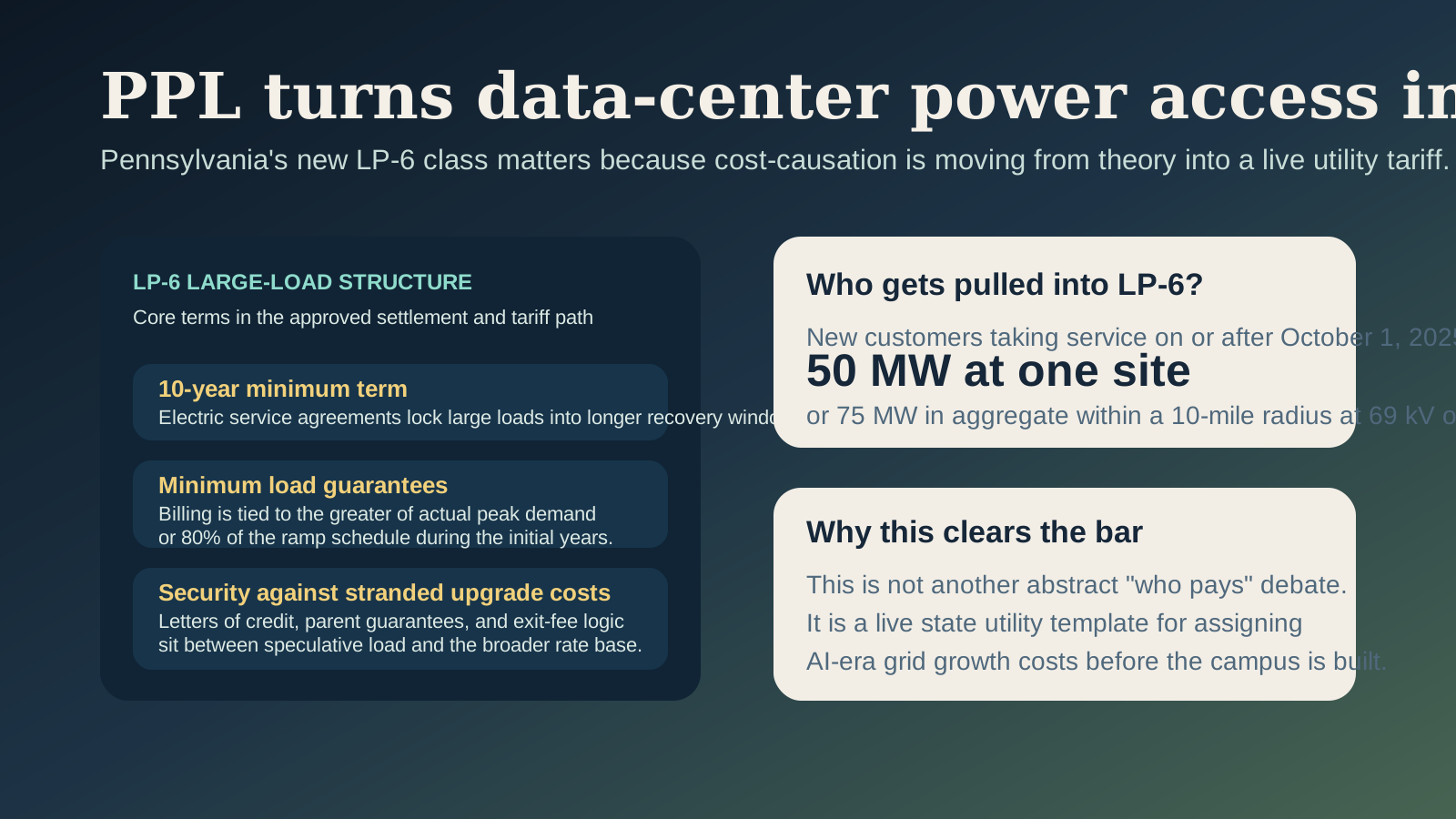
The settlement document makes the large-load mechanics more concrete. PPL says the new LP-6 schedule will govern large-load, data-center customers through electric service agreements that include an initial term of not less than 10 years, a multi-year load-ramp schedule, revenue-guarantee obligations, and security in the form of a letter of credit, parent guarantee, or another acceptable instrument. During the initial term, billing determinants are tied to the greater of actual peak demand or minimum percentages of the ramp schedule, which is exactly the kind of structure designed to protect the utility if a promised load arrives late, scales slowly, or walks away.
Just as important, the filing sets thresholds that make this a real AI-infrastructure rule rather than a symbolic one. Under the settlement terms, LP-6 applies to customers whose service commenced on or after October 1, 2025 and whose peak demand is at least 50 megawatts at a single facility or at least 75 megawatts in aggregate among facilities within a 10-mile radius taking service at 69 kilovolts or above. In other words, this is targeted at the exact kind of campus-scale load that has been driving national concern over data centers, interconnection queues, and ratepayer exposure.
That is what makes the story materially different from The Grid Report’s earlier “who pays” and large-load-rule coverage. Those pieces explained the principle. PPL is an implementation case. It shows what happens when cost-causation pressure is translated into utility paperwork, minimum demand guarantees, security obligations, and a class definition that can actually be applied to a prospective project.
For operators and developers, the practical message is that grid access is becoming more contract-heavy before steel is even in the ground. If a campus wants power in a constrained territory, it may increasingly need to prove seriousness through duration, financial security, ramp commitments, and acceptance of specialized rate treatment. That can reshape site selection, financing, phased deployment plans, and how developers pitch certainty to capital partners.
For investors and policymakers, the useful read-through is that utility economics are starting to harden around AI load instead of merely talking about it. A region that creates a dedicated class for data-center-scale demand is effectively signaling that ordinary commercial tariffs are no longer good enough for the next generation of load. The open question is whether these protections remain strong enough once real projects begin pressing on transmission-upgrade treatment, aggregation rules, and petitions for exceptions.
The Grid Report view is that PPL clears the publish bar because this is a search-worthy and operator-relevant answer to a live question: what does a data-center protection tariff actually look like when a utility has to file one? The answer is not abstract. It looks like longer contracts, minimum demand floors, security against stranded costs, and a clearer attempt to keep the biggest new loads from pretending they are ordinary customers.
Sources
PPL Electric Utilities, “Pennsylvania Public Utility Commission approves new distribution rates for PPL Electric Utilities prioritizing reliability, customer protections and long-term affordability,” published June 4, 2026: https://www.prnewswire.com/news-releases/pennsylvania-public-utility-commission-approves-new-distribution-rates-for-ppl-electric-utilities-prioritizing-reliability-customer-protections-and-long-term-affordability-302791773.html
PPL Electric Utilities, “Joint Petition for Non-Unanimous Settlement of All Issues,” accessed June 5, 2026: https://pplelectric.com/-/media/ppl-jss-app/assets/Home/Landing-Pages/Public-Utility-Commission/PDFs/2026/PPL--2025-Rate-Case--Joint-Petition-for-NonUnanimous-Settlement-of-All-Issues-FINAL.pdf
By Nawaz Lalani
The Grid Report is written by Nawaz Lalani and focuses on source-backed coverage of AI infrastructure, grid power demand, automation systems, and market signals.
Follow the signal, not just the headline.
Get the daily Grid brief for source-backed coverage on AI power demand, infrastructure timing, automation, and market signals.