- The June 3 Data Center Knowledge report is worth elevating, but not for the most obvious reason.
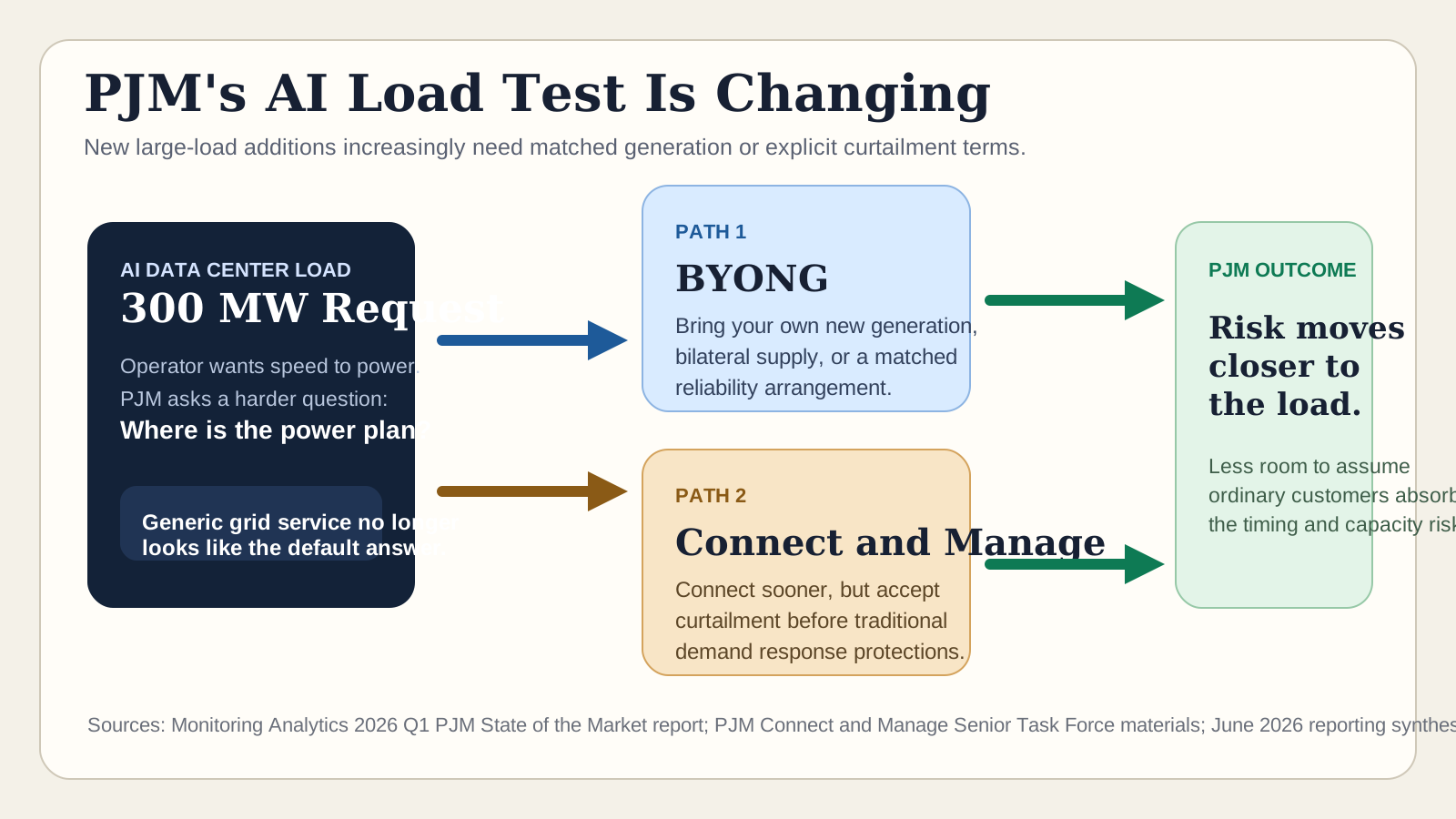
- That is why the acronym that matters here is BYONG, or bring your own new generation.
- PJM’s own stakeholder process points in the same direction.
- Section
- Policy
- Read time
- 5 min read
- Data included
- Why PJM’s BYONG turn matters
Why PJM’s BYONG turn matters
The useful signal is not just that data-center load is growing. It is that PJM’s emerging answer pushes new AI campuses toward matched supply or explicit curtailment instead of ordinary pooled-service assumptions.
The two practical paths now taking shape
| Path | What the data center must do | Why it matters |
|---|---|---|
| BYONG | Bring matched generation, bilateral contracts, or a dedicated reliability structure | Moves the power plan closer to the project and reduces pressure to socialize the mismatch through market pricing. |
| Connect and manage | Accept connection with a defined curtailment framework if supply is not yet sufficient | Speed can improve, but only if the operator tolerates interruption risk more explicitly than a normal firm-service customer would. |
| Base market dependence | Rely on generic PJM capacity additions to catch up later | This is the path under the most scrutiny because it can intensify scarcity pricing and reliability tensions. |
| Policy effect | Force clearer risk allocation before the campus scales | The commercial structure of AI load becomes part of grid policy, not just a private siting decision. |
Source frame: Monitoring Analytics May 14, 2026 quarterly market report, PJM Connect and Manage Senior Task Force materials, and June 3, 2026 reporting synthesis.
The June 3 Data Center Knowledge report is worth elevating, but not for the most obvious reason. The useful signal is not simply that AI-driven load growth is making PJM nervous or that another market monitor is warning about higher prices. The stronger signal is that PJM’s emerging rule posture is getting more explicit about who should carry the risk when very large data-center loads want to connect before enough supply is ready. Increasingly, the answer is: the load should show its power plan up front.
That is why the acronym that matters here is BYONG, or bring your own new generation. Monitoring Analytics’ first-quarter 2026 State of the Market report argues that PJM does not currently have enough capacity to serve the forecast wave of data-center demand cleanly. Its preferred answer is not to let the base market absorb the shock and then socialize the consequences through scarcity pricing. It is to push new large loads toward bilateral supply arrangements, matched generation, or other reliability structures that sit closer to the project itself.
In PJM, the useful question is no longer only how fast a data center can interconnect. It is whether the project arrives with its own power plan or with explicit curtailment risk.
PJM’s own stakeholder process points in the same direction. On the Connect and Manage Senior Task Force page, PJM says loads that do not bring their own new generation may still connect under a connect-and-manage framework, but with curtailment expected to occur before the deployment of pre-emergency demand response. That is not a small detail. It means the fast path for AI campuses is increasingly being defined not as ordinary firm service, but as a conditional operating arrangement with real interruption exposure.
That is the original Grid Report angle. The interconnection problem is evolving from a queue-management story into a contract-structure story. For years, large-load debates could be summarized as who waits, who studies, and who pays for upgrades. PJM is now drifting toward a more operator-grade question: if the capacity is not there today, does the data center arrive with its own supply, or does it agree to be first in line for curtailment when the system gets tight?
This clears the duplicate block against recent Grid Report coverage. The June 3 Google-Voltus piece was about turning distributed flexibility into a funded PJM capacity product. The May 31 summer-assessment piece was about reserve margins and seasonal reliability. The May 10 large-load rules story was about FERC’s broader timing and cost-allocation clock. This article is narrower and more operational. It is about how PJM may force the project-level commercial structure itself to change.
For operators, the implication is that speed to power in PJM may increasingly depend on how credibly a campus can pair load with generation, storage, contracted flexibility, or a curtailable operating profile. That pushes energy strategy earlier into the development stack. Power procurement, capacity rights, backup design, and curtailment tolerance all start mattering before the site can safely assume normal utility service economics.
For investors, the read-through is that the next value capture may shift toward developers, utilities, traders, and infrastructure platforms that can package power with the load instead of merely selling powered land. BYONG logic rewards counterparties that can secure dispatchable supply, structure bilateral contracts, and underwrite curtailment risk with enough confidence to move a hyperscale project through the queue faster.
For policymakers, the significance is that PJM is quietly drawing a harder line around cost and reliability discipline. If large loads can connect only by bringing supply or accepting earlier curtailment, then the region is moving away from the assumption that residential and ordinary commercial customers should absorb the timing mismatch created by AI buildout. That does not solve the capacity problem. But it does change where the pressure lands.
The reason to publish this now is that the June 3 reporting crystallizes a design turn that is likely to spread beyond one article cycle. The AI power debate is no longer only about how many gigawatts are coming. In PJM, it is increasingly about whether a new AI data center shows up as a generic customer or as a self-supplied, contractually constrained infrastructure project. That is a much more specific and much more investable question.
Sources
Monitoring Analytics, “2026 Quarterly State of the Market Report for PJM: January through March,” posted May 14, 2026: https://www.monitoringanalytics.com/reports/PJM_State_of_the_Market/2026/2026q1-som-pjm.pdf
PJM Interconnection, “Connect and Manage Senior Task Force,” accessed June 4, 2026: https://www.pjm.com/committees-and-groups/task-forces/camstf
Data Center Knowledge, “PJM Monitor: AI Data Center Growth Reshaping Power Markets,” published June 3, 2026: https://www.datacenterknowledge.com/energy-power-supply/pjm-monitor-ai-data-center-growth-reshaping-power-markets
By Nawaz Lalani
The Grid Report is written by Nawaz Lalani and focuses on source-backed coverage of AI infrastructure, grid power demand, automation systems, and market signals.
Follow the signal, not just the headline.
Get the daily Grid brief for source-backed coverage on AI power demand, infrastructure timing, automation, and market signals.