- EIA’s May 28 gas-for-power forecast is worth publishing because the useful signal is not simply that natural gas demand stays large.
- That matters because it gives the AI-power story more structure.
- That is the original Grid Report angle.
- Section
- Energy
- Read time
- 6 min read
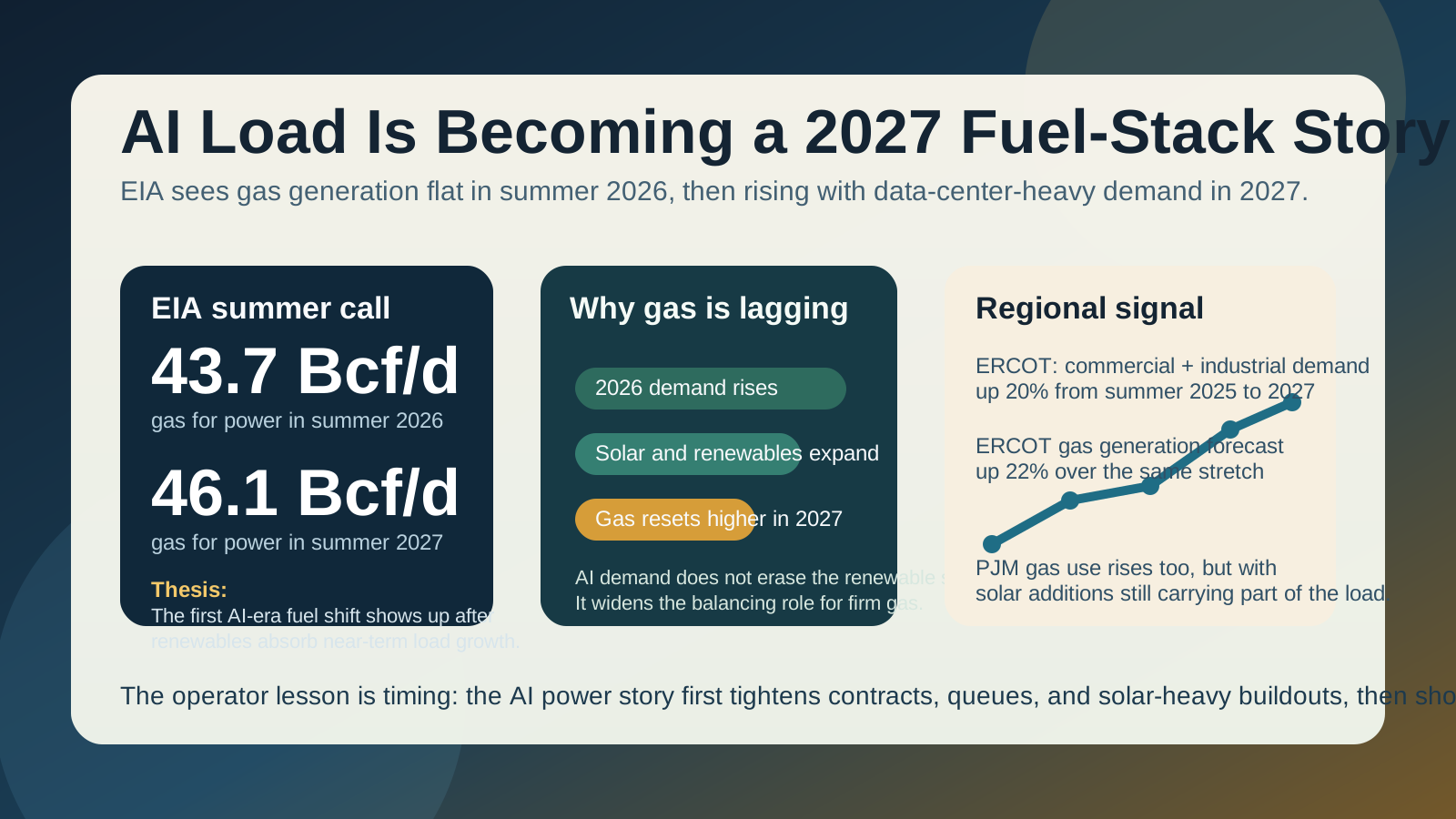
EIA’s May 28 gas-for-power forecast is worth publishing because the useful signal is not simply that natural gas demand stays large. The stronger signal is the timing. EIA says gas-fired power generation stays roughly flat this summer even with higher total electricity demand, then rises to a record next summer as commercial and industrial load keeps building in places where data centers and other large projects are showing up fastest.
That matters because it gives the AI-power story more structure. In the May Short-Term Energy Outlook, EIA says natural gas consumed by the electric power sector averages 43.7 billion cubic feet per day during the summer of 2026, the same as summer 2025. Then it rises 6% to 46.1 Bcf/d in summer 2027. The same EIA analysis ties the 2027 increase to stronger commercial demand from new data centers and large manufacturing facilities, with Texas and Virginia called out explicitly through ERCOT and PJM.
EIA’s new signal is that AI-heavy load growth does not instantly become a 2026 gas spike. It shows up more clearly as a 2027 fuel-stack problem after renewables absorb part of the first wave.
That is the original Grid Report angle. AI load is becoming a fuel-stack story on a lag, not an instant spike. The first thing large-load growth does is not necessarily blow out summer gas burn in the next quarter. In EIA’s framing, renewables absorb more of the near-term demand growth in 2026. The harder gas call shows up after the system has to keep serving a larger, more persistent commercial load base into 2027.
The regional detail is what makes this search-worthy. EIA says commercial and industrial electricity demand in the West South Central region rises 20% from the summer of 2025 to the summer of 2027, with ERCOT meeting that growth through more solar and more natural gas. Over that stretch, EIA expects ERCOT natural gas generation to increase 22%. In PJM, EIA expects natural gas consumption for electricity generation to increase 6% relative to summer 2025 while solar generation rises 32% over the same period.
That clears the duplicate block against the site’s existing EIA May forecast article and the broader AI power planning-range piece. Those stories were about demand growth, commercial load, and why AI power should be treated as a funnel rather than one headline number. This one is narrower and more operational. It is about when the fuel mix changes, what part renewables still play in the interim, and why the gas problem may land later than many fast-twitch AI power narratives suggest.
For operators, the implication is that “AI means more gas” is too blunt to be useful. The better question is when gas becomes the binding variable in a given region. In 2026, the main challenge may still be interconnection timing, solar additions, and load commitments. By 2027, the harder issue may be firm fuel, plant availability, and whether gas-delivery systems can support a larger base of always-on computing demand during summer peaks.
For investors and policymakers, the read-through is that the next AI-energy bottleneck may not be visible in this summer’s headline burn numbers. It may show up one planning cycle later in gas procurement, pipeline use, and emissions politics across the regions where hyperscale and industrial loads are compounding at the same time. That is a more specific and more useful signal than another vague statement that AI needs power.
The reason to publish this now is that it is timely, specific, and better than a commodity rewrite. EIA has now given a date-stamped answer to an important question: if AI demand keeps climbing, when does the U.S. power mix start to feel it more clearly through natural gas? Its answer is not “right away.” It is “more in 2027 than 2026,” and that changes how operators should read the next twelve months.
Sources
U.S. Energy Information Administration, “Natural gas for power generation flat this summer, record high expected in 2027,” published May 28, 2026: https://www.eia.gov/todayinenergy/detail.php?id=67725
U.S. Energy Information Administration, “Short-Term Energy Outlook,” May 2026 edition, accessed May 30, 2026: https://www.eia.gov/outlooks/steo/
By Nawaz Lalani
The Grid Report is written by Nawaz Lalani and focuses on source-backed coverage of AI infrastructure, grid power demand, automation systems, and market signals.
Follow the signal, not just the headline.
Get the daily Grid brief for source-backed coverage on AI power demand, infrastructure timing, automation, and market signals.