- Oregon’s May 7 Schedule 96 order is worth publishing because the real signal is not simply that regulators want data centers to pay more.
- The Oregon Public Utility Commission said its decision creates Schedule 96 under House Bill 3546, the POWER Act, so that fast-growing data-center demand does not push infrastructure costs onto households and small businesses.
- That is the original Grid Report angle.
- Section
- Energy
- Read time
- 6 min read
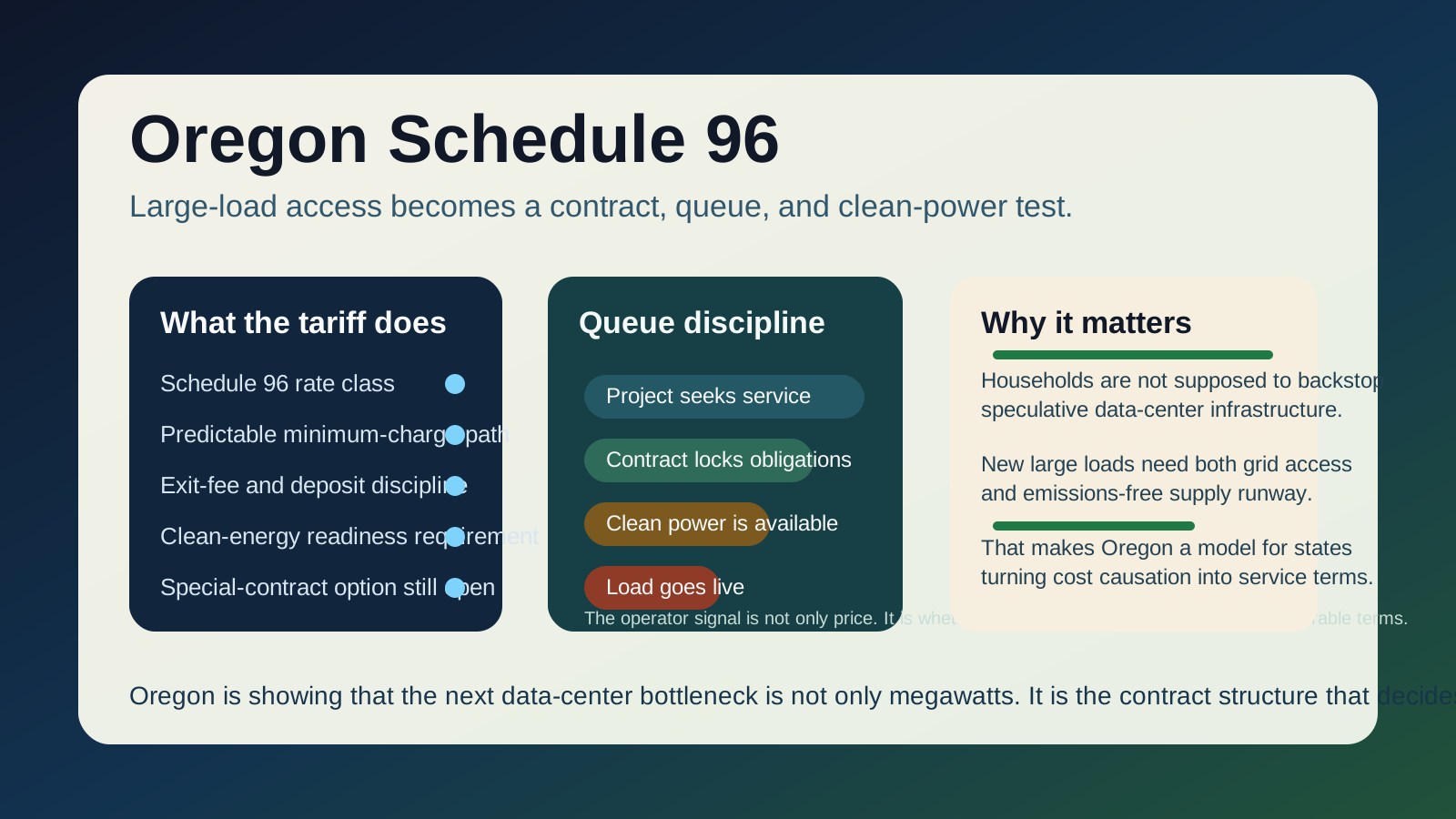
Oregon’s May 7 Schedule 96 order is worth publishing because the real signal is not simply that regulators want data centers to pay more. The stronger signal is that Oregon is treating large-load service as a more explicit grid-access product. If a project wants to connect at scale, it now faces clearer contract obligations, more visible stranded-asset protection, and a requirement that enough clean energy exists before it can take service. That is more useful than another generic story about household bills.
The Oregon Public Utility Commission said its decision creates Schedule 96 under House Bill 3546, the POWER Act, so that fast-growing data-center demand does not push infrastructure costs onto households and small businesses. The commission’s public summary also says the structure gives data centers clarity on what they must do to take service, lets them reduce costs through efficiency and flexibility, and requires them to pay for the emissions-free electricity needed to serve their loads while Oregon meets its clean-electricity mandates.
In Oregon, the next large-load bottleneck is no longer only megawatts. It is whether a project can live inside the contract, cost, and clean-power terms required to take service.
That is the original Grid Report angle. Oregon is not only changing a rate sheet. It is turning large-load access into a contract-and-clean-power story. Once a utility has to build substations, line extensions, and generation support for a customer that may arrive in enormous blocks, the real operational question is whether the customer will stay long enough, use enough, and align with enough clean supply to justify the buildout. Schedule 96 is one answer to that problem.
That reading gets stronger when you look at the surrounding materials. Oregon’s large-customer-demand page says PGE’s large-load work now includes line-extension policy, refund structure, minimum load or billing agreements, voltage-level service, and other policies meant to avoid stranded assets while assigning investment costs more fairly. The utility commission is effectively saying that large-load service can no longer be handled as if it were routine industrial demand with ordinary assumptions about growth and recovery.
The contract details matter more than the headline. The commission said future agreements between PGE and data-center customers must include predictable charges if a project does not use the infrastructure PGE built to serve it. Oregon CUB’s summary adds more texture: deposits, 10-to-30-year contract lengths depending on size, penalties for going above contracted usage, and more transparency around the agreements. Whether every implementation detail survives unchanged matters less than the structural shift. Oregon is packaging grid access with performance obligations rather than quietly socializing speculative buildout risk.
This clears the site’s duplicate block because it is materially different from the existing “who pays for upgrades” and FERC large-load pieces. Those stories were broad explainers about cost allocation and federal queue governance. Oregon is narrower and more operator-relevant. It is about one state showing what a concrete access model looks like when regulators force the tariff, the contract, and the clean-energy condition to work together.
It also clears the last-30-day similarity test against the Freestone and CAISO stories. Freestone was about co-location and the meter boundary. CAISO was about transmission capex. Oregon is about the service contract that sits before energization and defines whether a large load gets to move at all. That makes it a better search story for readers trying to understand Schedule 96, the POWER Act, or whether data-center projects now need to prove more than demand forecasts and land control.
For operators, the implication is clear: in some markets, speed to power is turning into speed to an acceptable contract. A project may have a site, a capital partner, and a utility conversation and still be blocked if it cannot satisfy the utility’s clean-power, load-commitment, or cost-recovery conditions. For investors and policymakers, the read-through is that Oregon is offering one of the clearer early models for how states may try to ringfence AI-era load growth without shutting it out entirely.
The reason to publish this now is that it is specific, current enough to matter, and more useful than a soft trend piece about data-center backlash. Oregon has moved the conversation from abstract fairness claims to a live utility framework that other states can copy, resist, or adapt.
Sources
Oregon Public Utility Commission, “Oregon PUC Approves New Rate Structure To Protect Customers Amid Rapid Data Center Growth,” published May 7, 2026: https://flashalert.net/id/PUC/188407
Oregon Public Utility Commission, “Large Customer Demand,” accessed May 30, 2026: https://www.oregon.gov/puc/utilities/pages/large-load.aspx
Oregon Public Broadcasting, “Portland General Electric’s data center customers to pay more for electricity under landmark law,” published May 12, 2026: https://www.opb.org/article/2026/05/12/portland-general-electric-oregon-power-data-centers/
Oregon Citizens’ Utility Board, “Regulators Direct PGE to Protect Oregonians from Data Centers,” published May 20, 2026: https://oregoncub.org/news/water-wastewater/regulators-direct-pge-to-protect-oregonians-from-data-centers/3275/
Portland General Electric, “PGE Secures Regulatory Approval To Ensure Data Centers Pay For The Growth They Drive,” published May 8, 2026: https://flashalert.net/news.html?id=101
By Nawaz Lalani
The Grid Report is written by Nawaz Lalani and focuses on source-backed coverage of AI infrastructure, grid power demand, automation systems, and market signals.
Follow the signal, not just the headline.
Get the daily Grid brief for source-backed coverage on AI power demand, infrastructure timing, automation, and market signals.