- California’s newest transmission-planning signal is more important than the headline project count.
- For years, the easier story about California transmission was renewable integration: build lines to reach remote solar, wind, and storage resources.
- That matters for AI and other large-load developers because it changes the siting question.
- Section
- Energy
- Read time
- 7 min read
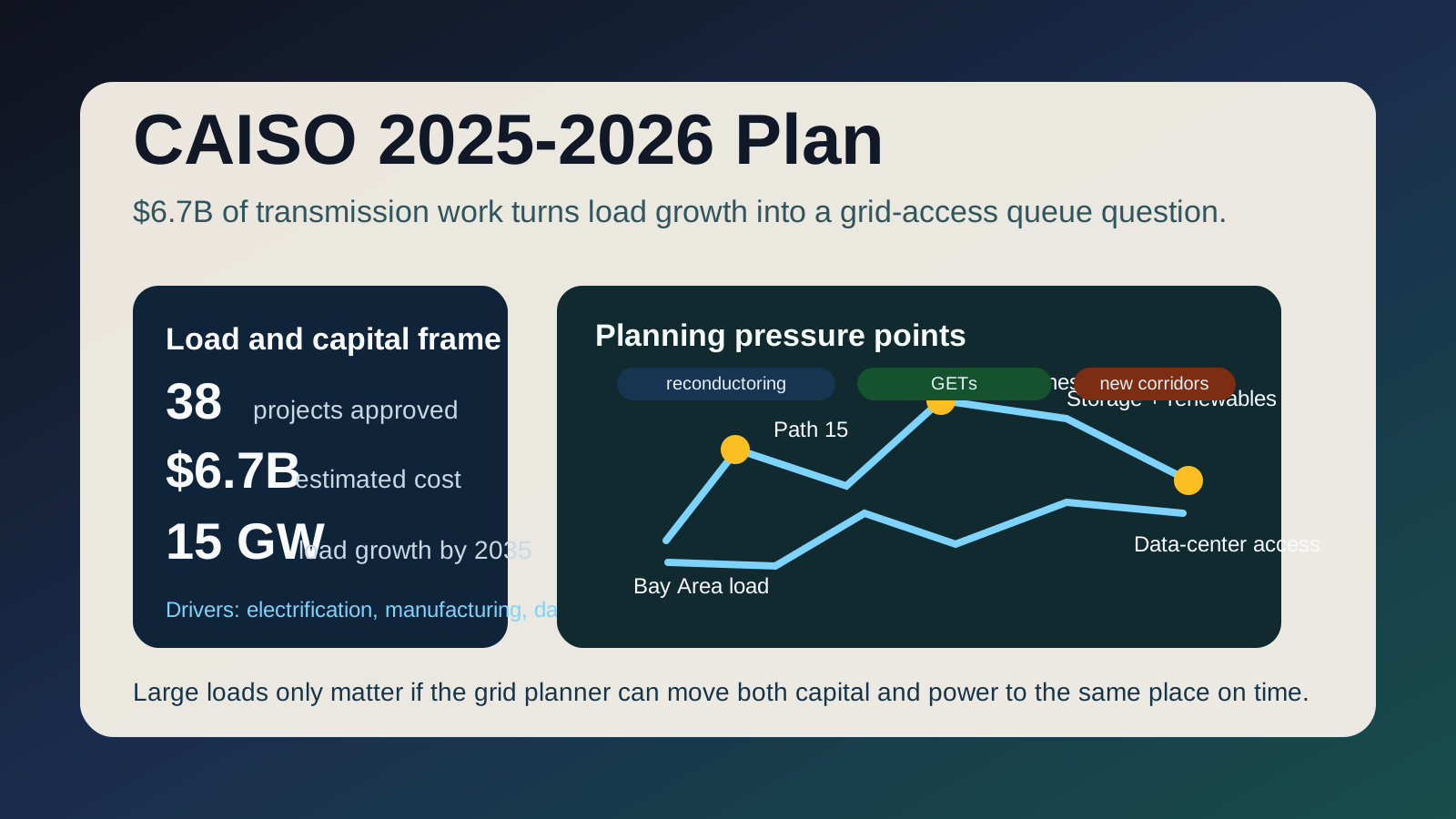
California’s newest transmission-planning signal is more important than the headline project count. In its approved 2025-2026 Transmission Plan, the California ISO recommended 38 infrastructure projects with an estimated cost of $6.7 billion. The sharper detail is that more than half of those projects, and more than half of that cost, are being driven by forecasted load growth. That is a meaningful shift in what transmission spending is solving for.
For years, the easier story about California transmission was renewable integration: build lines to reach remote solar, wind, and storage resources. That remains true, and the CAISO plan still includes major work to reach resource development basins identified by the California Public Utilities Commission. But the new document makes clear that planners are now also spending real capital to serve growing demand reliably and economically. In other words, the transmission system is being pulled by the load side, not only the supply side.
Once more than half of approved transmission spend is load-growth-driven, grid capex stops being background context and becomes part of the large-load product itself.
That matters for AI and other large-load developers because it changes the siting question. Once load growth becomes a formal driver of approved transmission capital, grid access stops being a soft strategic talking point and becomes a harder timing-and-cost problem. A developer can no longer look at California as a place with demand and capital alone. It has to ask where the grid upgrades are being approved, how fast they can be delivered, and whether large new loads will land in parts of the system already under planning pressure.
CAISO’s own load outlook explains why this is happening. The ISO says the plan is based on California Energy Commission projections showing load growth of 15 gigawatts by 2035 and 20 gigawatts by 2040. It also says the increasing demand is being driven by building and transportation electrification, manufacturing, and large loads including data centers. That is the practical bridge to the AI story. Data centers are not the whole California load-growth story, but they are explicitly inside the planning frame now.
The approved plan also shows what this next phase of grid buildout looks like. It includes 12 reconductoring projects that add capacity without rebuilding corridors from scratch, and three of those use advanced conductors as part of a broader grid-enhancing-technology toolkit. CAISO is also canceling one previously approved 500-kilovolt reinforcement in the Los Angeles Basin in favor of smaller, lower-cost upgrades and more reliance on storage development. That is a useful operator signal: the grid response to demand growth is not only “build more.” It is also “squeeze more throughput and flexibility out of what already exists.”
The geography matters too. CAISO highlights Greater Bay Area load growth as a major driver of specific upgrades, including the Tesla-Trimble-Metcalf 230-kV corridor expansion. It also points to congestion along Path 15, the major north-south corridor, where planners identified the need for a new 500-kV line that will be refined in the next planning cycle. Those are not abstract planning notes. They are clues about where future power-delivery friction could show up for data-center, industrial, and electrification-heavy projects.
The investor implication is that transmission planning is becoming a more visible part of the AI infrastructure stack. If more than half of approved grid capex is now load-growth-driven, the value of “power-ready” sites goes up and the cost of getting the location wrong rises with it. That does not just affect utilities and regulators. It affects private developers, hyperscalers, land bankers, and anyone underwriting California capacity as if the main constraint were still only compute or permitting.
The Grid Report view is that CAISO’s plan should be read as a capital-allocation signal, not a generic infrastructure update. California is telling the market that demand growth is now important enough to reshape which transmission projects get approved and how they are justified. For large-load operators, the implication is straightforward: in the next phase of AI buildout, transmission capital is part of the product.
Sources
California ISO, “ISO Board of Governors approves 2025-2026 transmission plan,” published May 19, 2026: https://www.caiso.com/about/news/news-releases/iso-board-of-governors-approves-2025-2026-transmission-plan
California ISO, “Revised Draft 2025-2026 Transmission Plan,” accessed May 27, 2026: https://stakeholdercenter.caiso.com/InitiativeDocuments/Revised-Draft-2025-2026-Transmission-Plan.pdf
By Nawaz Lalani
The Grid Report is written by Nawaz Lalani and focuses on source-backed coverage of AI infrastructure, grid power demand, automation systems, and market signals.
Follow the signal, not just the headline.
Get the daily Grid brief for source-backed coverage on AI power demand, infrastructure timing, automation, and market signals.