- The short answer for a Texas household is: AI data centers can put upward pressure on electricity bills, but they do not automatically raise your bill the moment a project is announced.
- That distinction matters because a lot of Texas headlines treat every announced data center as if it immediately lands on your monthly statement.
- That is the heart of the Texas ratepayer issue.
- Section
- Energy
- Read time
- 8 min read
- Data included
- How AI data-center costs can reach a DFW household bill
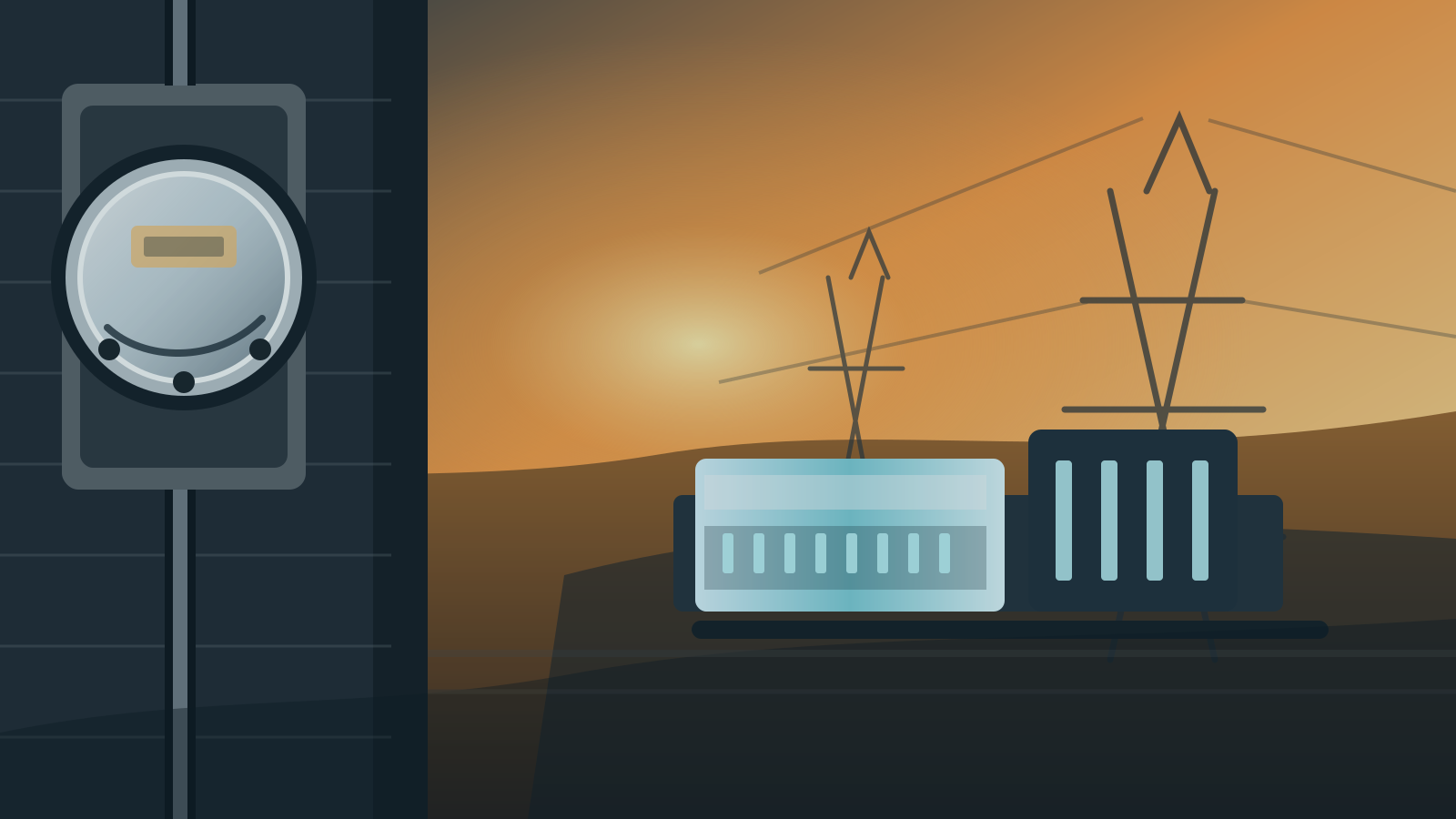
How AI data-center costs can reach a DFW household bill
The bill risk is indirect. It moves through load verification, transmission planning, utility rate recovery, and delivery charges before it reaches a residential customer.
DFW delivery-charge examples using an illustrative ~5.6 cents/kWh Oncor pass-through
| Step | What happens | Why DFW households should care |
|---|---|---|
| 1. Data center requests power | Large-load developers ask for tens or hundreds of megawatts. | Not every request is guaranteed to become real load. |
| 2. ERCOT and TSPs verify demand | Forecasts separate contracted loads from less certain officer-letter loads. | Bad verification can turn speculative demand into real planning cost. |
| 3. Grid upgrades are planned | Substations, transmission, transformers, and reliability work may be needed. | These are the costs that can become controversial. |
| 4. PUCT approves recovery | Rates and tariffs decide who pays: large load, all customers, or some mix. | This is where fairness becomes a ratepayer issue. |
| 5. REP bill reflects charges | Oncor delivery costs are passed through or bundled by the retail provider. | DFW customers see the result as delivery or all-in rate pressure. |
Sources: ERCOT preliminary 2026-2032 forecast, ERCOT May 2025 CDR, Oncor delivery-charge materials, and Oncor tariff documents.
The short answer for a Texas household is: AI data centers can put upward pressure on electricity bills, but they do not automatically raise your bill the moment a project is announced. For Dallas-Fort Worth customers in Oncor territory, the path is more specific. A data center asks for power. The transmission or distribution provider reports expected load. ERCOT folds verified or semi-verified large-load requests into planning. Utilities may need substations, transmission upgrades, transformers, or reliability work. Then the Public Utility Commission of Texas decides which costs can be recovered through approved rates. Only after that does the cost show up in the delivery portion of a residential bill.
That distinction matters because a lot of Texas headlines treat every announced data center as if it immediately lands on your monthly statement. It does not. ERCOT itself warned in April 2026 that its preliminary long-term forecast is a planning snapshot, not a prediction of what will actually be built. The headline number was huge: approximately 367,790 megawatts of demand in the ERCOT region by 2032, compared with ERCOT’s all-time peak of 85,508 megawatts recorded on August 10, 2023. But ERCOT also said it believes the forecast is higher than expected future load growth and wants to work with the PUCT to refine how load is verified.
The Texas question is not whether AI data centers should exist. It is whether large loads prove, pay, and flex before speculative grid costs land on household bills.
That is the heart of the Texas ratepayer issue. If every large-load request is treated as equally likely, Texas could overbuild or over-plan around projects that never fully materialize. If utilities wait too long, real data centers and industrial loads may hit a grid that is not ready. The bill question lives in that tension: how much infrastructure should Texas build in advance, and who should pay if the demand forecast turns out to be too high?
The near-term ERCOT numbers are less dramatic but still large. In the May 2025 Capacity, Demand and Reserves report, ERCOT showed new TSP-reported large loads rising from 7,627 megawatts in summer 2026 to 47,783 megawatts by summer 2030. ERCOT also listed a base summer peak forecast of 94,159 megawatts for 2026 and 138,010 megawatts by 2030. Those figures include multiple load types, not only AI data centers, but ERCOT explicitly identifies large loads such as data centers, cryptocurrency mining, industrial activity, and oil and gas processes as part of the planning problem.
For a DFW household, the most visible place this can show up is the delivery side of the electric bill. Oncor does not sell power to you directly. In the deregulated Texas market, your retail electric provider sells you electricity, while Oncor delivers and meters it across much of North Texas, including the Dallas-Fort Worth area. Oncor explains that residential delivery charges include fixed monthly charges, such as customer and metering charges, and variable charges tied to usage, including distribution, transmission cost recovery, distribution cost recovery, energy efficiency, and other tariff components approved by regulators.
Here is the practical DFW math. Oncor has described its residential delivery charge structure as a fixed monthly amount plus a per-kilowatthour charge. Public retail disclosures in 2026 commonly show Oncor residential TDU delivery charges around a little over 5.6 cents per kilowatthour plus a monthly customer charge. At 1,000 kilowatthours in a month, that means the delivery component alone is roughly around $60 before the retail energy charge. At 1,500 kilowatthours, it is closer to the high-$80s. At 2,000 kilowatthours during a hot summer month, the delivery portion can move into the low-$110s. These are examples, not a universal bill, because every plan and usage pattern is different.
That makes the AI question easier to understand. If data-center-driven grid costs eventually add half a cent per kilowatthour to a delivery or pass-through component, a 1,000-kilowatthour household would feel roughly $5 more in a month. A 2,000-kilowatthour summer household would feel roughly $10. If the effect were one cent per kilowatthour, those examples become about $10 and $20. The point is not that those exact increases are guaranteed. They are not. The point is that small per-kilowatthour changes become real money when Texas households use a lot of power for air conditioning.
So the correct headline is not “AI will definitely raise your DFW bill in 2026.” The correct headline is that AI data-center growth increases the stakes of Texas cost allocation. If grid upgrades are assigned directly to the large customers causing them, the household impact can be limited. If costs are spread across the broader rate base, DFW customers can end up paying for part of a buildout they did not directly request. That is why rate design, large-load tariffs, interconnection deposits, and demand verification matter more than the raw megawatt headline.
The fairness question is especially important in Texas because ERCOT is trying to separate real load from speculative requests. ERCOT’s May 2025 report says new data-center load requests were reduced to 49.8% of the original request for forecasting purposes and that officer-letter loads were also adjusted. That is an important signal: even the grid operator is not treating every request as fully certain. For ratepayers, that is exactly the safeguard to watch. The more Texas requires signed contracts, deposits, flexibility commitments, and verified construction timelines before building expensive grid infrastructure, the lower the risk that ordinary households subsidize speculative projects.
There is another side to the story. Data centers can also bring economic activity, tax base, and demand that supports new generation and grid investment. The policy issue is not whether Texas should block AI infrastructure. It is whether Texas should make large loads pay a fair share of the infrastructure they trigger and prevent vague forecasts from becoming automatic household costs. A serious Texas approach would ask four questions before costs are socialized: Is the data-center load contractually committed? Does it have a credible energization date? Which upgrades are project-specific? And can the load reduce or shift during grid stress?
For readers in Dallas, Fort Worth, Plano, Frisco, Arlington, McKinney, and the wider Oncor footprint, the thing to watch in 2026 is not just the ERCOT demand headline. Watch Oncor rate filings, PUCT dockets, delivery-charge updates, and any new large-load tariff proposals. Also watch whether ERCOT and the PUCT continue tightening verification rules for data centers and other large loads. That is where the household bill risk will become visible before it reaches the monthly statement.
The Grid Report view is that this article should not be framed as anti-data-center or pro-data-center. It should be framed as a cost-causation story. Texas needs enough power and grid capacity to support growth, but DFW households should not be the default backstop for speculative AI load forecasts. The right question for 2026 is not simply whether AI raises your electric bill. It is whether Texas forces large loads to prove, pay, and flex before the costs land on ordinary customers.
Sources
ERCOT, “ERCOT Releases Preliminary Long-Term Load Forecast for Years 2026–2032 for PUCT Discussion,” April 15, 2026: https://www.ercot.com/news/release/04152026-ercot-releases-preliminary
ERCOT, “Capacity, Demand and Reserves Report,” May 2025: https://www.ercot.com/files/docs/2025/05/15/CapacityDemandandReservesReport_May2025.pdf
Oncor, “Delivery Charges 101,” accessed May 27, 2026: https://www.oncor.com/content/oncorwww/us/en/home/about-us/regulatory/delivery-charges-101.html
Oncor, “Understanding the Oncor Part of Your Electric Bill,” accessed May 27, 2026: https://www.oncor.com/content/oncorwww/wire/en/home/powering-texas/understanding-the-oncor-part-of-your-electric-bill.html
Oncor, “Tariff for Retail Delivery Service,” accessed May 27, 2026: https://www.oncor.com/content/dam/oncorwww/documents/about-us/regulatory/tariff-and-rate-schedules/Tariff%20for%20Retail%20Delivery%20Service_.pdf.coredownload.pdf
By Nawaz Lalani
The Grid Report is written by Nawaz Lalani and focuses on source-backed coverage of AI infrastructure, grid power demand, automation systems, and market signals.
Follow the signal, not just the headline.
Get the daily Grid brief for source-backed coverage on AI power demand, infrastructure timing, automation, and market signals.