- One of the strongest unpublished grid stories today is EIA showing that Texas is the origin point for more than two-thirds of planned U.S.
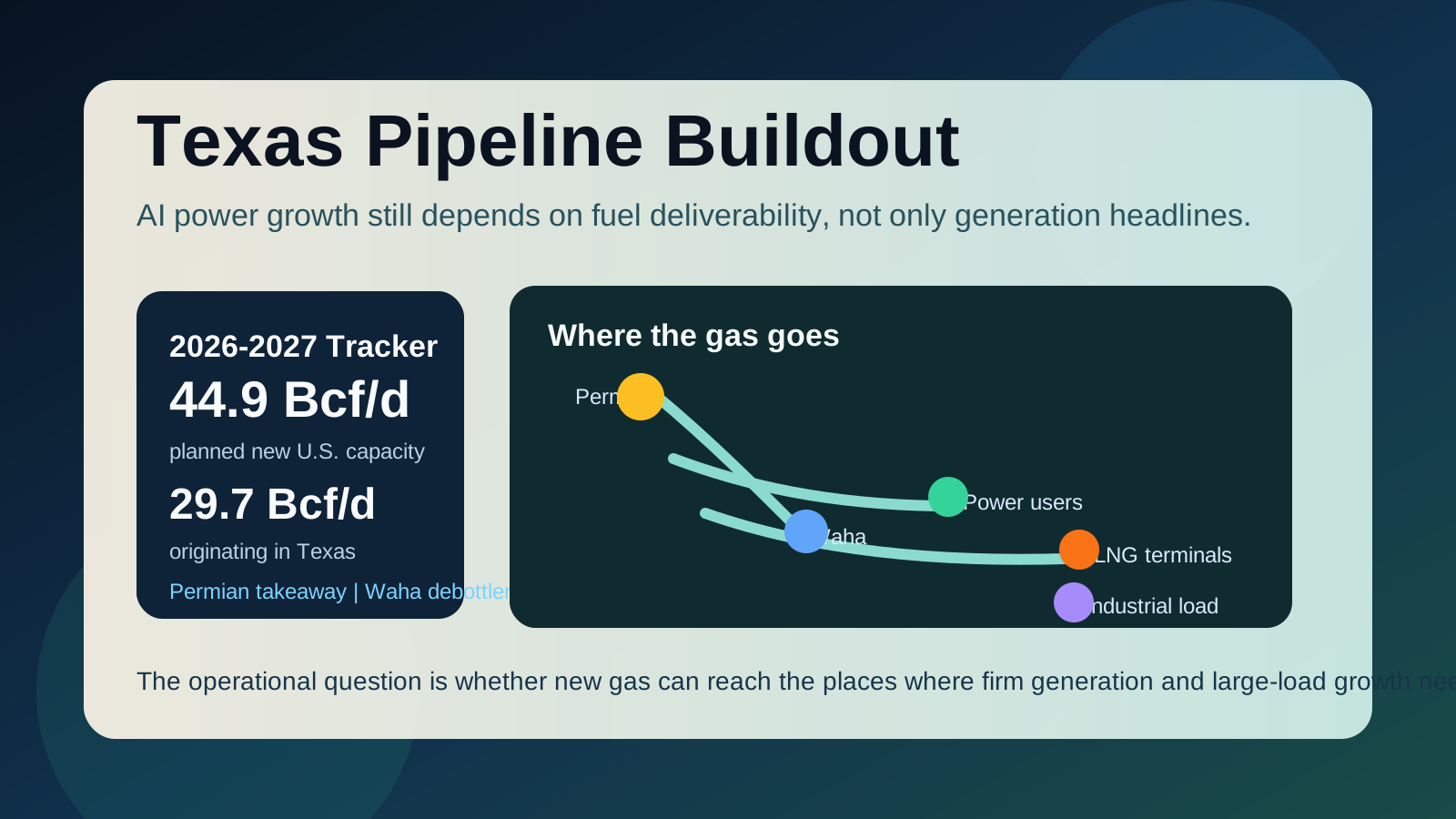
- EIA says developers plan to bring about 44.9 billion cubic feet per day of new pipeline capacity online across 2026 and 2027, with 29.7 billion cubic feet per day originating in Texas.
- The Texas detail is what makes this useful for The Grid Report.
- Section
- Energy
- Read time
- 5 min read
One of the strongest unpublished grid stories today is EIA showing that Texas is the origin point for more than two-thirds of planned U.S. natural gas pipeline capacity additions in 2026 and 2027. The article clears the bar because it is not just another fossil-fuel volume update. The useful signal is that AI power growth in Texas still depends on whether gas can physically move to the right generators and industrial corridors when large loads arrive.
EIA says developers plan to bring about 44.9 billion cubic feet per day of new pipeline capacity online across 2026 and 2027, with 29.7 billion cubic feet per day originating in Texas. The agency also notes that roughly 70 percent of the total is already under construction. That matters because it shifts the conversation away from generic talk about abundant gas supply. In practice, firm power for new data-center demand is constrained not only by commodity availability but by takeaway capacity, hub bottlenecks, and whether pipeline timing lines up with generation and campus build schedules.
The useful Texas signal is not just cheap gas. It is whether pipeline capacity can deliver firm fuel fast enough for generators, LNG terminals, and AI load growth at the same time.
The Texas detail is what makes this useful for The Grid Report. EIA ties the new capacity directly to additional Permian takeaway and debottlenecking at Waha, with flows serving LNG export terminals as well as residential, power, and industrial users. For AI operators, that is the important operational frame. The question is not simply whether Texas has low-cost gas in the abstract. It is whether the state can move enough molecules through the system while power generators, export demand, and large data-center loads all compete for the same underlying fuel-delivery network.
This clears the site’s duplicate block. The Grid Report has already covered ERCOT’s changing solar mix, large-load timing, and ratepayer risk. This article is materially different because it focuses on the upstream fuel logistics behind dispatchable generation. In other words, it treats firm AI power as a pipeline-and-hub problem before it becomes a turbine problem.
For operators and developers, the practical implication is that Texas site selection should be read through a deeper stack than land, interconnection headlines, or nameplate generation additions. Gas deliverability can still shape local power economics, backup generation planning, and how much confidence utilities and merchant generators have in adding firm capacity near new campuses.
For investors, the signal is that pipeline and gas-transport infrastructure remain part of the AI buildout story even when the conversation centers on renewables or batteries. If large-load growth keeps clustering in Texas, the economic winners may include not only generators and utilities, but also the transport systems that reduce basis risk and help convert gas supply into dependable power availability.
The Grid Report view is that this article is publishable because it has a same-day primary-source hook, a specific Texas thesis, and strong search value around EIA pipeline capacity, the Permian, and AI power demand. The important shift is not just more pipeline miles. It is that AI load growth is increasingly exposing fuel deliverability as infrastructure.
Sources
U.S. Energy Information Administration, “Most planned natural gas pipeline capacity additions in 2026 and 2027 originate in Texas,” May 26, 2026: https://www.eia.gov/todayinenergy/detail.php?id=67707
U.S. Energy Information Administration Natural Gas Pipeline Projects Tracker, accessed May 26, 2026: https://www.eia.gov/naturalgas/data.php#pipelines
By Nawaz Lalani
The Grid Report is written by Nawaz Lalani and focuses on source-backed coverage of AI infrastructure, grid power demand, automation systems, and market signals.
Follow the signal, not just the headline.
Get the daily Grid brief for source-backed coverage on AI power demand, infrastructure timing, automation, and market signals.