- One of the few same-week grid stories worth publishing is CAISO’s board approving a transmission plan with 38 projects and roughly $6.7 billion of estimated cost.
- CAISO says more than half of the projects, and more than half of the estimated cost, are driven by forecast load growth.
- The more original Grid Report angle is about grid access.
- Section
- Energy
- Read time
- 5 min read
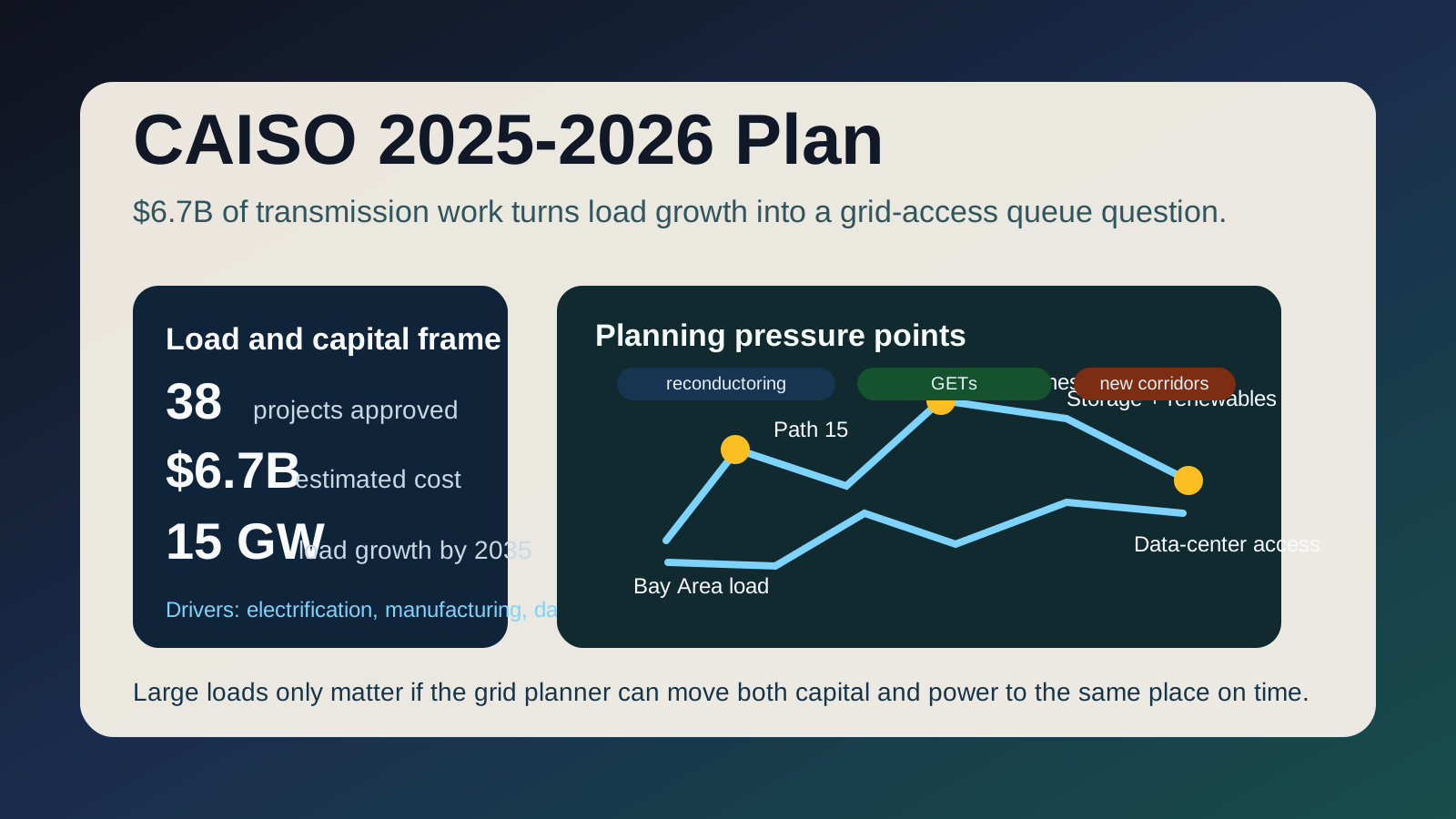
One of the few same-week grid stories worth publishing is CAISO’s board approving a transmission plan with 38 projects and roughly $6.7 billion of estimated cost. The story clears the bar because CAISO is not speaking abstractly about future demand. It is explicitly placing capital behind a load-growth frame that includes data centers, electrification, manufacturing, and the corridors needed to move power where those loads will land.
CAISO says more than half of the projects, and more than half of the estimated cost, are driven by forecast load growth. The ISO also says California Energy Commission projections point to 15 gigawatts of load growth by 2035 and 20 gigawatts by 2040, with large loads including data centers named as part of that demand picture. That makes the article useful. A lot of AI-power reporting still treats data-center growth as a headline risk. CAISO is treating it as a planning input that changes real transmission investment decisions now.
CAISO is not merely acknowledging large-load growth. It is turning that demand into a transmission capital map that will decide where grid access opens first.
The more original Grid Report angle is about grid access. Transmission planning determines not just reliability, but which regions become realistic for new power-hungry campuses and which remain trapped behind congestion or slow reinforcement cycles. CAISO’s plan emphasizes reconductoring, grid-enhancing technologies, and a future Path 15 upgrade, which means the system is trying to stretch more capacity out of existing corridors before defaulting to slower and more expensive greenfield construction.
This clears the duplicate block for the site. The Grid Report has already covered FERC large-load rules, PJM summer strain, and national AI power forecasts. This article is materially different because it is about a specific grid planner converting large-load expectations into a concrete capital map. The useful question is not only whether California can attract more AI infrastructure. It is whether transmission capital will open enough pathways for that demand to coexist with electrification, storage, and resource buildout.
For operators, the practical implication is that California’s AI and data-center story cannot be read through utility service territories alone. Transmission availability, congestion relief, and the pace of corridor upgrades increasingly shape what “power available” really means. A market can have ambitious demand and still be functionally constrained if the backbone is not upgraded in time.
For investors and developers, the signal is that transmission is becoming a cleaner monetizable layer of the AI buildout. If planners are already baking large-load growth into long-horizon capital plans, the economic relevance spreads beyond hyperscalers into transmission owners, equipment suppliers, and developers that can navigate where capacity will actually open first.
The Grid Report view is that this article is publishable because it has a hard official hook, a distinct planning thesis, and search value around CAISO, transmission, load growth, and data centers. The important shift is not another demand forecast. It is load growth being turned into a grid-access capital program.
Sources
California ISO, “ISO Board of Governors approves 2025-2026 transmission plan,” accessed May 26, 2026: https://www.caiso.com/about/news/news-releases/iso-board-of-governors-approves-2025-2026-transmission-plan
California ISO 2025-2026 Transmission Planning Process materials, accessed May 26, 2026: https://stakeholdercenter.caiso.com/RecurringStakeholderProcesses/Transmission-planning-process
By Nawaz Lalani
The Grid Report is written by Nawaz Lalani and focuses on source-backed coverage of AI infrastructure, grid power demand, automation systems, and market signals.
Follow the signal, not just the headline.
Get the daily Grid brief for source-backed coverage on AI power demand, infrastructure timing, automation, and market signals.