- The June 4 Data Center Knowledge report is worth elevating because the useful signal is not simply that another set of vendors wants to sell gas equipment.
- That shift is increasingly visible in the equipment menu itself.
- The permitting angle is what makes the story Grid-native.
- Section
- Infrastructure
- Read time
- 5 min read
- Why this page exists
- The Grid Report publishes operator-grade coverage on AI, power, infrastructure, automation, and markets.
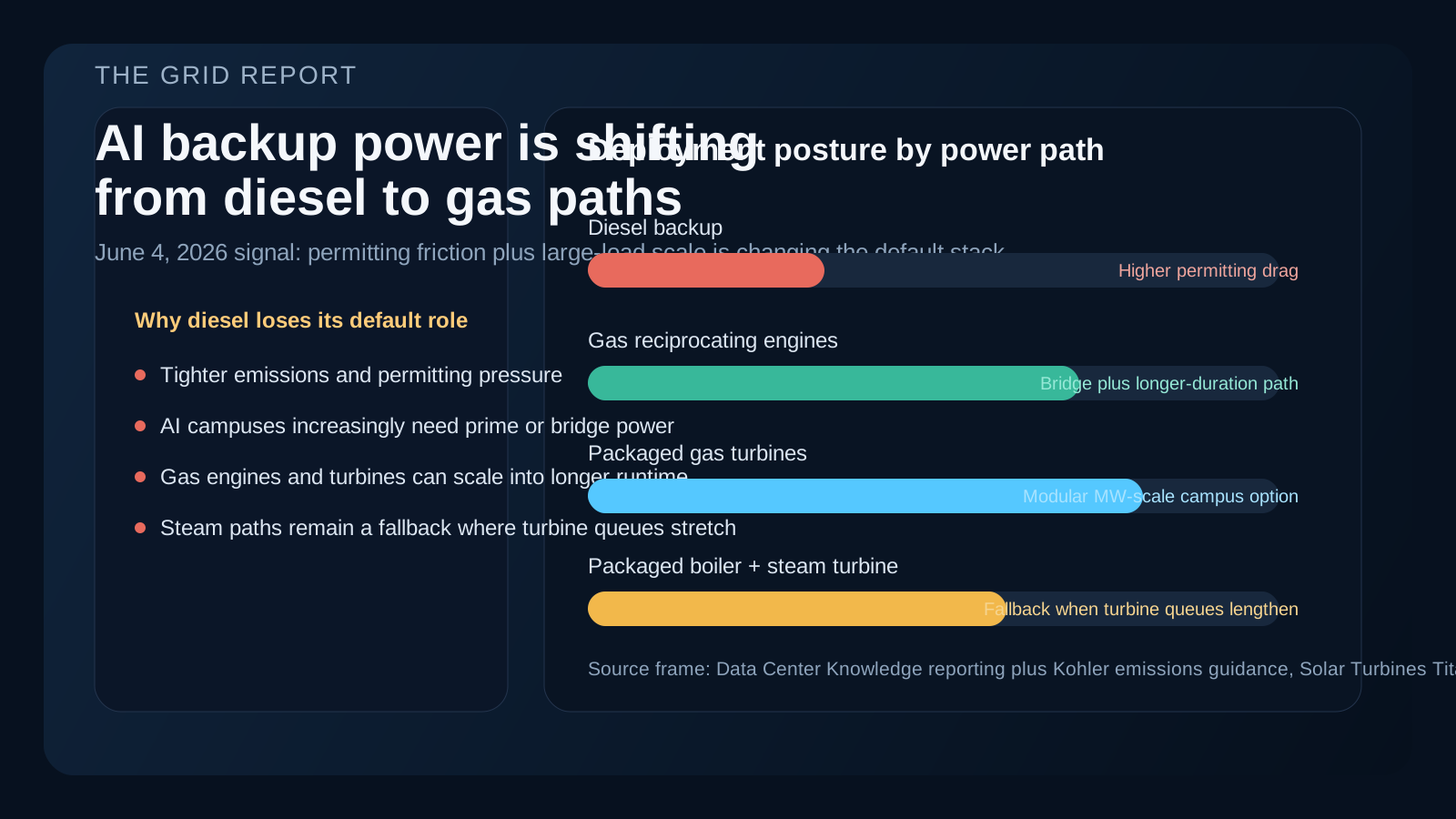
Why the June 4 power-stack shift matters
The useful signal is not that every campus suddenly abandons diesel. It is that AI-scale backup power is being evaluated against runtime, permitting, and energization risk instead of only emergency-standby cost.
How the fallback stack is being reframed
| Power path | What changed | Why Grid Report cares |
|---|---|---|
| Diesel backup | Still viable, but permitting and emissions scrutiny are rising | The emergency-only model fits poorly when AI campuses need longer runtime and smoother public approvals. |
| Gas reciprocating engines | More attractive where operators need bridge power and operational flexibility | Backup is moving closer to the critical path of campus energization. |
| Packaged gas turbines | Offer larger modular power blocks for AI-scale facilities | MW-scale on-site power becomes a deployment product, not only a resilience accessory. |
| Boiler and steam path | Re-enters the conversation when turbine lead times stretch | Fallback technologies matter when schedule control becomes more valuable than architectural purity. |
Source frame: June 4, 2026 Data Center Knowledge reporting plus Solar Turbines, Kohler, and Rentech source materials.
The June 4 Data Center Knowledge report is worth elevating because the useful signal is not simply that another set of vendors wants to sell gas equipment. The stronger signal is that diesel is losing its default role in the AI-campus power stack. Once operators start looking for backup systems that can also support bridge power, longer runtime, and faster energization, the question stops being which generator is cheapest on paper. It becomes which architecture best fits permitting, deployment timing, and campus-scale load.
That shift is increasingly visible in the equipment menu itself. Solar Turbines markets the Titan 350 as a packaged 38-megawatt gas-turbine power-generation unit, which is a very different posture from legacy diesel backup sized only for short emergency use. Rentech Boiler Systems markets packaged boiler systems for faster installation with less field work than stick-built alternatives, which helps explain why steam-based fallback options are even part of the current discussion. These are not niche curiosities. They are signs that AI data center developers are shopping the backup layer more like a live infrastructure program.
The useful signal is not that diesel vanishes. It is that AI campuses increasingly need backup power systems that fit permitting friction, longer runtime, and faster energization.
The permitting angle is what makes the story Grid-native. Kohler's emissions white paper on EPA standards lays out how Tier 4 rules for nonroad engines sharply constrain nitrogen oxides and particulate emissions. In practice, that means diesel remains usable, but it becomes harder to treat as the frictionless default when communities, air permits, and runtime expectations all tighten at once. Gas paths are not politically simple, but they align better with a world where operators may need more hours, more megawatts, and more defensible air-quality posture around large AI loads.
That is the original Grid Report angle. Backup power is starting to merge with campus energization strategy. Generac's June 2 hyperscaler story already showed that resilience hardware is being reserved earlier. This June 4 signal goes a step further: the resilience layer itself is changing shape. Instead of assuming diesel sits off to the side as a last-resort insurance product, developers are increasingly evaluating gas engines, packaged turbines, and even boiler-steam configurations as part of how a campus reaches usable power on time.
This clears the duplicate block against the site's recent infrastructure coverage. The Generac story was about supply assurance and qualification. The EIA gas-fuel-stack story was about power-market timing into 2027. This one is more operational. It is about how AI campuses are redesigning the on-site power stack because schedule risk, runtime expectations, and air permitting are all getting harder at the same time.
For operators, the implication is straightforward. Backup power procurement can no longer wait until the end of the build. If the campus may need bridge generation before full utility service, or if regulators are skeptical of large diesel fleets, then the resilience system starts affecting site design, gas delivery planning, cooling assumptions, and the path to first revenue. In a constrained market, that is no longer a facilities footnote.
For investors and infrastructure readers, the read-through is that a wider set of power-equipment categories may capture AI buildout value than a diesel-generator lens suggests. Gas engines, packaged turbines, emissions-compliant controls, and boiler-based fallback systems all move closer to the critical path once power timing matters more than generic nameplate capacity. That does not mean diesel disappears. It means the default stack is being renegotiated.
The reason to publish this now is that the June 4 reporting captures a real design turn inside the AI infrastructure race. The market has spent the year talking about megawatts and land. The more specific question is what kind of on-site power stack can actually get permitted, delivered, and run hard enough to support an AI campus before the full grid buildout arrives. Increasingly, the answer is not diesel alone.
Sources
Data Center Knowledge, “Replacing Diesel in AI-Scale Data Centers: Gas Engines, Turbines, and Steam,” published June 4, 2026: https://www.datacenterknowledge.com/sustainability/replacing-diesel-in-ai-scale-data-centers-gas-engines-turbines-and-steam
Solar Turbines, “Titan 350 Gas Turbine Generator Set,” accessed June 4, 2026: https://www.solarturbines.com/en_US/products/power-generation-packages/titan-350-38mw.html
Kohler, “Emission Standards White Paper,” accessed June 4, 2026: https://resources.kohler.com/power/kohler/industrial/pdf/Emission_Std_White_Paper.pdf
Rentech Boiler Systems, company site and packaged-boiler materials, accessed June 4, 2026: https://rentechboilers.com/
Nawaz Lalani
Nawaz Lalani is the creator of The Grid Report and writes about AI infrastructure, grid power demand, automation systems, and the market signals shaping the physical AI economy. His focus is translating technical and industrial shifts into practical coverage for operators, investors, builders, and teams making real deployment decisions.
B.S. in Geology from UT Arlington. Covers AI infrastructure, energy systems, grid constraints, automation workflows, and market signals.
Stories are built from primary sources, utility and infrastructure signals, company disclosures, filings, and operator-grade context. The goal is to explain what changed, why it matters now, and what it means for builders, investors, utilities, and teams making real deployment decisions.
Follow the lane, not just the headline.
The strongest value in The Grid Report comes from following how AI, infrastructure, power, automation, and markets connect over time.