- FERC’s summer assessment is worth publishing because it gives the operating backdrop that AI power stories often skip.
- The Commission’s 2026 Summer Energy Market and Electric Reliability Assessment says most regions are expected to have adequate resources under normal summer conditions, but it also points to reliability risk under extreme conditions.
- The original Grid Report angle is that AI load growth is becoming a reserve-margin story.
- Section
- Energy
- Read time
- 6 min read
- Data included
- The summer reliability stack AI data centers now enter
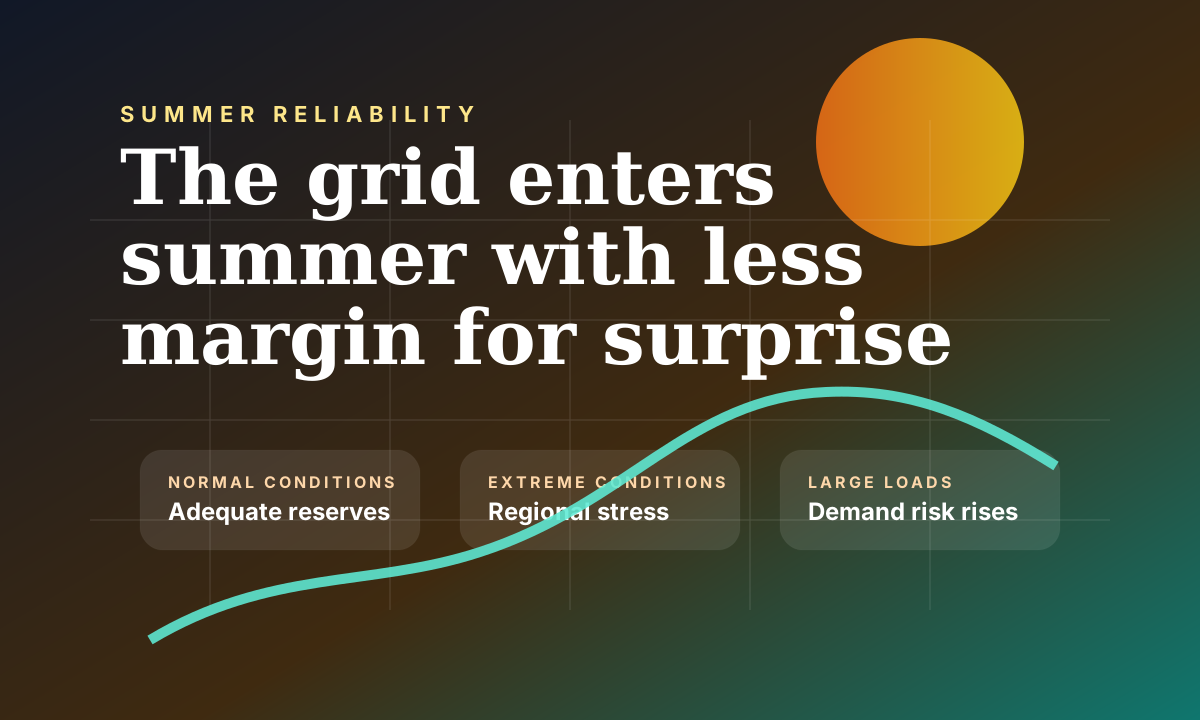
The summer reliability stack AI data centers now enter
The relevant planning question is not whether resources are adequate on average. It is how reserve margin behaves when multiple stressors arrive together.
Stress factors
| Planning layer | Why it matters |
|---|---|
| Normal reserves | Can look adequate in forecast tables while still leaving extreme-condition risk. |
| Extreme conditions | Heat, outages, and transmission limits determine whether capacity is actually deliverable. |
| Large-load timing | AI projects can stress the system if they arrive before generation, transmission, or flexibility upgrades. |
Sources: FERC 2026 Summer Assessment; NERC 2026 Summer Reliability Assessment.
FERC’s summer assessment is worth publishing because it gives the operating backdrop that AI power stories often skip. The grid can look adequate in a normal forecast and still become fragile when heat, generator outages, fuel constraints, transmission limits, and fast-growing large loads arrive at the same time.
The Commission’s 2026 Summer Energy Market and Electric Reliability Assessment says most regions are expected to have adequate resources under normal summer conditions, but it also points to reliability risk under extreme conditions. That distinction is the heart of the AI load story. Data centers do not create the entire reliability problem, but they arrive in a system where reserve margins are already conditional rather than absolute.
The AI-era grid question is not only how many megawatts a data center wants. It is how many deliverable megawatts remain during the hottest, tightest hours of the year.
The original Grid Report angle is that AI load growth is becoming a reserve-margin story. Most public debate still talks about megawatts as if new load is only a capacity number. Operators care about a harder question: when the hottest week arrives, when outages are higher than planned, and when transmission constraints show up, how much dispatchable, deliverable capacity is actually available?
That is why this differs from the NERC Level 3 alert article. NERC’s alert framed large inverter-based and data-center loads as a reliability-modeling problem. The DOE-PJM Wagner story framed a specific Mid-Atlantic summer operating constraint. FERC’s assessment provides the broader seasonal frame: the system may be sufficient on paper, but extreme operating conditions remain the test.
For AI data-center developers, this means interconnection and power procurement should not be evaluated only by annual energy availability or headline capacity. The practical issue is whether the local system has enough deliverable capacity during stress periods, whether backup generation is accepted, how demand response is treated, and how quickly a project can curtail or ride through grid events.
For utilities and regulators, the implication is that large-load approvals need to be tied to seasonal reliability rather than only average demand forecasts. A data center that appears manageable in annual load models can still worsen the reserve-margin problem if it concentrates demand in a constrained pocket or arrives before planned transmission and generation upgrades.
For markets, this is why power names, electrical-equipment suppliers, and transmission contractors remain central to the AI infrastructure tape. The higher-value question is not only who signs data-center leases. It is who can provide capacity, flexibility, equipment, and construction timing that protects the grid during seasonal stress.
The reason to publish this now is that summer reliability is the near-term test for a grid absorbing industrial, electrification, and data-center load growth at the same time. FERC’s assessment says the headline may be “adequate under normal conditions,” but the AI-era read is narrower: reserve margin is becoming a planning product.
Sources
Federal Energy Regulatory Commission, “2026 Summer Energy Market and Electric Reliability Assessment,” May 2026: https://www.ferc.gov/media/2026-summer-energy-market-and-electric-reliability-assessment
North American Electric Reliability Corporation, “2026 Summer Reliability Assessment,” May 2026: https://www.nerc.com/pa/RAPA/ra/Reliability%20Assessments%20DL/NERC_SRA_2026.pdf
By Nawaz Lalani
The Grid Report is written by Nawaz Lalani and focuses on source-backed coverage of AI infrastructure, grid power demand, automation systems, and market signals.
Follow the signal, not just the headline.
Get the daily Grid brief for source-backed coverage on AI power demand, infrastructure timing, automation, and market signals.