- EIA’s May 13 ERCOT forecast clears the publish bar because it gives the Texas AI-power debate a more useful frame.
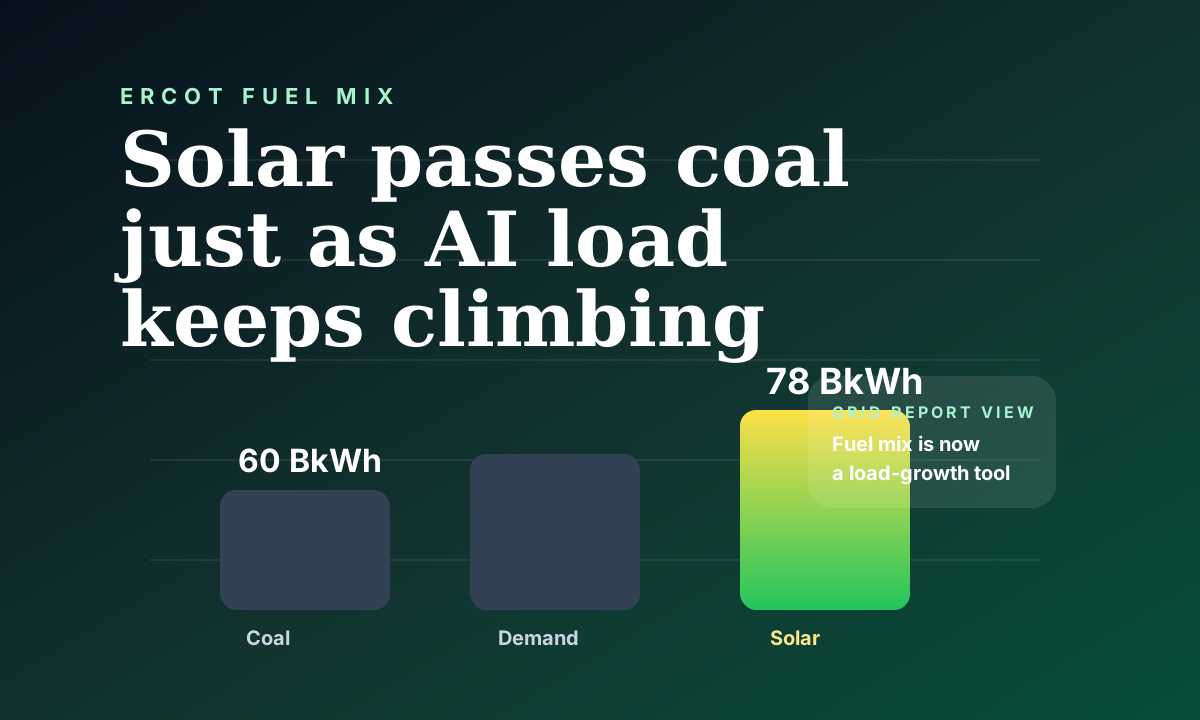
- EIA said solar generation in ERCOT is expected to reach 78 billion kilowatthours in 2026, versus 60 billion for coal.
- That is why the stronger angle is timing.
- Section
- Energy
- Read time
- 4 min read
EIA’s May 13 ERCOT forecast clears the publish bar because it gives the Texas AI-power debate a more useful frame. The headline fact is that utility-scale solar generation is expected to exceed coal generation in ERCOT on an annual basis for the first time in 2026. The more important read-through is operational: Texas is becoming less constrained by annual energy volume and more constrained by when power shows up relative to when AI load wants it.
EIA said solar generation in ERCOT is expected to reach 78 billion kilowatthours in 2026, versus 60 billion for coal. It also said solar first exceeded coal on a monthly basis in March 2025 and is expected to remain above coal from March through November in 2026. Those are real mix changes, but they do not mean AI infrastructure suddenly has an easy power path. They mean the grid is leaning harder into an energy source that is abundant at some hours and absent at others.
Texas is becoming less constrained by annual power volume than by whether AI load arrives when the system still has firm supply around it.
That is why the stronger angle is timing. AI campuses do not care only about annual megawatt-hours. They care about power quality, coincidence with peak and net-load stress, curtailment risk, and how much firm capacity surrounds an intermittent supply stack. A system can produce more solar than coal across the year and still struggle to support new high-load demand if the tightest hours land after sunset or during stressed weather conditions.
EIA’s own Texas load context reinforces that point. The agency said electricity demand in ERCOT continues to rise because of large loads from cryptocurrency mining, data-center buildout, rising industrial activity, and oil-and-gas-related processing. In other words, the load growth story is getting heavier at the same time the generation mix is shifting further toward solar. That combination pushes storage, gas balancing, and load flexibility much closer to the center of the AI infrastructure story.
This is where many generic power stories fall short. “Solar beats coal” sounds like a fuel-switching story. For AI operators and investors, it is really a load-shaping story. The practical winners in Texas are likely to be projects that can combine grid access with batteries, on-site generation, flexible operation, or contract structures that recognize the difference between cheap midday energy and reliable evening delivery.
The crossover also fits with what ERCOT’s own planning materials have been signaling. ERCOT continues to publish reserve and resource-adequacy work that emphasizes the importance of peak net-load hours, not only peak gross load. That distinction matters because a grid with more solar can look comfortable in broad annual terms while remaining more exposed during the hours when solar fades and dispatchable support has to take over.
This is why the story is still worth publishing even after the recent Texas queue coverage. Batch Zero explains who may connect faster. The solar-coal crossover explains what kind of system those projects are trying to connect into. They are related, but they are not the same thesis. One is an access screen. The other is a power-shape reality check.
There are limits to the claim. EIA is publishing a forecast, not a guaranteed year-end result, and coal is no longer the main benchmark that determines ERCOT reliability anyway. Natural gas remains the dominant generation source in the region. But those caveats do not weaken the main conclusion. Texas AI power is increasingly a timing and firmness problem, not just a bulk-energy problem.
That is enough to publish. The useful search answer is not only whether solar will beat coal. It is what that crossover means for data-center developers, utilities, and investors trying to understand how AI load actually gets served in Texas.
Sources
U.S. Energy Information Administration, “Electricity generation from solar could exceed coal in ERCOT for the first time in 2026,” published May 13, 2026: https://www.eia.gov/todayinenergy/detail.php?id=67685
ERCOT Resource Adequacy page, accessed June 23, 2026, including current Capacity, Demand, and Reserves and Monthly Outlook materials: https://www.ercot.com/gridinfo/resource
By Nawaz Lalani
The Grid Report is written by Nawaz Lalani and focuses on source-backed coverage of AI infrastructure, grid power demand, automation systems, and market signals.
Follow the signal, not just the headline.
Get the daily Grid brief for source-backed coverage on AI power demand, infrastructure timing, automation, and market signals.