- NextEra Energy and Dominion Energy’s May 18 merger announcement is worth publishing because the real signal is not simply that two large utilities want to get bigger.
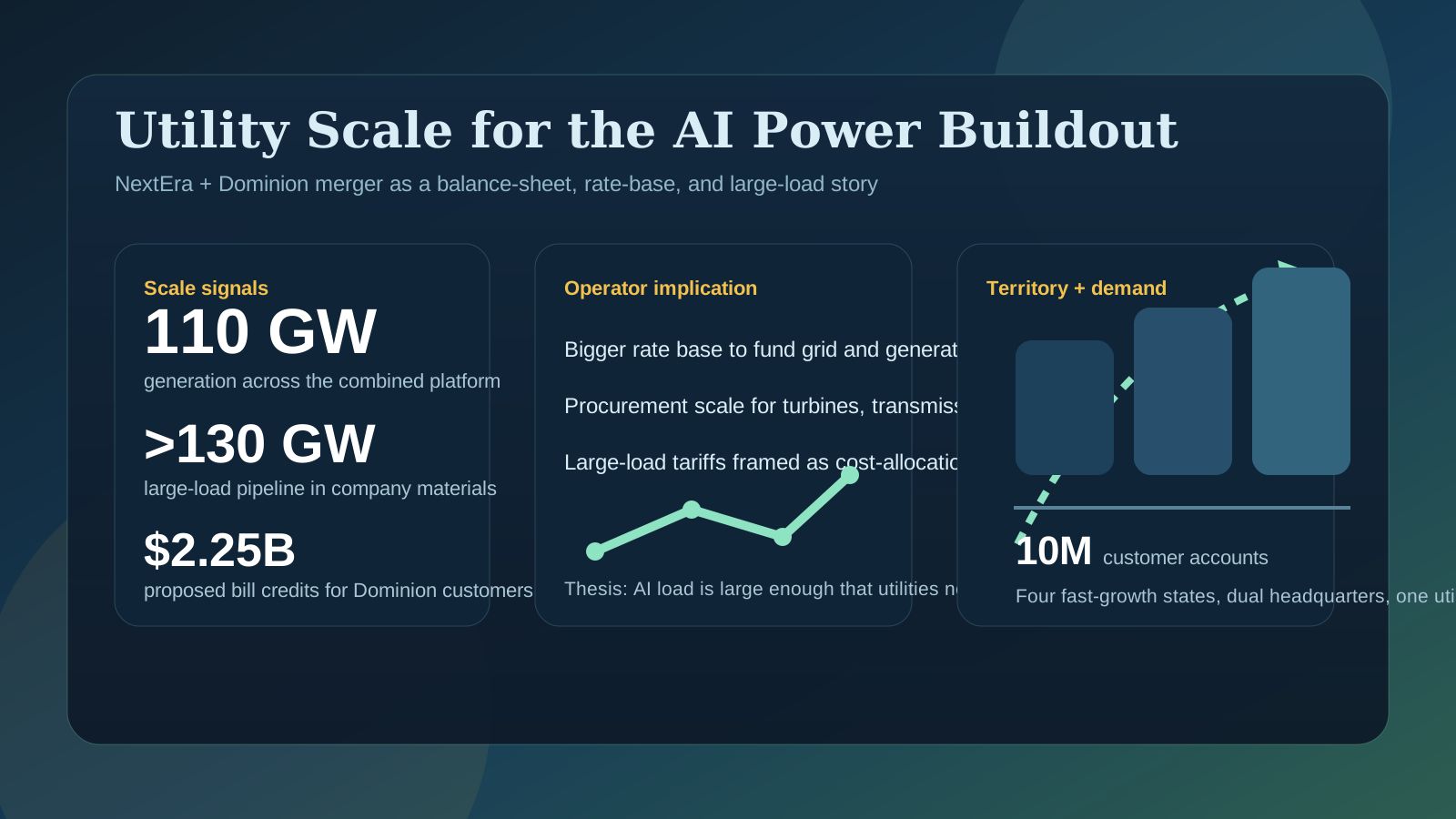
- The companies say the combined platform would create the world’s largest regulated electric utility business by market capitalization, serve about 10 million customer accounts across four states, own 110 gigawatts of generation, and carry more than 130 gigawatts of large-load opportunities in its pipeline.
- That is the original Grid Report angle.
- Section
- Markets
- Read time
- 6 min read
NextEra Energy and Dominion Energy’s May 18 merger announcement is worth publishing because the real signal is not simply that two large utilities want to get bigger. The better signal is that AI-era load growth is starting to reward the utilities that can assemble enough balance-sheet capacity, procurement leverage, and regulated growth runway to finance generation and grid buildout at a different scale from the rest of the sector.
The companies say the combined platform would create the world’s largest regulated electric utility business by market capitalization, serve about 10 million customer accounts across four states, own 110 gigawatts of generation, and carry more than 130 gigawatts of large-load opportunities in its pipeline. They also frame the deal around affordability, proposing $2.25 billion of bill credits for Dominion customers while arguing that bigger scale lowers financing and construction costs over time.
In the AI buildout, the winning utility is increasingly the one with enough balance-sheet scale to turn large-load demand into financed generation and grid capacity.
That is the original Grid Report angle. In the AI buildout, utility scale is becoming a financing strategy. Once load requests from data centers and other large customers start arriving in concentrated blocks, the contest is no longer only about who has service territory in the right geography. It is also about who can raise capital cheaply enough, procure equipment broadly enough, and grow rate base fast enough to turn demand into energized infrastructure before the queue moves somewhere else.
This makes the merger more useful than a generic M&A recap. Dominion already sits at one of the most important demand chokepoints in the country because Northern Virginia data-center growth is bending both electricity-sales data and PJM peak-load expectations. NextEra brings a larger development machine, a broader supply chain, and a public argument that scale now matters because projects are larger, more complex, and more time-sensitive than traditional utility growth cycles assumed.
The political design of the transaction is also instructive. The companies are not only promising size. They are pairing that size with bill credits, explicit reliability and resiliency language, and a stated view that large loads should pay their fair share through tariff structures. That matters because future AI-power expansion will increasingly depend on whether utilities can show regulators and customers that new data-center demand expands infrastructure without simply socializing every cost onto smaller users.
This clears the site’s duplicate block because it is materially different from the recent Virginia electricity-sales story, the Freestone meter-boundary story, and the CAISO transmission-plan story. Those pieces were about visible load growth, co-location rules, and transmission capex. This one is about utility consolidation as a response to AI-era capital intensity and the need for a larger financing platform behind future grid expansion.
For investors, the read-through is that utility M&A may increasingly track where AI load is concentrating and where rate-base growth can be scaled without breaking customer politics. For operators and policymakers, the implication is that interconnection, generation, and transmission buildout may increasingly be decided by which utility platforms can absorb multiyear capex, secure equipment, and defend the cost-allocation model in public.
The reason to publish this now is that it is specific, search-worthy, and more useful than another “AI drives power demand” rewrite. NextEra and Dominion are showing what the next phase looks like when the load story grows large enough to reshape utility strategy itself.
Sources
Dominion Energy investor relations, “NextEra Energy and Dominion Energy to Combine, Creating the World’s Largest Regulated Electric Utility Business and North America’s Premier Energy Infrastructure Platform Benefiting Customers,” published May 18, 2026: https://investors.dominionenergy.com/news/press-release-details/2026/NextEra-Energy-and-Dominion-Energy-to-Combine-Creating-the-Worlds-Largest-Regulated-Electric-Utility-Business-and-North-Americas-Premier-Energy-Infrastructure-Platform-Benefiting-Customers/default.aspx
SEC exhibit 99.2, joint NextEra-Dominion investor presentation filed with the May 18, 2026 8-K: https://www.sec.gov/Archives/edgar/data/753308/000110465926063001/tm2614888d1_ex99-2.htm
U.S. Energy Information Administration, “Commercial electricity sales have soared in Virginia, driven by data centers,” published May 5, 2026: https://www.eia.gov/TODAYINENERGY/detail.php?id=67664
By Nawaz Lalani
The Grid Report is written by Nawaz Lalani and focuses on source-backed coverage of AI infrastructure, grid power demand, automation systems, and market signals.
Follow the signal, not just the headline.
Get the daily Grid brief for source-backed coverage on AI power demand, infrastructure timing, automation, and market signals.