- DigitalBridge’s agreement to acquire ArcLight is one of the clearest recent signs that AI infrastructure investing is moving upstream into power.
- The strongest reason to care is not simply deal size.
- That changes how this should be read versus a conventional data-center capital story.
- Section
- Markets
- Read time
- 7 min read
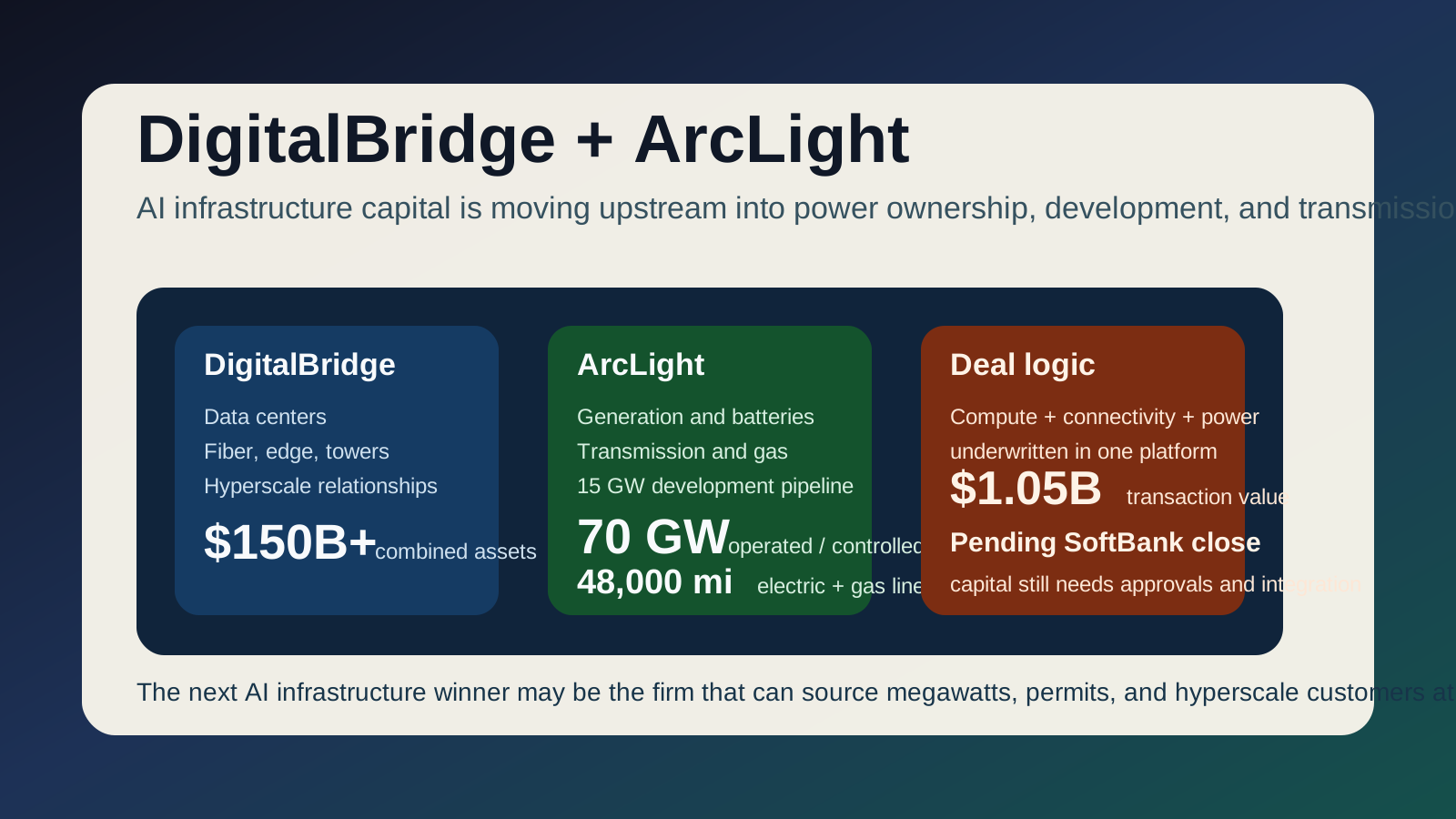
DigitalBridge’s agreement to acquire ArcLight is one of the clearest recent signs that AI infrastructure investing is moving upstream into power. On May 27, 2026, DigitalBridge said it had entered into a definitive agreement to acquire ArcLight for a total transaction value of up to $1.05 billion, made up of a $650 million base purchase price and up to $400 million of contingent consideration. The company framed the combination as a platform at the convergence of power, AI, and digital infrastructure. That phrasing is not marketing fluff. It is the thesis.
The strongest reason to care is not simply deal size. It is what ArcLight brings into the stack. DigitalBridge said ArcLight has owned, controlled, or operated more than 70 gigawatts of generation assets and 48,000 miles of electric and gas transmission and storage infrastructure, representing more than $90 billion of enterprise value. It also said ArcLight has an 85-person power development organization and a pipeline exceeding 15 gigawatts. For a market increasingly constrained by power readiness, that is not adjacent capability. It is direct leverage on the bottleneck.
If power is the bottleneck, the next AI infrastructure premium may go to the platform that can underwrite both megawatts and hyperscale demand.
That changes how this should be read versus a conventional data-center capital story. Digital infrastructure investors have spent years optimizing around land, fiber, compute demand, and customer relationships. But as AI campuses get larger and more power-intensive, those advantages are no longer enough on their own. The hard edge of competition has shifted toward generation access, transmission pathways, interconnection timing, behind-the-meter options, and the ability to underwrite power risk with the same confidence as digital demand.
DigitalBridge already sits inside the digital side of that equation. The company describes itself as an alternative asset manager focused on digital infrastructure across cell towers, data centers, fiber, small cells, and edge assets. By buying ArcLight, it is effectively saying that future returns in AI infrastructure may depend on controlling more of the power layer instead of negotiating around it project by project.
This is also a capital-markets signal, not just an operating one. If major infrastructure managers start combining hyperscale relationships with generation portfolios, battery expertise, transmission know-how, and regulatory depth, the market may begin valuing some AI-linked platforms less like real-estate wrappers and more like integrated infrastructure underwriters. That would matter for private funds, listed developers, utilities, independent power producers, and any capital provider trying to price the next wave of AI-campus execution risk.
The deal is not a free pass. DigitalBridge says the transaction is conditioned on completion of SoftBank Group’s pending acquisition of DigitalBridge and on customary regulatory approvals and limited-partner consents. SoftBank stockholders already approved the DigitalBridge acquisition on April 23, 2026, but the larger point is that this platform is still in the realm of announced strategy, not finished integration. Investors should treat the ArcLight move as a directional signal first and a de-risked earnings story later.
Still, the strategic message is hard to miss. DigitalBridge is not buying a generic infrastructure manager. It is buying a specialist platform in power and electric infrastructure at the moment when power has become the gating factor for a meaningful share of the AI buildout. That is why this story deserves attention beyond merger arithmetic. It suggests that the next serious AI infrastructure platforms may be the ones able to source megawatts, permits, and customers in one coordinated system.
The Grid Report view is that this is what convergence actually looks like when it stops being a buzzword. The market spent the first phase of the AI boom treating power as an external constraint on digital growth. Deals like this imply the next phase may treat power control as part of the product.
Sources
DigitalBridge, “DigitalBridge and ArcLight Announce Strategic Combination to Form a Leading Alternative Asset Manager at the Convergence of Power, AI, and Digital Infrastructure,” published May 27, 2026: https://www.digitalbridge.com/news/2026-05-27-digitalbridge-and-arclight-announce-strategic-combination-to-form-a-leading-alternative-asset-manager-at-the-convergence-of-power-ai-and-digital-infrastructure
DigitalBridge, “DigitalBridge Stockholders Approve Acquisition by SoftBank Group Corp.,” published April 23, 2026: https://ir.digitalbridge.com/news-releases/news-release-details/digitalbridge-stockholders-approve-acquisition-softbank-group/
By Nawaz Lalani
The Grid Report is written by Nawaz Lalani and focuses on source-backed coverage of AI infrastructure, grid power demand, automation systems, and market signals.
Follow the signal, not just the headline.
Get the daily Grid brief for source-backed coverage on AI power demand, infrastructure timing, automation, and market signals.