- One of the few genuinely strong infrastructure stories on May 26 is Modine announcing a long-term capacity agreement worth more than $4 billion with a strategic data center customer for Airedale cooling products through calendar years 2027 to 2029.
- According to Modine, the agreement guarantees capacity for more than $4 billion of Airedale data center cooling products over the 2027 through 2029 period.
- The original Grid Report angle is that AI infrastructure bottlenecks are spreading outward from chips and power into thermal manufacturing.
- Section
- Infrastructure
- Read time
- 5 min read
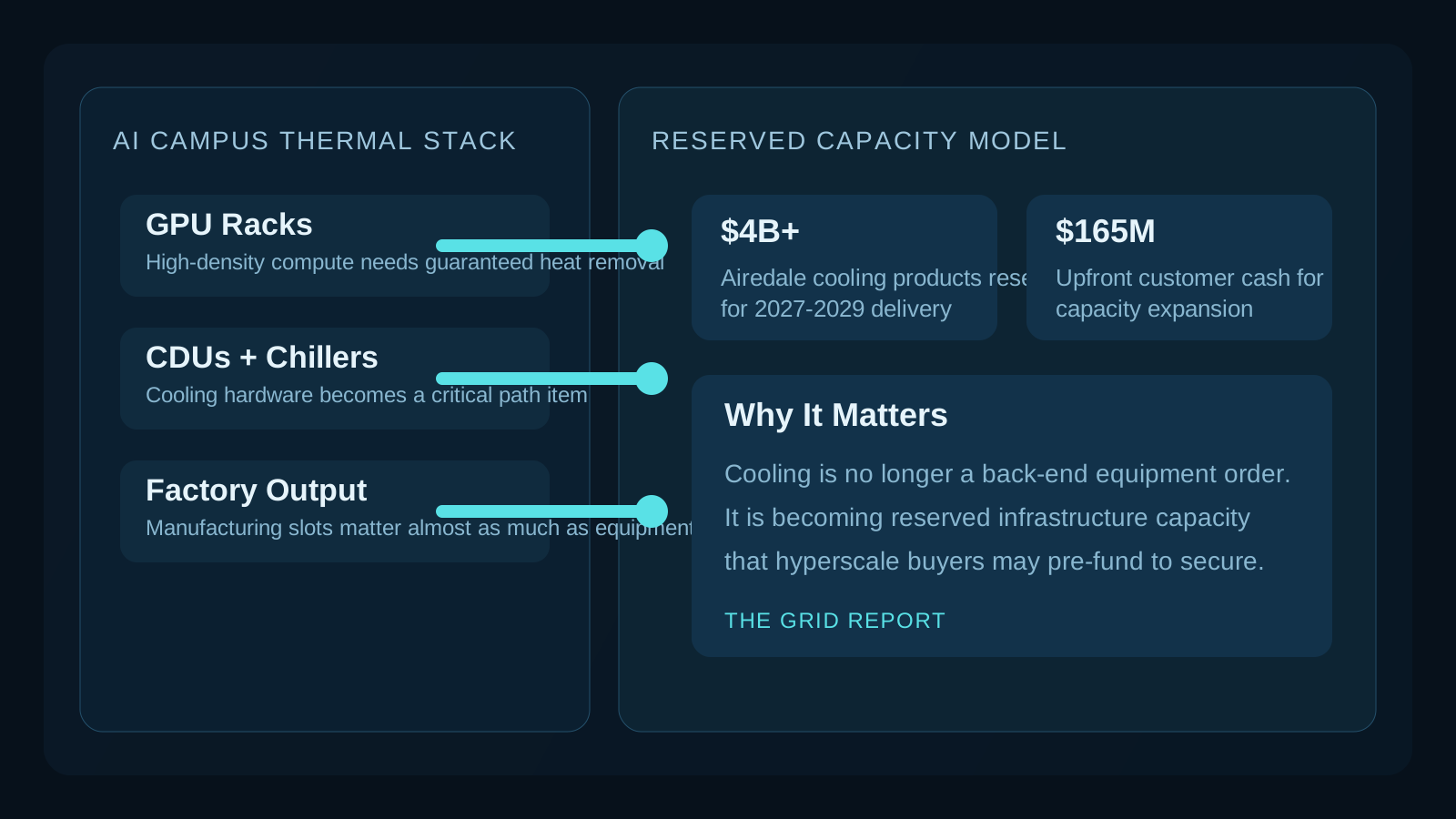
One of the few genuinely strong infrastructure stories on May 26 is Modine announcing a long-term capacity agreement worth more than $4 billion with a strategic data center customer for Airedale cooling products through calendar years 2027 to 2029. The story clears the bar because this is not just another supplier claiming AI exposure. The useful signal is that a customer is reserving thermal capacity years in advance, which means cooling is moving closer to the economic behavior of core infrastructure.
According to Modine, the agreement guarantees capacity for more than $4 billion of Airedale data center cooling products over the 2027 through 2029 period. The company also said it received a $165 million upfront cash payment to support the capacity investments and related spending needed to fulfill that commitment. That detail is what makes the story publishable. Once a customer is prepaying to lock in manufacturing output, cooling stops looking like a routine line item and starts looking like constrained strategic capacity.
Once a hyperscale customer prepays to lock in cooling output years ahead, thermal equipment starts behaving less like a component order and more like reserved infrastructure capacity.
The original Grid Report angle is that AI infrastructure bottlenecks are spreading outward from chips and power into thermal manufacturing. GPU demand still gets the attention, but dense AI clusters only become usable if the surrounding cooling stack can be delivered on time, at scale, and in the right architecture. A multiyear reservation agreement suggests at least some buyers no longer trust spot procurement or normal project sequencing to secure that outcome.
This clears the site’s duplicate block. The Grid Report has already published on optical bottlenecks, packaging throughput, financed TPU capacity, and power-readiness. This article is materially different because it focuses on cooling vendors being pulled into long-horizon capacity reservation and customer financing. The thesis is not merely that thermal systems matter. It is that customers are beginning to buy cooling output the way they buy scarce infrastructure access.
The operator implication is straightforward. If lead times for liquid and high-density cooling systems tighten further, developers may need earlier design lock-in, more conservative schedule assumptions, and stronger vendor relationships before a campus is truly financeable. In practical terms, the path from “site selected” to “compute online” depends not only on utility service and server procurement, but also on whether the thermal layer has been reserved early enough to avoid becoming the hidden delay.
For investors, the signal is broader than Modine alone. On May 26, Modine shares traded sharply higher after the announcement, reflecting how quickly the market is repricing specialist suppliers that sit inside the physical AI stack. The stronger takeaway, though, is structural: if customers are willing to pre-fund cooling capacity, thermal-management companies may start to look less like cyclical components businesses and more like capacity-constrained infrastructure suppliers.
There is also a geographic and manufacturing angle. Modine had already been expanding data-center cooling capacity through Franklin, Wisconsin, Grand Prairie, Texas, and other sites. This new agreement suggests those investments are not speculative ecosystem theater. They are part of a supply chain that hyperscale buyers increasingly appear willing to underwrite directly when thermal delivery becomes mission-critical.
The Grid Report view is that this article is publishable because it has a same-day company hook, a specific original thesis, clear operator relevance, and useful search demand around Modine, Airedale, data center cooling, and AI infrastructure bottlenecks. The important shift is not just a large contract. It is cooling capacity being reserved and partially financed like infrastructure.
Sources
Modine, “Modine Announces Landmark $4 Billion Long-Term Capacity Agreement through 2029 with Strategic Data Center Customer for Airedale by Modine Cooling Solutions,” May 26, 2026: https://www.prnewswire.com/news-releases/modine-announces-landmark-4-billion-long-term-capacity-agreement-through-2029-with-strategic-data-center-customer-for-airedale-by-modine-cooling-solutions-302779610.html
Modine, “Modine Expands Data Center Cooling Capacity with Opening of New Facility in Franklin, Wisconsin,” November 17, 2025: https://www.prnewswire.com/news-releases/modine-expands-data-center-cooling-capacity-with-opening-of-new-facility-in-franklin-wisconsin-302614862.html
By Nawaz Lalani
The Grid Report is written by Nawaz Lalani and focuses on source-backed coverage of AI infrastructure, grid power demand, automation systems, and market signals.
Follow the signal, not just the headline.
Get the daily Grid brief for source-backed coverage on AI power demand, infrastructure timing, automation, and market signals.