- One of the strongest unpublished infrastructure stories this week is SoftBank pairing a new AI Data Center GPU Cloud launch with a separate battery-manufacturing push tied to its Osaka Sakai AI data center cluster.
- On May 25, SoftBank said it will offer an AI Data Center GPU Cloud starting in October 2026, with a beta rollout beginning immediately for internal and group-company use.
- The second source is what makes the thesis stronger.
- Section
- Infrastructure
- Read time
- 6 min read
One of the strongest unpublished infrastructure stories this week is SoftBank pairing a new AI Data Center GPU Cloud launch with a separate battery-manufacturing push tied to its Osaka Sakai AI data center cluster. The article clears the bar because it is not just another sovereign-cloud press release. The useful signal is that SoftBank is widening the definition of AI infrastructure to include orchestration software, domestic facilities, and eventually part of the power hardware stack itself.
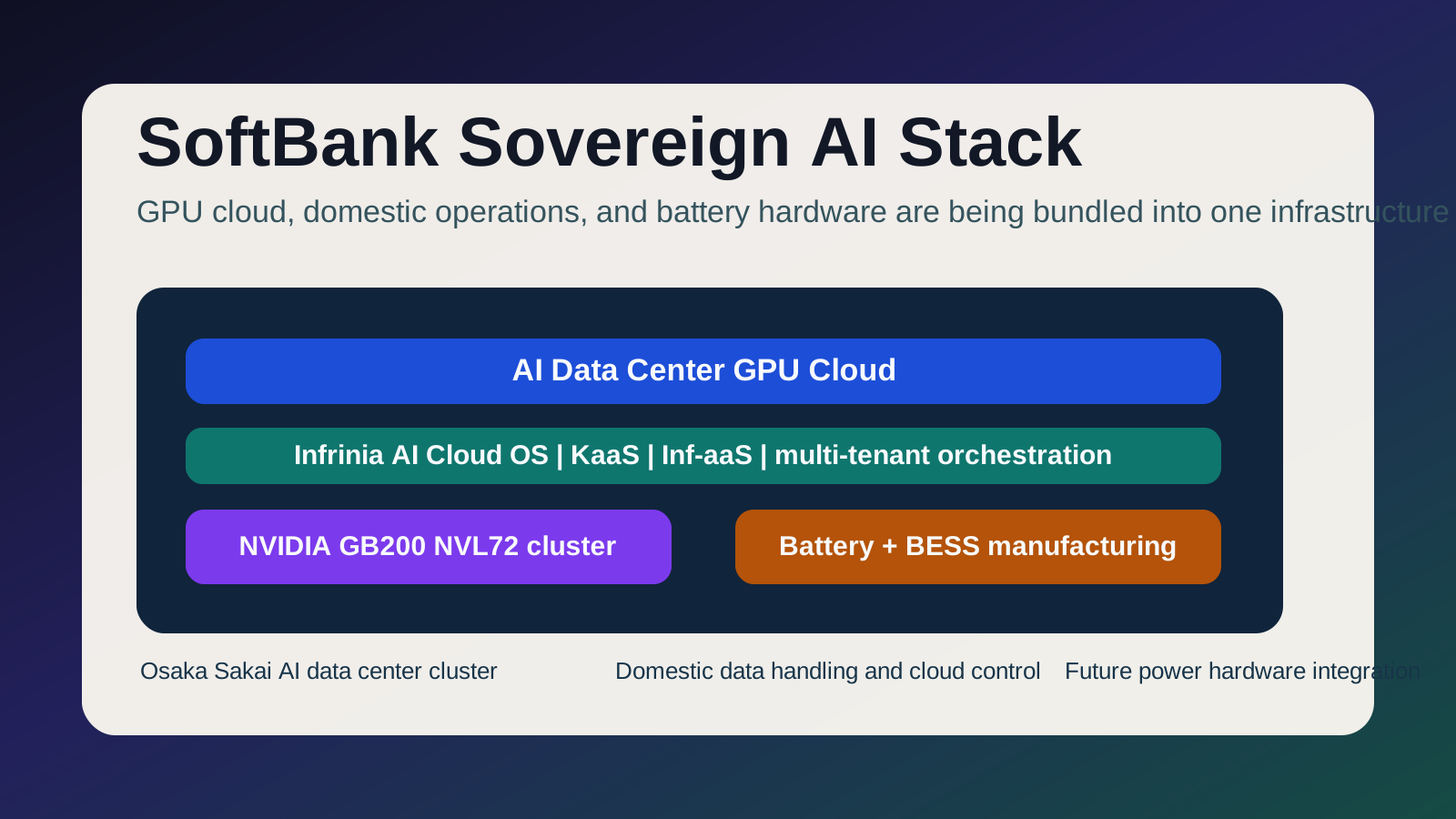
On May 25, SoftBank said it will offer an AI Data Center GPU Cloud starting in October 2026, with a beta rollout beginning immediately for internal and group-company use. The service combines its AI compute platform with Infrinia AI Cloud OS, including multi-tenant Kubernetes as a Service and Inference as a Service, and it points directly to domestic use of NVIDIA GB200 NVL72 systems. That alone would be a meaningful infrastructure story because it treats sovereign AI as an operating environment, not merely a reserved-capacity contract.
SoftBank is not just selling sovereign AI capacity. It is trying to assemble a domestic stack that reaches from GPU orchestration into future power hardware.
The second source is what makes the thesis stronger. On May 11, SoftBank also announced a Japan-based battery business and said its Osaka Sakai AI data center would anchor both an AX Factory for AI infrastructure hardware and a GX Factory for next-generation batteries, solar panels, and related products. The company’s stated ambition is to reach gigawatt-hour-scale battery production in the years ahead. Put together, the two announcements imply a broader vertical strategy: compute capacity, orchestration software, and part of the energy system are increasingly being assembled as one domestic industrial stack.
This clears the site’s duplicate block. The Grid Report has already covered AMD’s packaging investment, Google and Blackstone’s financed TPU capacity, and NVIDIA-linked power-ready campuses. This article is materially different because it is about a telecom operator trying to bundle sovereign AI cloud services with local industrial and power infrastructure. The useful question is not only who owns the GPUs. It is who can own enough adjacent layers to make sovereign AI durable, operable, and politically legible.
For operators, the implication is practical. If sovereign AI buyers increasingly care about domestic data handling, workload control, and service continuity, then the winning platforms may need to offer more than chips and rack space. They may need software control planes, local support structures, and a more explicit story about how power resilience will be handled as demand scales.
For investors and infrastructure builders, the signal is that sovereign AI may become a capex-heavy cluster strategy rather than a light cloud-labeling exercise. If SoftBank’s model works, value can spread across data-center operations, cloud orchestration, battery storage, and the regional supply chains that support them. That is a harder-edged infrastructure read than treating sovereignty as a purely regulatory marketing term.
The Grid Report view is that this article is publishable because it combines two recent official hooks into a single original thesis with real search value around SoftBank GPU cloud, Infrinia, Osaka Sakai, and AI-era power hardware. The important shift is not just a new cloud product. It is sovereign AI being built as a compute-and-power stack.
Sources
SoftBank Corp., “AI Data Center GPU Cloud” launch announcement, May 25, 2026: https://www.softbank.jp/corp/news/press/sbkk/2026/20260525_01/
SoftBank Corp., “Launches Gigawatt-Hour-Scale Battery Business in Japan to Build Next-Generation Infrastructure that Supports the AI Era,” May 11, 2026: https://www.softbank.jp/en/corp/news/press/sbkk/2026/20260511_01/
By Nawaz Lalani
The Grid Report is written by Nawaz Lalani and focuses on source-backed coverage of AI infrastructure, grid power demand, automation systems, and market signals.
Follow the signal, not just the headline.
Get the daily Grid brief for source-backed coverage on AI power demand, infrastructure timing, automation, and market signals.