- One of the strongest infrastructure stories still worth publishing this week is Blackstone and Google creating a new TPU cloud venture.
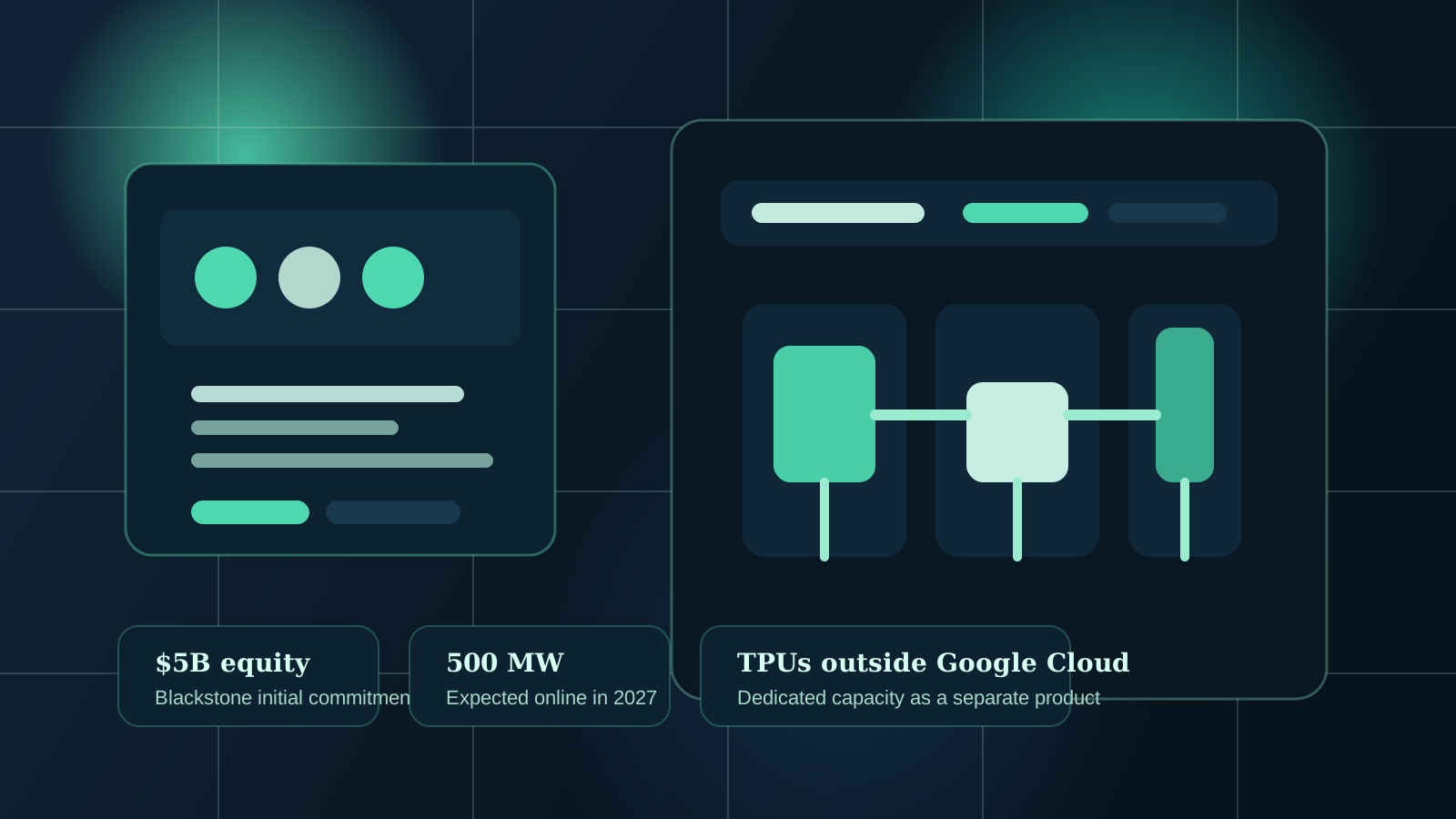
- Blackstone says it is making an initial $5 billion equity commitment and expects to bring 500 megawatts of capacity online in 2027, with plans to scale significantly over time.
- The better Grid Report angle is about product structure.
- Section
- Infrastructure
- Read time
- 5 min read
One of the strongest infrastructure stories still worth publishing this week is Blackstone and Google creating a new TPU cloud venture. The useful signal is not merely that another investor wants AI exposure. It is that Google is starting to package TPU access with dedicated capital, operations, and data-center capacity outside the standard Google Cloud channel.
Blackstone says it is making an initial $5 billion equity commitment and expects to bring 500 megawatts of capacity online in 2027, with plans to scale significantly over time. Google says the new company will give customers another way to access cloud TPUs in addition to using them through Google Cloud, while Google supplies the hardware, software, and services. That combination is what clears the bar. This is not only a financing announcement or only a cloud announcement. It is a new distribution model for frontier compute.
The important shift is not just more AI capex. It is Google TPU capacity being packaged as a separately financed delivery product.
The better Grid Report angle is about product structure. Most AI infrastructure stories still assume the compute path runs through hyperscaler balance sheets and hyperscaler cloud contracts. This joint venture suggests Google wants a second route: let outside capital fund the heavy physical stack while Google extends TPU supply and operating expertise into a separate capacity vehicle. That turns TPU access into something closer to a financed infrastructure product than a normal cloud SKU.
This clears the duplicate block for the site. The Grid Report has already covered OpenAI’s power-timing problem, NVIDIA and IREN as power-ready capacity, and CME’s attempt to financialize compute pricing. This article is materially different because it is about channel structure. The useful question is not only who has the best chips. It is who can open new capital channels to put those chips in front of customers faster than a single cloud platform could on its own.
For operators, the implication is practical. A dedicated TPU cloud backed by separate financing could widen procurement options for teams that want long-duration AI capacity without depending entirely on Google Cloud’s normal commercial lane. It also suggests that power, facilities, and chip access are becoming modular enough to be recombined into new market structures.
For investors and infrastructure developers, the signal is broader. Once a hyperscaler starts externalizing part of the compute buildout through a purpose-built venture, value shifts toward sponsors that can underwrite land, power, construction, and operations while still locking in privileged hardware relationships. That is a more infrastructure-native model than pure software-margin narratives imply.
The Grid Report view is that this article is publishable because it has a hard primary-source hook, a distinct thesis, and clear search value. The important shift is not just more AI capex. It is TPU capacity being turned into a financed product with its own capital stack and delivery path.
Sources
Blackstone, “Blackstone Announces Joint Venture with Google to Create New TPU Cloud,” May 18, 2026: https://www.blackstone.com/news/press/blackstone-announces-joint-venture-with-google-to-create-new-tpu-cloud/
Google, “Blackstone and Google to develop TPU cloud,” May 18, 2026: https://blog.google/innovation-and-ai/infrastructure-and-cloud/google-cloud/blackstone-tpu-cloud/
By Nawaz Lalani
The Grid Report is written by Nawaz Lalani and focuses on source-backed coverage of AI infrastructure, grid power demand, automation systems, and market signals.
Follow the signal, not just the headline.
Get the daily Grid brief for source-backed coverage on AI power demand, infrastructure timing, automation, and market signals.