- Anthropic’s May 28 Series H is worth publishing because the useful signal is not the headline valuation by itself.
- The company says its run-rate revenue crossed $47 billion earlier this month and that the new funding will help expand compute to meet demand for Claude.
- That is the original Grid Report angle.
- Section
- Markets
- Read time
- 6 min read
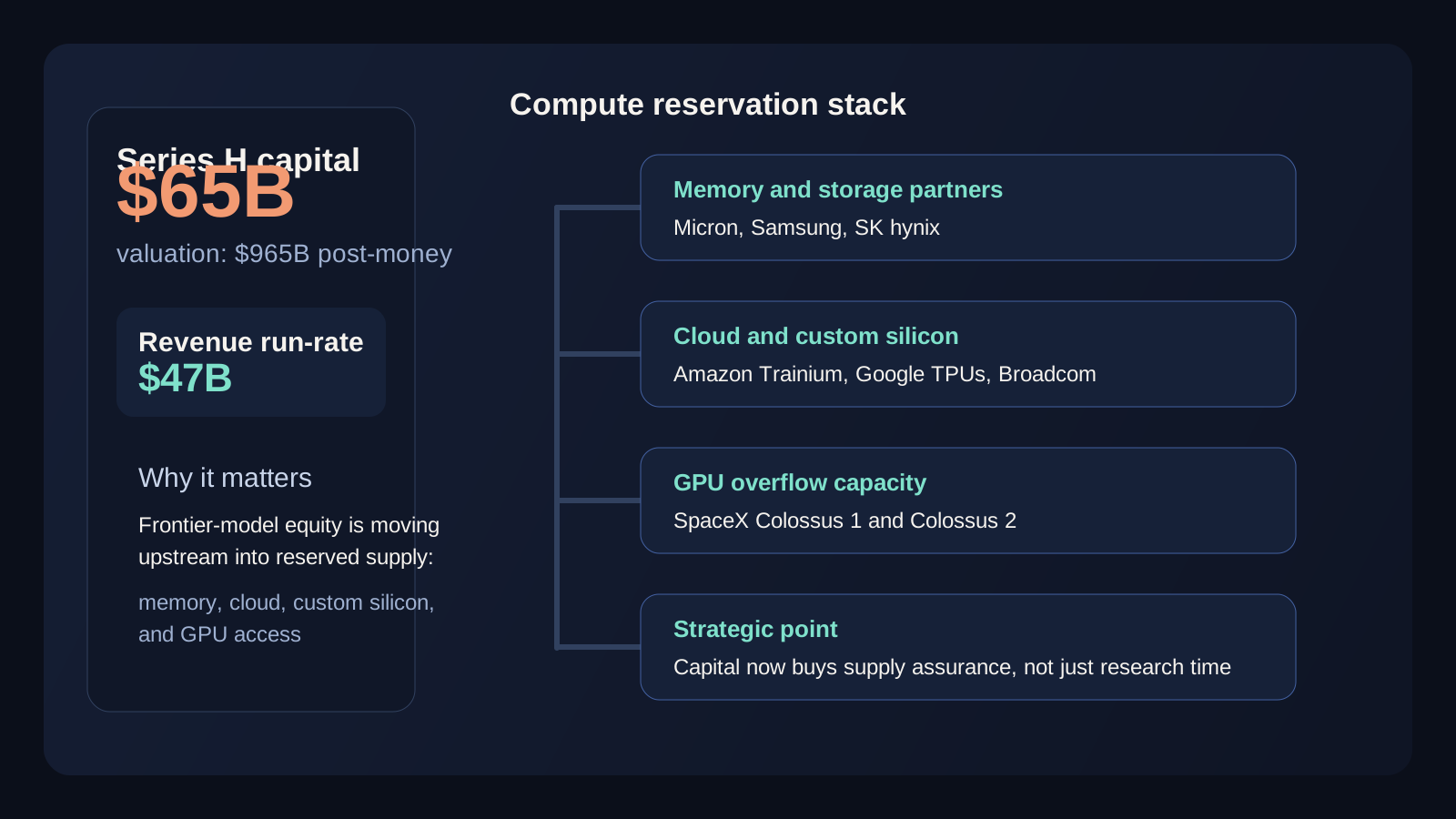
Anthropic’s May 28 Series H is worth publishing because the useful signal is not the headline valuation by itself. Anthropic says the $65 billion round comes with strategic infrastructure partners including Micron, Samsung, and SK hynix, and follows recent agreements with Amazon, Google, Broadcom, and SpaceX to expand Claude’s compute capacity. That turns the story into something more specific than “another AI company raised a lot of money.” It is about how frontier-model equity is being converted into supply assurance across multiple hardware layers at once.
The company says its run-rate revenue crossed $47 billion earlier this month and that the new funding will help expand compute to meet demand for Claude. On its own, that would still read like ordinary financing language. What makes this search-worthy is that Anthropic also names the infrastructure stack the money is meant to protect: memory, storage, logic-chip supply, custom silicon capacity, and GPU access. In other words, capital is being pushed upstream into the physical dependencies that can throttle product growth.
Frontier-model equity is starting to buy supply assurance: memory, custom silicon, cloud capacity, and GPU access before the bottlenecks hit product delivery.
That is the original Grid Report angle. Frontier-model funding is starting to look less like research bankroll and more like reserve-margin planning for AI infrastructure. If the commercial promise of a model depends on keeping inference and training capacity available at the moment enterprise demand arrives, then the relevant competition is not only model quality. It is whether a lab can secure enough hardware, cloud capacity, and component availability to keep its product reliable.
Anthropic’s April announcements make that pattern clearer. The company said on April 20 that it had secured up to five gigawatts of new capacity with Amazon and committed more than $100 billion over ten years to AWS technologies. On April 6 it said it had signed for multiple gigawatts of next-generation TPU capacity with Google and Broadcom. On May 6 it said it had signed a compute deal with SpaceX for Colossus GPU capacity. The Series H round now reads less like a standalone event and more like the financing layer sitting on top of a rapidly assembled compute portfolio.
This clears the duplicate block because the site’s existing Anthropic coverage is about containment engineering, not capital structure. It is also materially different from the Blackstone-Google TPU article and the CME compute-futures article. Those stories were about financed cloud capacity and benchmarked compute markets. This one is about what frontier-model equity finances before the market ever sees a finished product: secured supply lanes across cloud, chips, and memory.
The operator relevance is straightforward. Enterprises buying frontier AI products should assume reliability, deployment speed, and global availability will increasingly reflect upstream procurement strategy, not only model benchmarks. A lab that controls diversified supply across Trainium, TPUs, and external GPU pools has more room to absorb outages, regional demand spikes, or hardware bottlenecks than a lab leaning on a single stack.
For investors, the implication is that AI financing rounds need to be read less like software growth capital and more like infrastructure capitalization. Once a company is using equity to lock in memory partners and multigigawatt compute agreements, the valuation story is partly a view on procurement discipline and capital intensity. The market is not only underwriting model demand. It is underwriting the lab’s ability to keep the hardware pipeline full.
The Grid Report view is that this is one of the cleaner AI-markets stories available right now because it is recent, specific, and structurally useful. Anthropic is effectively telling the market that frontier AI companies are no longer just raising money to invent intelligence. They are raising money to reserve the physical stack that keeps intelligence deliverable.
Sources
Anthropic, “Anthropic raises $65B in Series H funding at $965B post-money valuation,” published May 28, 2026: https://www.anthropic.com/news/series-h
Anthropic, “Anthropic and Amazon expand collaboration for up to 5 gigawatts of new compute,” published April 20, 2026: https://www.anthropic.com/news/anthropic-amazon-compute
Anthropic, “Anthropic expands partnership with Google and Broadcom for multiple gigawatts of next-generation compute,” published April 6, 2026: https://www.anthropic.com/news/google-broadcom-partnership-compute
Anthropic, “Higher usage limits for Claude and a compute deal with SpaceX,” published May 6, 2026: https://www.anthropic.com/news/higher-limits-spacex
By Nawaz Lalani
The Grid Report is written by Nawaz Lalani and focuses on source-backed coverage of AI infrastructure, grid power demand, automation systems, and market signals.
Follow the signal, not just the headline.
Get the daily Grid brief for source-backed coverage on AI power demand, infrastructure timing, automation, and market signals.