- Schneider Electric and Kraken are worth publishing now because the useful signal is not another broad claim that flexibility matters.
- The disclosed facts are specific enough to matter.
- That clears the duplicate block against the site’s recent Google-Voltus, DOE microgrid, and Agora flexibility coverage.
- Section
- Energy
- Read time
- 4 min read
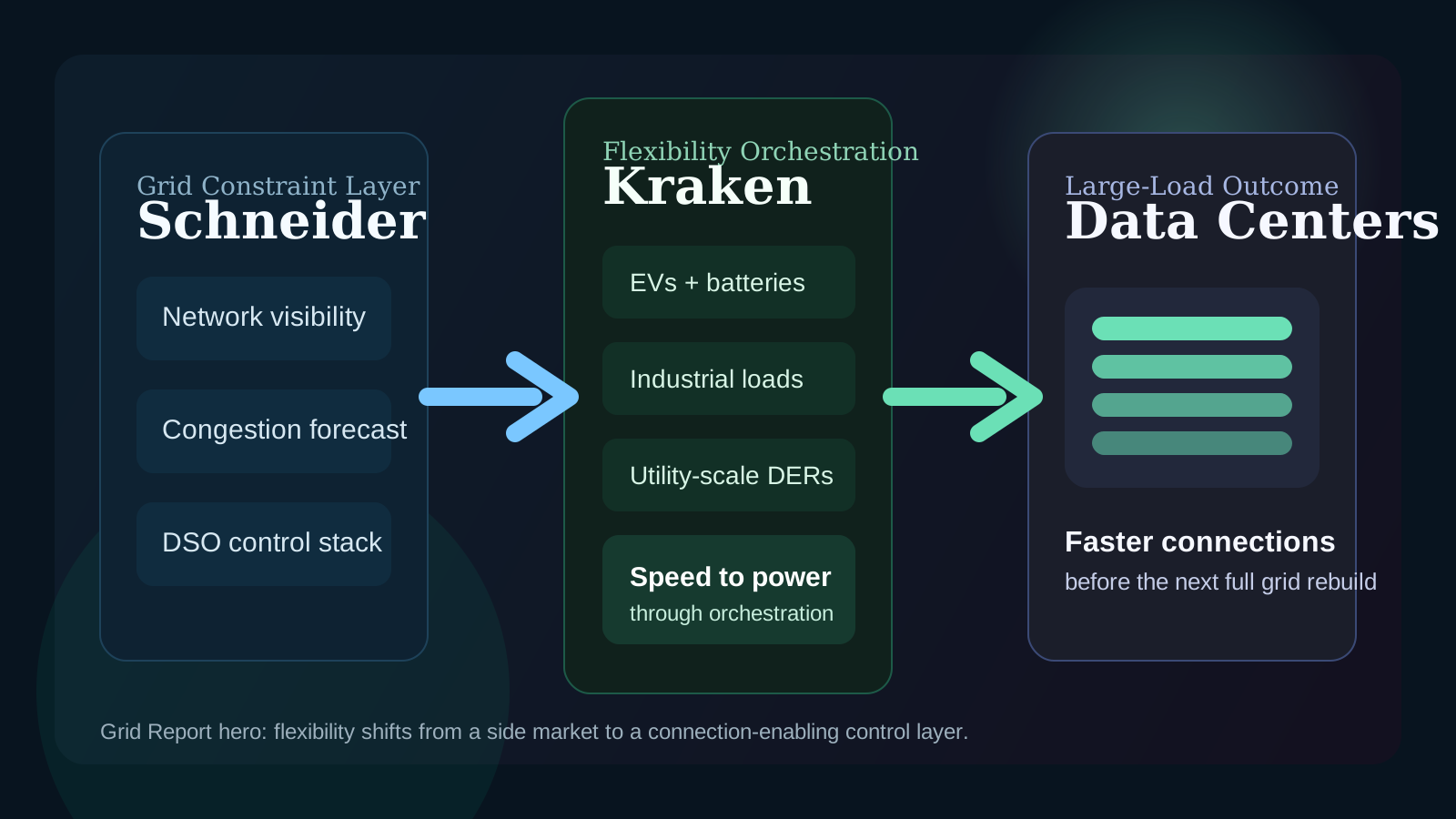
Schneider Electric and Kraken are worth publishing now because the useful signal is not another broad claim that flexibility matters. The stronger signal is architectural. A new layer is being built between the data center and the utility: software that can see local constraints, forecast congestion, and actively shape demand so large loads can connect sooner without waiting for every upgrade to arrive as new steel in the ground.
The disclosed facts are specific enough to matter. In the partnership announcement published June 8 in U.S. time and June 9 in U.K. time, Schneider Electric and Kraken said they will combine Schneider’s distribution-grid visibility and distributed-energy management tools with Kraken’s orchestration of distributed and industrial energy resources. The stated goal is to help utilities and distribution-system operators monitor the grid, forecast congestion, shift demand in real time, and deliver faster connections for data centers and other large industrial loads.
The useful shift is not simply that flexibility is valuable. It is that flexibility is being packaged as a utility-facing control layer that may unlock data-center connection capacity before the next full round of grid upgrades is finished.
That clears the duplicate block against the site’s recent Google-Voltus, DOE microgrid, and Agora flexibility coverage. Those stories were about capacity procurement, campus-level controllable-load design, or validation of flexibility claims. This one is different. The angle is not that data centers might someday be flexible. The angle is that flexibility is being packaged as connection middleware for the grid operator itself, sitting closer to the utility’s constraint map and dispatch logic than to a standalone demand-response pitch deck.
The reason this matters for operators is that “speed to power” increasingly depends on whether a project can be understood as controllable by the system it wants to join. Kraken’s public grid material emphasizes low- and medium-voltage monitoring, dynamic tariffs, and decision support for distribution networks. Schneider has been making a similar point in its own data-center and grid commentary for months: large loads need active grid interdependence, not just backup generation and a substation plan. Put together, the partnership suggests the next interconnection advantage may come from control quality and real-time coordination, not only from capex or land position.
For utilities and regulators, the practical implication is that flexibility is being moved earlier in the stack. Instead of treating load flexibility mainly as a wholesale-market service after interconnection, the pitch is to use visibility and orchestration before or during the connection process to release hidden capacity on the existing network. That is a narrower and more operationally useful proposition than generic claims that data centers can help the grid “someday.”
For investors, the read-through is that some of the value in AI infrastructure may migrate toward grid-edge control layers that make existing wires work harder. If the next few years are defined by connection bottlenecks rather than pure demand shortage, then the winners are not only generation owners and powered-land developers. The winners also include the software, controls, and utility-integration vendors that can convert theoretical flexibility into financeable interconnection speed.
This also lines up with the broader direction of travel visible in EPRI’s DCFlex work. Flex MOSAIC is explicitly being framed as a shared flexibility framework to accelerate time to power for data centers and large loads. Schneider and Kraken are not the whole answer, and the partnership does not mean physical upgrades suddenly stop mattering. But it does show the market trying to operationalize the same idea: flexibility is becoming a grid-integration product, not just an aspirational feature.
The Grid Report view is that this clears the search bar because it answers a live and specific question better than a generic partnership rewrite: what changed here? The useful answer is that one more part of the data-center power stack is becoming legible as software-mediated interconnection. The emerging product is not simply flexible load. It is a control layer that can help utilities decide which large loads can move faster, under what operating terms, and with how much confidence.
Sources
MarketScreener / Wiztrust, “Schneider Electric and Kraken partner to boost grid flexibility and accelerate grid connections,” published June 8, 2026 U.S. time / June 9, 2026 U.K. time: https://www.marketscreener.com/news/schneider-electric-and-kraken-partner-to-boost-grid-flexibility-and-accelerate-grid-connections-ce7f5dd3dc8bf126
Kraken, “Manage distribution grids with confidence,” accessed June 9, 2026: https://kraken.tech/distribution-grids
Octopus Energy Group, “Kraken Flex,” accessed June 9, 2026: https://octopusenergy.group/kraken-flex
DCFlex, “Flex MOSAIC,” accessed June 9, 2026: https://dcflex.epri.com/flex-mosaic
Schneider Electric Blog, “Grid interdependence and the future of data centers,” published January 13, 2026: https://blog.se.com/datacenter/2026/01/13/rethinking-power-grid-interdependence-future-of-data-centers/
By Nawaz Lalani
The Grid Report is written by Nawaz Lalani and focuses on source-backed coverage of AI infrastructure, grid power demand, automation systems, and market signals.
Follow the signal, not just the headline.
Get the daily Grid brief for source-backed coverage on AI power demand, infrastructure timing, automation, and market signals.