- DOE’s June 3 microgrid guidance is worth publishing because the useful signal is not simply that microgrids can help power data centers.
- The official language is unusually direct.
- What makes this publishable is that DOE is not describing microgrids as a side technology for remote sites.
- Section
- Energy
- Read time
- 5 min read
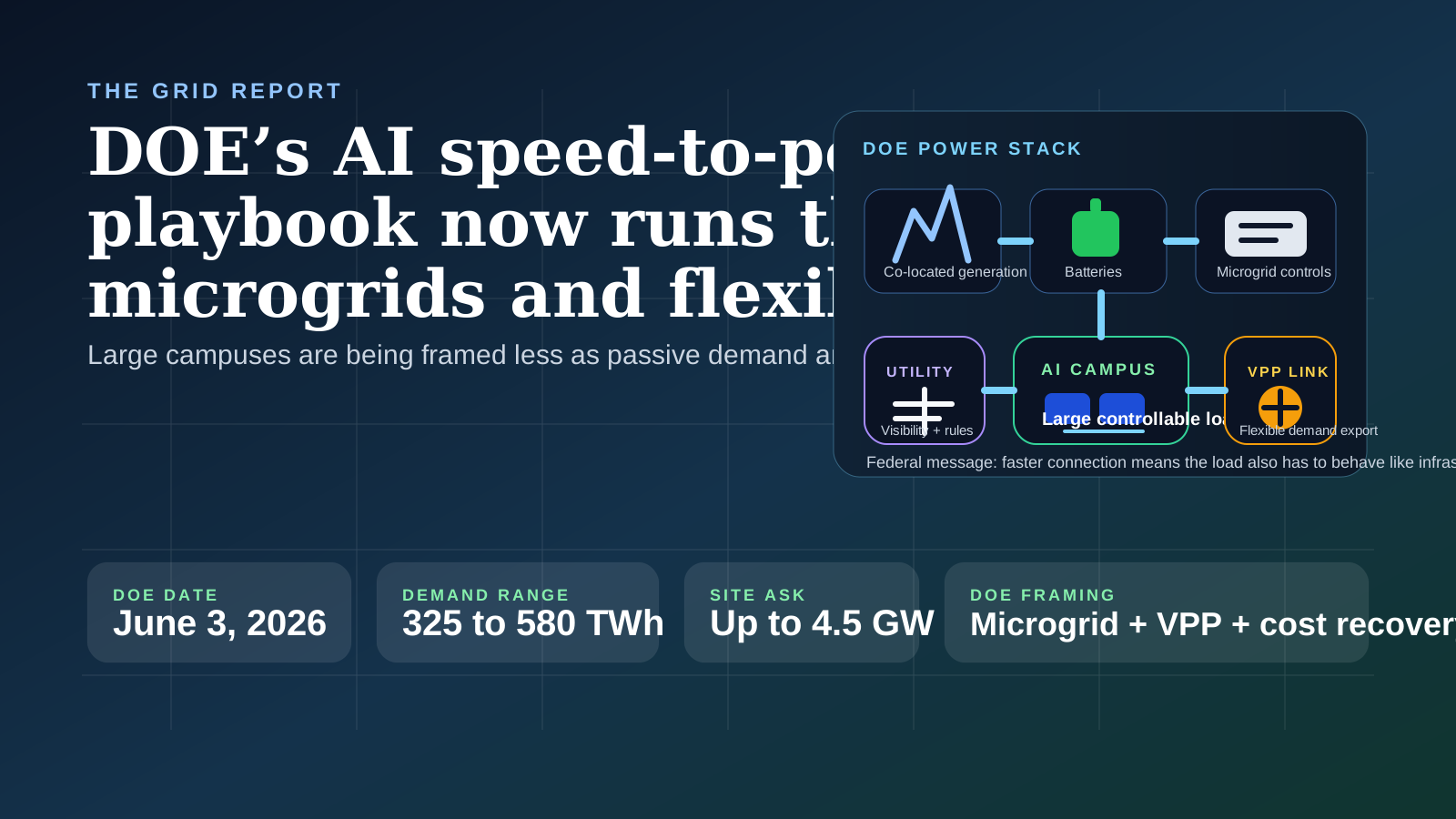
DOE’s June 3 microgrid guidance is worth publishing because the useful signal is not simply that microgrids can help power data centers. The stronger signal is that the federal large-load playbook is becoming more specific about what AI-era power readiness now requires: not just more megawatts somewhere on the system, but large campuses that arrive with their own controllable architecture, co-located supply options, and clearer rules for how they support rather than destabilize the surrounding grid.
The official language is unusually direct. DOE’s Office of Electricity says microgrids offer a promising solution to enable the fast, reliable, and affordable build-out of data centers with shorter timelines relative to distribution and transmission grid expansion. The same piece says data-center electricity use climbed from 58 terawatt-hours in 2014 to 176 terawatt-hours in 2023 and is estimated to reach 325 to 580 terawatt-hours by 2028, with single sites requesting as much as 4.5 gigawatts of power. That is the scale of the problem DOE is now writing around.
DOE’s new signal is that faster AI power buildouts will increasingly depend on campuses behaving like controllable infrastructure, not just showing up as bigger load requests.
What makes this publishable is that DOE is not describing microgrids as a side technology for remote sites. It is describing them as part of the answer to AI deployment timing. The June 3 article says traditional interconnection is struggling to absorb large electric loads at this pace and that co-location with existing or refurbished generation is being explored to accelerate data-center development. That is a shift in emphasis. The useful question is no longer just how many new transmission projects get approved. It is how much of the first power stack can be assembled at the load itself.
DOE’s adjacent guidance fills in the rest of the federal logic. Its new data-center electricity-demand resource page says the country is returning to a period of rising electricity demand and that total energy demand could grow roughly 15% to 20% over the next decade because of AI, data centers, manufacturing, and electrification. The same page explicitly points to virtual power plants, onsite energy technical assistance, coal-plant redevelopment tools, grid-enhancement programs, and federal financing pathways as part of the response. In other words, DOE is not offering one silver bullet. It is assembling an operator menu for getting large loads online faster without pretending the bulk grid can instantly absorb every request.
This is where the original angle becomes clearer. The federal story is moving from passive load accommodation toward controllable-load design. DOE’s resource-adequacy page says the Speed to Power Initiative exists to accelerate large-scale transmission and generation development so the United States has the power needed to win the AI race. But the June 3 microgrid piece explains what happens before that wider system fully arrives: data centers are being pushed toward modular microgrids, networked coordinated control, storage, backup generation, and formal utility visibility into how the load behaves.
That matters because DOE is also explicit about the tradeoffs. The microgrid article warns that co-located generation and faster data-center development raise regulatory issues around sudden loss of data-center load and fair allocation of distribution-system costs. It says DOE can support research on fair and robust cost recovery for grid and microgrid assets serving large electric loads. That is the real operator and investor signal. Faster connection is becoming conditional on proving that the campus can control itself and on deciding who pays for the supporting assets.
This clears the duplicate block against the site’s recent coverage because the thesis is different. The oscillation-monitoring story was about measurement and protection when AI loads behave dynamically. The Google-Voltus piece was about one buyer-funded capacity product in PJM. The Agora story was about a private-sector test bed for validating large-load behavior. This article is about DOE making those ideas look less like isolated experiments and more like the emerging federal playbook for AI power readiness.
For operators, the practical takeaway is that “speed to power” increasingly means showing up with a power design, not just a load request. For utilities and regulators, it means large-load policy is drifting toward a bargain: connect sooner if the campus brings flexibility, backup systems, and clearer cost causation. For investors, it means the value is moving into the enabling layers around AI load: microgrid controls, batteries, onsite generation, grid-integration services, and redevelopment pathways that can compress energization timelines.
The Grid Report view is that this clears the search bar because it answers a timely question better than a generic DOE recap: what is the federal government actually signaling about how AI campuses get powered before the whole grid catches up? The useful answer is that DOE is increasingly treating those campuses as controllable infrastructure systems, not passive loads, and that changes the economics, the permitting path, and the timetable for what gets built first.
Sources
U.S. Department of Energy Office of Electricity, “Microgrids, Large Electric Loads & Grid Support: How to Leverage Microgrids to Support Utilities and Large Load Customers,” published June 3, 2026: https://www.energy.gov/oe/articles/microgrids-large-electric-loads-grid-support-how-leverage-microgrids-support-utilities
U.S. Department of Energy Office of Electricity, “Clean Energy Resources to Meet Data Center Electricity Demand,” accessed June 7, 2026: https://www.energy.gov/oe/clean-energy-resources-meet-data-center-electricity-demand
U.S. Department of Energy Office of Electricity, “Resource Adequacy,” accessed June 7, 2026: https://www.energy.gov/oe/resource-adequacy
By Nawaz Lalani
The Grid Report is written by Nawaz Lalani and focuses on source-backed coverage of AI infrastructure, grid power demand, automation systems, and market signals.
Follow the signal, not just the headline.
Get the daily Grid brief for source-backed coverage on AI power demand, infrastructure timing, automation, and market signals.