- The June 5 EIA update is worth publishing because the useful signal is not simply that China has more nuclear reactors than it used to.
- The primary-source facts are clear.
- That pushes the story beyond a backward-looking milestone.
- Section
- Energy
- Read time
- 5 min read
- Why this page exists
- The Grid Report publishes operator-grade coverage on AI, power, infrastructure, automation, and markets.
What the June 5 EIA nuclear update actually says
The useful signal is not just that capacity rose. It is that operating additions and the construction backlog together point to sustained firm-power build speed.
China nuclear capacity and pipeline snapshot
| Metric | Value | Why it matters |
|---|---|---|
| 2016 to 2024 capacity growth | +24 GW | EIA says China added 24 GW over the period, a 76% increase in nuclear capacity. |
| 2025 additions | +1.1 GW | PRIS additions carried EIA capacity estimates beyond 2024. |
| 2026 additions through May | +2.2 GW | EIA attributes the 2026 increase to new units including Sanao-1 and Taipingling-1. |
| Operational fleet as of May 2026 | 60 reactors / 58.7 GW | The operating base is already large enough to matter at system scale. |
| Construction backlog | 36 reactors / 38.9 GW | The pipeline means the buildout is not just a historical milestone. |
| Share of world nuclear construction | More than 49% | China now represents the largest single concentration of nuclear build activity in the world, per EIA citing PRIS. |
Source: EIA Today in Energy, June 5, 2026, using EIA International Energy Statistics and IAEA PRIS.
The June 5 EIA update is worth publishing because the useful signal is not simply that China has more nuclear reactors than it used to. The stronger signal is that one of the few scalable firm clean-power options is still being built there with industrial speed, a standardized project model, and a backlog large enough to shape how serious people think about long-duration grid capacity.
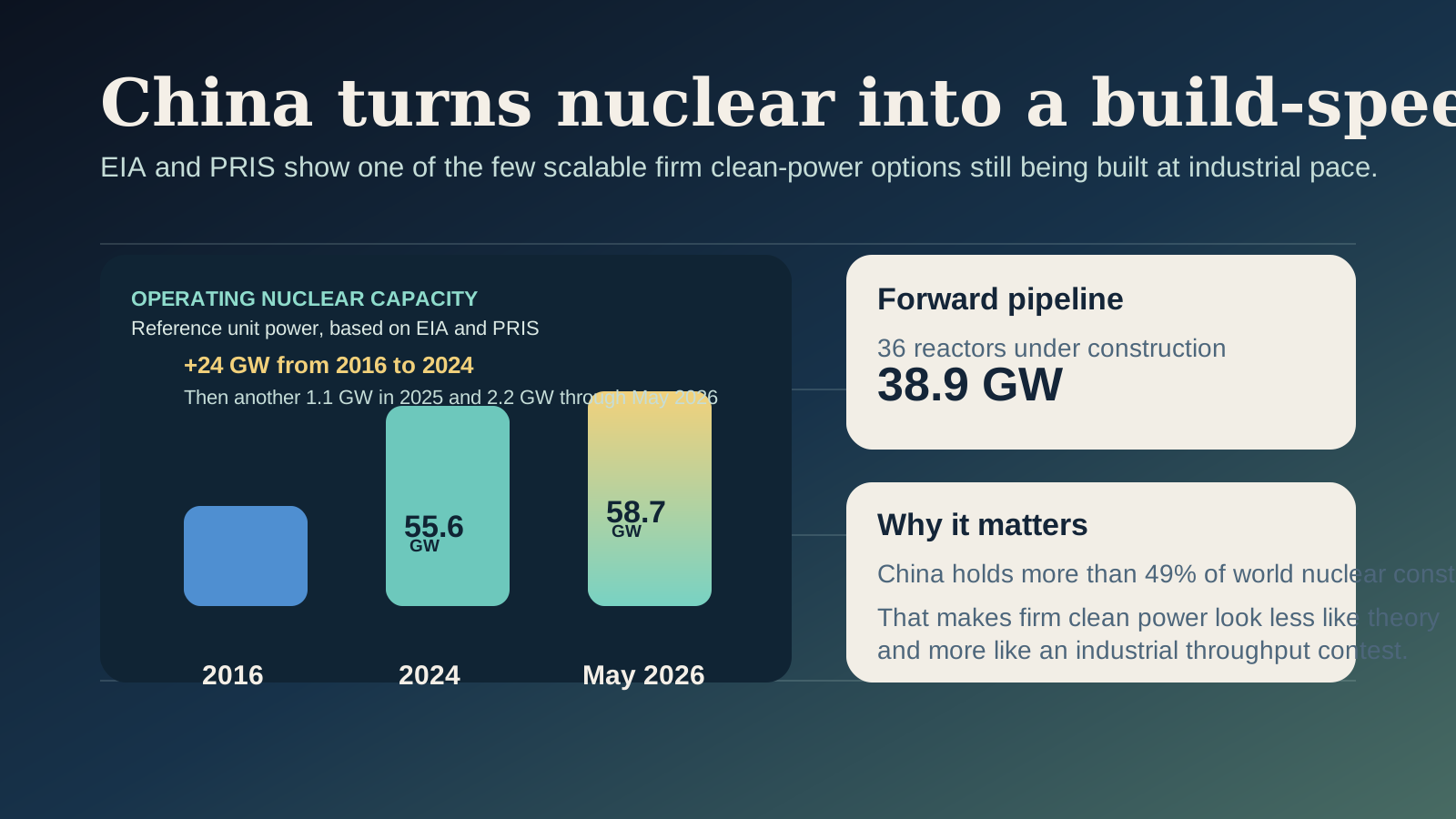
The primary-source facts are clear. EIA said China’s nuclear generation capacity increased 76%, or 24 gigawatts, from 2016 to 2024. Using International Atomic Energy Agency Power Reactor Information System data to capture the newest additions, EIA said China then added another 1.1 gigawatts in 2025 and 2.2 gigawatts in 2026 through May.
The useful signal is that China is treating firm clean power less like a policy slogan and more like an industrial build-speed problem.
That pushes the story beyond a backward-looking milestone. EIA said China had 60 operational reactors with 58.7 gigawatts of installed capacity across 18 sites as of May 2026. Just as important, it said China has 36 reactors under construction across 19 sites that would add about 38.9 gigawatts of additional capacity, accounting for more than 49% of total world nuclear construction according to PRIS.
PRIS also gives the 2026 commissioning detail that makes the pipeline feel live rather than theoretical. The database shows Sanao-1 reached first grid connection on March 12, 2026, and Taipingling-1 on February 13, 2026. EIA cites those two units as the newly commissioned additions that lifted 2026 capacity through May.
The Grid Report angle is that this is really a build-speed story. Much of the AI-power conversation still treats firm generation as something everyone wants in principle but few systems can add in volume on useful timelines. China is showing a different version of the playbook: standardized designs, repeated multi-unit construction, domestic supply-chain depth, and enough continuity to keep adding clean firm capacity instead of only announcing it.
That does not mean China has solved every power problem or that nuclear is the only answer. It does mean the comparison set is changing. When a country can move from roughly 31.6 gigawatts in 2016 to 58.7 gigawatts by May 2026 and still keep nearly 39 more gigawatts under construction, firm clean generation starts to look less like a policy aspiration and more like a manufacturing and execution contest.
For AI infrastructure watchers, that matters as an inference from the power data, not as a claim in the EIA article itself. Large data-center systems need energy that is available at scale, not just energy that looks good in a long-term target deck. Regions that can add reliable generation faster will enter the next capacity race with more optionality on where compute clusters can actually be energized.
For Western grid policy, the uncomfortable read-through is that the bottleneck may be organizational as much as technological. EIA notes that China uses standardized project management for design, licensing, and construction and builds reactors in batches to capture economies of scale. That is a very different operating posture from the stop-start permitting, bespoke delivery, and fragmented supply chains that dominate many other power markets.
The Grid Report view is that the useful June 5 signal is not about celebrating a reactor count. It is that China is treating firm clean power like an industrial capacity problem. In an era when AI, electrification, and reindustrialization all compete for dependable electricity, that may become the more important distinction.
Sources
U.S. Energy Information Administration, “China’s nuclear power capacity nearly doubled since 2016,” published June 5, 2026: https://www.eia.gov/todayinenergy/detail.php?id=67746
International Atomic Energy Agency Power Reactor Information System, China country details, accessed June 5, 2026: https://pris.iaea.org/PRIS/CountryStatistics/CountryDetails.aspx?current=CN
Nawaz Lalani
Nawaz Lalani is the creator of The Grid Report and writes about AI infrastructure, grid power demand, automation systems, and the market signals shaping the physical AI economy. His focus is translating technical and industrial shifts into practical coverage for operators, investors, builders, and teams making real deployment decisions.
B.S. in Geology from UT Arlington. Covers AI infrastructure, energy systems, grid constraints, automation workflows, and market signals.
Stories are built from primary sources, utility and infrastructure signals, company disclosures, filings, and operator-grade context. The goal is to explain what changed, why it matters now, and what it means for builders, investors, utilities, and teams making real deployment decisions.
Follow the lane, not just the headline.
The strongest value in The Grid Report comes from following how AI, infrastructure, power, automation, and markets connect over time.