- Constellation’s June 1 waiver win is worth publishing because the useful signal is not simply that another nuclear plant may come back.
- The specific facts clear the bar.
- Constellation’s own first-quarter filing explains why that matters.
- Section
- Energy
- Read time
- 6 min read
- Data included
- Why the Crane waiver matters
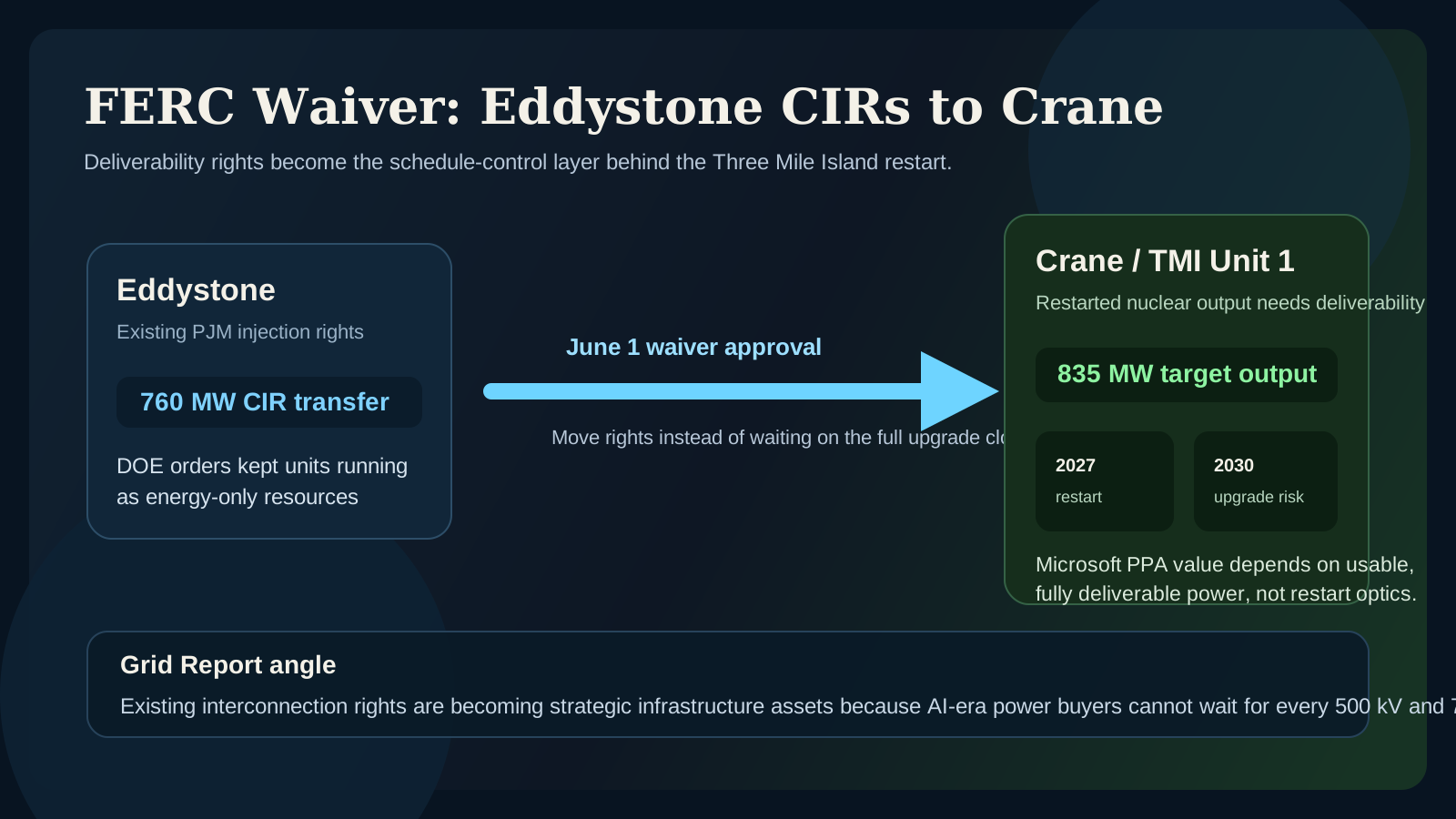
Why the Crane waiver matters
The practical question is not whether a nuclear restart sounds promising in theory. It is whether enough deliverability can move with the plant fast enough to make a 2027 restart commercially and operationally useful.
The disclosed signals that make the waiver publishable
| Signal | Disclosed fact | Why it matters |
|---|---|---|
| FERC action | Waiver approved June 1 to transfer CIRs from Eddystone to Crane | The order treats deliverability rights as the scheduling lever that can change restart timing. |
| Commercial anchor | Crane restart is tied to a 20-year Microsoft power purchase agreement | A faster path to deliverable output matters because the buyer value depends on actual usable power, not symbolism. |
| Grid bottleneck | PJM Phase I study flagged contingent upgrades with some dates as late as December 2030 | Without the waiver, grid timing could have diluted the usefulness of a nominal 2027 restart. |
| Operational consequence | Constellation argued long operation below rated output can raise wear and vibration risk for nuclear equipment | Partial deliverability can be an operating problem, not just a revenue problem. |
Sources: Constellation 10-Q, Constellation project page, Utility Dive summary of the June 1 FERC order, and ANS Nuclear News background reporting.
Constellation’s June 1 waiver win is worth publishing because the useful signal is not simply that another nuclear plant may come back. The stronger signal is that FERC treated grid deliverability as the gating issue and gave Constellation a path to move interconnection rights from one asset to another so the Crane Clean Energy Center can avoid waiting for the full transmission-upgrade timeline.
The specific facts clear the bar. Utility Dive reported that FERC approved Constellation’s waiver request on June 1, allowing 760 megawatts of Capacity Interconnection Rights to move from the Eddystone plant near Philadelphia to Crane, the restarted former Three Mile Island Unit 1. Utility Dive also reported FERC’s explanation that the waiver may reduce or eliminate contingent facilities for Crane, increase interim deliverability, and enable the plant to be fully operational before December 31, 2030.
The important Crane signal is that a restarted power plant is only as useful as the grid rights that let it deliver full output on time.
Constellation’s own first-quarter filing explains why that matters. In its May 2026 10-Q, the company said PJM’s Phase I System Impact Study identified contingent transmission upgrades for Crane, with some projected in-service dates extending as late as December 2030. Constellation said it filed the waiver in March 2026 specifically to reduce the number of upgrades that would have to be completed before Crane could be fully deliverable to the grid.
That is the original Grid Report angle. The core bottleneck here is not reactor readiness by itself. It is whether a returning generator can actually inject and sell its full output into a constrained system on the schedule that matters to buyers. Once the story is framed that way, the real product is not just restarted nuclear generation. It is a package of nuclear output plus enough deliverability rights to make a 2027 restart economically useful.
The Microsoft connection makes the timing more important. Constellation says Crane’s restart is supported by a 20-year power purchase agreement with Microsoft. The Crane project page says the unit is expected to restore 835 megawatts of carbon-free power and target service in 2027. If the plant restarted on schedule but could not fully deliver because the grid-side rights and upgrades lagged, the commercial value of that restart would look very different.
This is why the story is distinct from the site’s recent power-access coverage. The Freestone article was about meter boundaries and behind-the-meter logic. The large-load and cost-allocation pieces were about who pays and how queues get managed. The Crane waiver is different. It shows that existing interconnection rights are becoming strategic infrastructure in their own right, especially when AI-era buyers want firm power faster than the traditional upgrade cycle can deliver it.
There is also an operator lesson hiding inside the waiver. Utility Dive reported that Constellation argued extended operation below rated output can raise vibration and wear issues for nuclear equipment. That means partial deliverability is not just a revenue haircut. For this kind of asset, it can also become a reliability and operating problem. In other words, full grid usefulness matters to plant economics and plant behavior at the same time.
For search, the article is strong because it answers a specific live question better than a generic restart recap: what did FERC actually approve for Three Mile Island, and why does a waiver over capacity interconnection rights matter more than the headline alone suggests? The useful answer is that the restart’s timeline depends as much on transferable grid rights and contingent upgrades as it does on nuclear refurbishment.
Sources
Constellation Energy, Form 10-Q for quarter ended March 31, 2026, section “Capacity Interconnection Rights for Crane Clean Energy Center”: https://www.sec.gov/Archives/edgar/data/1868275/000186827526000067/ceg-20260331.htm
Constellation Energy, Crane Clean Energy Center project page, accessed June 4, 2026: https://www.constellationenergy.com/about/locations/crane-clean-energy-center.html
Utility Dive, “Constellation’s Three Mile Island nuclear restart gets boost with FERC waiver,” published June 3, 2026: https://www.utilitydive.com/news/constellation-three-mile-island-crane-nuclear-ferc-waiver/821836/
ANS Nuclear News, “Constellation seeks FERC help with Crane restart,” published April 3, 2026: https://www.ans.org/news/2026-04-03/article-7905/constellation-seeks-ferc-help-with-crane-restart/-2/
By Nawaz Lalani
The Grid Report is written by Nawaz Lalani and focuses on source-backed coverage of AI infrastructure, grid power demand, automation systems, and market signals.
Follow the signal, not just the headline.
Get the daily Grid brief for source-backed coverage on AI power demand, infrastructure timing, automation, and market signals.