- Agora’s May 19 launch is worth publishing because the useful signal is not that one more research platform exists.
- The primary-source facts are specific.
- That makes the original Grid Report angle different from the site’s recent grid-modeling stories.
- Section
- Energy
- Read time
- 6 min read
- Data included
- Why Agora is different from a generic AI-power warning
Why Agora is different from a generic AI-power warning
The useful shift is not just more concern about large-load growth. It is the creation of a physical validation layer where flexibility claims can be tested before they become planning assumptions.
What the primary sources actually add
| Signal | Primary-source fact | Why it matters |
|---|---|---|
| Facility purpose | A DOE-backed large-load test bed built to help data centers participate in grid reliability | This moves the discussion from vague flexibility claims toward real validation of behavior. |
| Technical scope | Replicates the complexity of a large-scale data center interconnection | Utilities can examine campus behavior in conditions closer to real interconnection stress. |
| Policy lineage | DOE’s 2024 AI-power recommendations called for a data-center-scale test bed and operational-flexibility work | Agora appears tied to an existing federal roadmap rather than being an isolated experiment. |
| Market implication | Large campuses may need demonstrated flexibility and control quality, not just megawatt requests | The next interconnection advantage may come from provable behavior rather than land or chip rhetoric alone. |
Sources: NLR Agora launch release, DOE AI-and-data-center recommendations, DOE Office of Electricity resource adequacy page, and ORNL MEGA-DC overview.
Agora’s May 19 launch is worth publishing because the useful signal is not that one more research platform exists. The stronger signal is that AI data centers are becoming important enough to require a dedicated proving ground for grid behavior. The question is no longer only how many megawatts a campus wants. It is whether utilities and developers can validate, before scale, how that campus will respond during stressed system conditions and whether it can act like a better grid citizen.
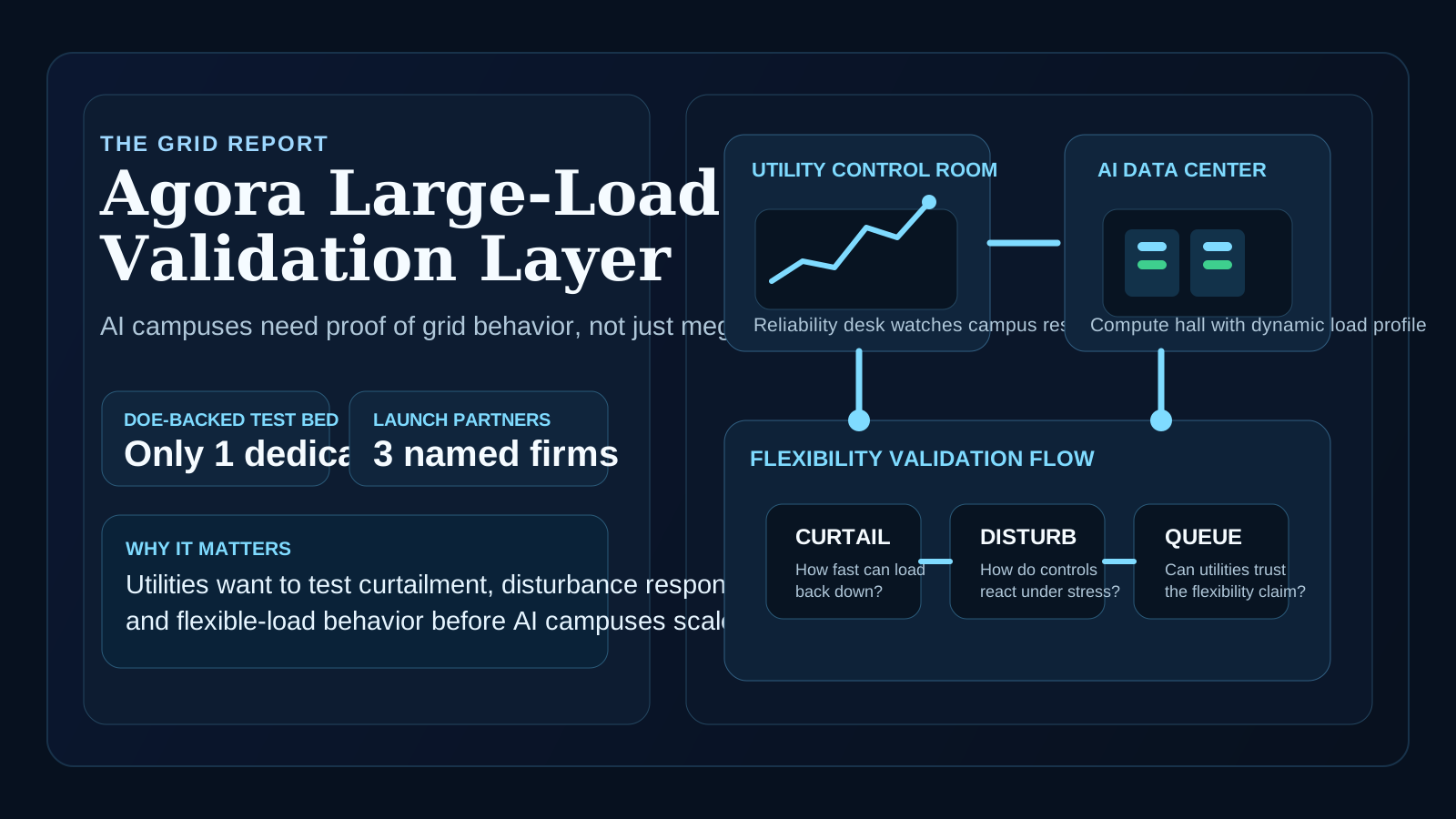
The primary-source facts are specific. The National Laboratory of the Rockies says Agora is a DOE Office of Electricity-funded large-load test bed designed to help data centers become active participants in grid reliability. The lab says it is the only dedicated large-load grid-integration test bed across the U.S. national laboratory complex, that it replicates the technical complexity of a large-scale data center interconnection, and that Schneider Electric, Compass Datacenters, and Verrus are already using it with the lab.
The next bar for AI data centers may not be promising flexibility. It may be proving that flexibility works before the interconnection is real.
That makes the original Grid Report angle different from the site’s recent grid-modeling stories. The ERCOT large-load model article was about simulation inputs for planners. The DOE oscillation piece was about seeing bad electrical behavior on the grid quickly enough to respond. Agora is one step closer to operating reality. It is a validation environment where utilities, data center developers, and equipment providers can test whether flexibility, curtailment logic, and large-load coordination will actually work before arguments about those capabilities get embedded into contracts, studies, and political promises.
The timing also matters because it lines up with where DOE has already been pointing. In the department’s July 30, 2024 recommendations on powering AI and data center infrastructure, one highlighted recommendation was to establish a data-center-scale AI test bed inside DOE. The same document also called for an operational-flexibility framework and active collaboration between utilities and data center operators. Agora looks less like an isolated lab ribbon-cutting and more like the physical implementation of that policy direction.
The strongest operating implication is that “flexibility” is being forced out of slideware and into test conditions. The NLR release says data centers could reduce electricity use when demand risks exceeding supply, lowering the chance of blackouts and potentially lowering electricity rates. That matters because utilities and regulators have heard many versions of the flexible-load promise over the past year. Agora suggests the next bar is proof. If a project says it can shift, curtail, or coordinate load in ways that help the system, the market increasingly needs a place to see those claims behave under realistic conditions.
This clears the duplicate block against the last 30 days of site coverage. It is not the same thesis as the DOE oscillation article, which focused on measurement blind spots after a large campus is already connected. It is not the same as the ERCOT PSCAD article, which focused on dynamic models for planning studies. And it is not the same as Oregon’s Schedule 96 piece, which focused on contracts and clean-power conditions for service. Agora is narrower and more useful right now: it is about the emerging validation layer between a flexibility claim and a real interconnection.
For operators and developers, the practical takeaway is that future large-load negotiations may increasingly hinge on demonstrated behavior rather than declared intent. A campus that can prove how quickly it can back down, how its controls respond during disturbances, and how its power profile changes under different compute mixes is easier for utilities and regulators to trust. That can matter for queue posture, tariff design, backup-power expectations, and whether a project is treated as a burden or as a partially coordinated asset.
For search performance, the story is strong because it answers a live and specific question: what is the Agora large-load test bed and why does it matter for AI data centers? Readers searching for DOE Agora, large-load grid integration test bed, or AI data center flexibility get a more useful answer than a generic “power demand is rising” rewrite.
Sources
National Laboratory of the Rockies, “News Release: NLR Launches Agora, First-of-Its-Kind Large-Load Grid Integration Test Bed,” published May 19, 2026: https://www.nlr.gov/news/detail/press/2026/news-release-nlr-launches-agora-first-of-its-kind-large-load-grid-integration-test-bed
U.S. Department of Energy, “Recommendations on Powering Artificial Intelligence and Data Center Infrastructure,” presented July 30, 2024: https://www.energy.gov/sites/default/files/2024-11/Powering%20AI%20and%20Data%20Center%20Infrastructure%20Recommendations%20July%202024.pdf
U.S. Department of Energy Office of Electricity, “Resource Adequacy,” accessed June 2, 2026: https://www.energy.gov/oe/resource-adequacy
Oak Ridge National Laboratory, “Modeling Energy Growth Associated with Data Center (MEGA-DC) as a Grid-Orchestrated Load,” updated March 26, 2026: https://www.ornl.gov/technology/202405845
By Nawaz Lalani
The Grid Report is written by Nawaz Lalani and focuses on source-backed coverage of AI infrastructure, grid power demand, automation systems, and market signals.
Follow the signal, not just the headline.
Get the daily Grid brief for source-backed coverage on AI power demand, infrastructure timing, automation, and market signals.