- Google’s June 4 announcement of the Meitner Energy Center in Gray and Roberts Counties, Texas is worth publishing because it shows the AI power problem being attacked at the campus-design level.
- That matters because AI infrastructure is no longer constrained mainly by land, tax abatements, or fiber routes.
- Google’s own wording is unusually clear on the operating point.
- Section
- Energy
- Read time
- 6 min read
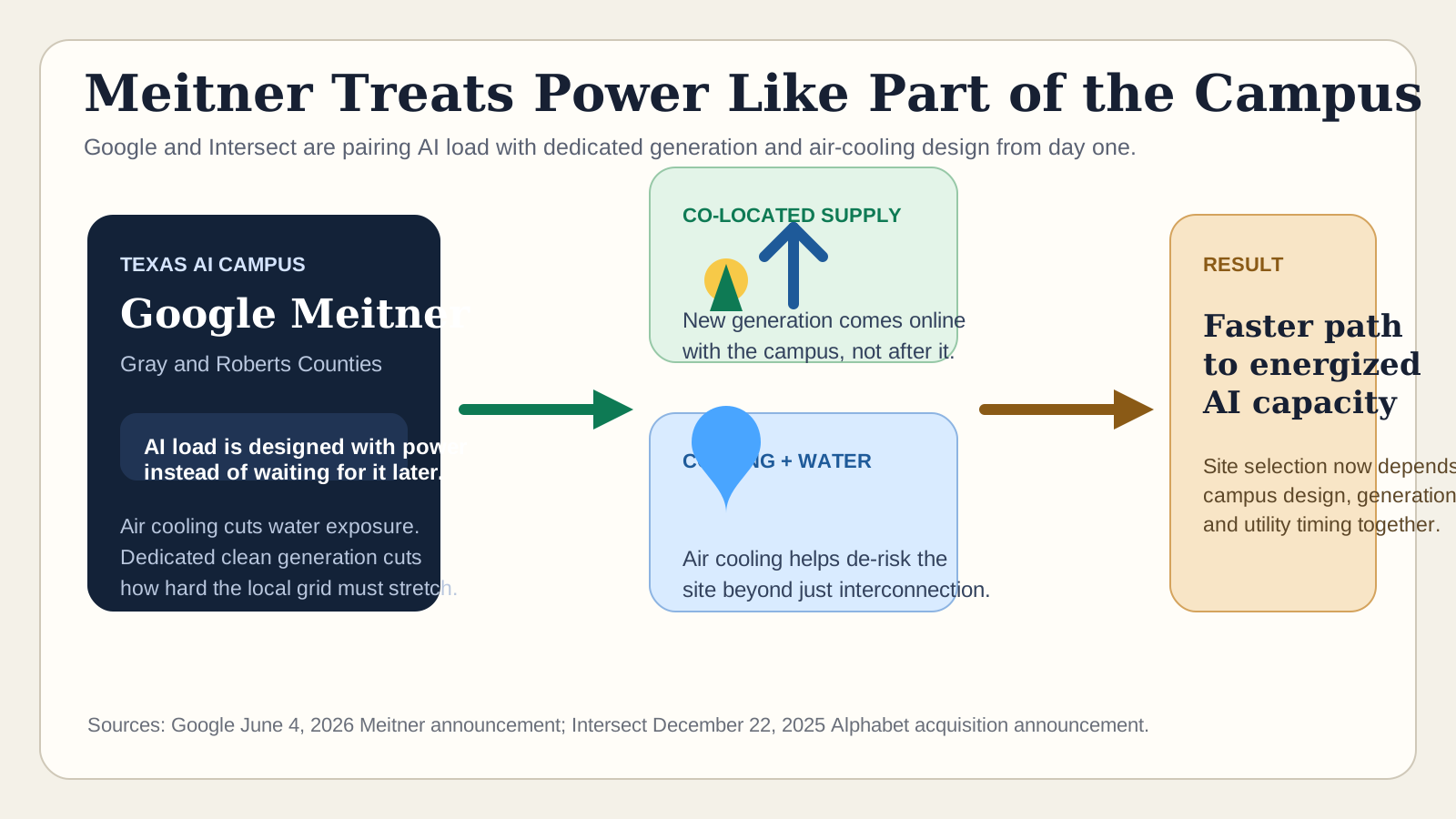
Google’s June 4 announcement of the Meitner Energy Center in Gray and Roberts Counties, Texas is worth publishing because it shows the AI power problem being attacked at the campus-design level. The useful signal is not that Google is building another large data center in Texas. The stronger signal is that Google and Intersect are explicitly pairing the campus with dedicated clean generation so the site can come online with its own supply stack instead of leaning as heavily on the local grid.
That matters because AI infrastructure is no longer constrained mainly by land, tax abatements, or fiber routes. The hard bottleneck is energization timing. In many regions, the question is not whether a developer can announce a campus. It is whether the utility system can serve it quickly enough without a long queue, a costly upgrade fight, or a ratepayer backlash. Co-location is one answer: move the generation decision inside the project instead of treating it as a later procurement exercise.
Meitner matters because it treats power supply, cooling, and site energization as one campus-design problem instead of three separate negotiations.
Google’s own wording is unusually clear on the operating point. The company said Meitner will include a new data center co-located with new energy generation and that dedicated clean power will help meet the site’s demand while reducing the need for new power supply on the local grid. That is not generic sustainability branding. It is a load-serving design choice aimed at reducing grid friction for a very large compute campus.
The project also matters because it sits inside Google’s broader integration with Intersect. In December 2025, Alphabet said acquiring Intersect would help bring more data-center and generation capacity online faster by building new power generation in lockstep with new load. Meitner is the practical version of that strategy. Instead of waiting for a separate utility, merchant generator, and data-center developer stack to align, Google is pulling those layers closer together.
For operators, the signal is that AI campuses are increasingly being judged by power-readiness and water-readiness, not just acreage. Google said Meitner will use air cooling to limit water consumption, which matters because water can become the second physical bottleneck after interconnection. A site that reduces both power and water uncertainty is more strategically valuable than one that looks cheap on a map but is slow to de-risk.
For regulators and local stakeholders, Meitner changes the shape of the debate. If a project arrives with dedicated generation and a lower draw on existing supply, the political fight is less about whether the campus should consume scarce local capacity and more about transmission needs, backup arrangements, and whether the promised infrastructure bargain is real. That does not remove the grid question, but it changes who is carrying more of the burden up front.
For investors, this is another sign that the AI infrastructure stack is converging. The advantage is shifting toward platforms that can combine energy development, campus construction, cooling design, and utility timing into one coordinated build rather than relying on a looser chain of counterparties. Meitner is useful because it shows Google treating power architecture as a first-order AI capacity input, not as an externality.
The Grid Report view is that Meitner is not just another hyperscale site announcement. It is evidence that co-located generation is becoming a live operating model for getting AI capacity energized faster with tighter control over supply, water, and local grid exposure.
Sources
Google Blog, “We’re announcing a new data center and energy investments in Gray and Roberts Counties, Texas,” published June 4, 2026: https://blog.google/innovation-and-ai/infrastructure-and-cloud/global-network/meitner-energy-center/
Intersect, “Alphabet Announces Agreement to Acquire Intersect to Advance U.S. Energy Innovation,” published December 22, 2025: https://www.intersect.com/news/alphabet-announces-agreement-to-acquire-intersect-to-advance-u-s-energy-innovation
By Nawaz Lalani
The Grid Report is written by Nawaz Lalani and focuses on source-backed coverage of AI infrastructure, grid power demand, automation systems, and market signals.
Follow the signal, not just the headline.
Get the daily Grid brief for source-backed coverage on AI power demand, infrastructure timing, automation, and market signals.