- DOE’s June 4 emergency order to Orlando Utilities Commission is worth publishing because the useful signal is not simply that one coal unit stayed online.
- The official facts are clear.
- What makes the release more useful than a normal emergency-order notice is the explicit large-load language.
- Section
- Energy
- Read time
- 4 min read
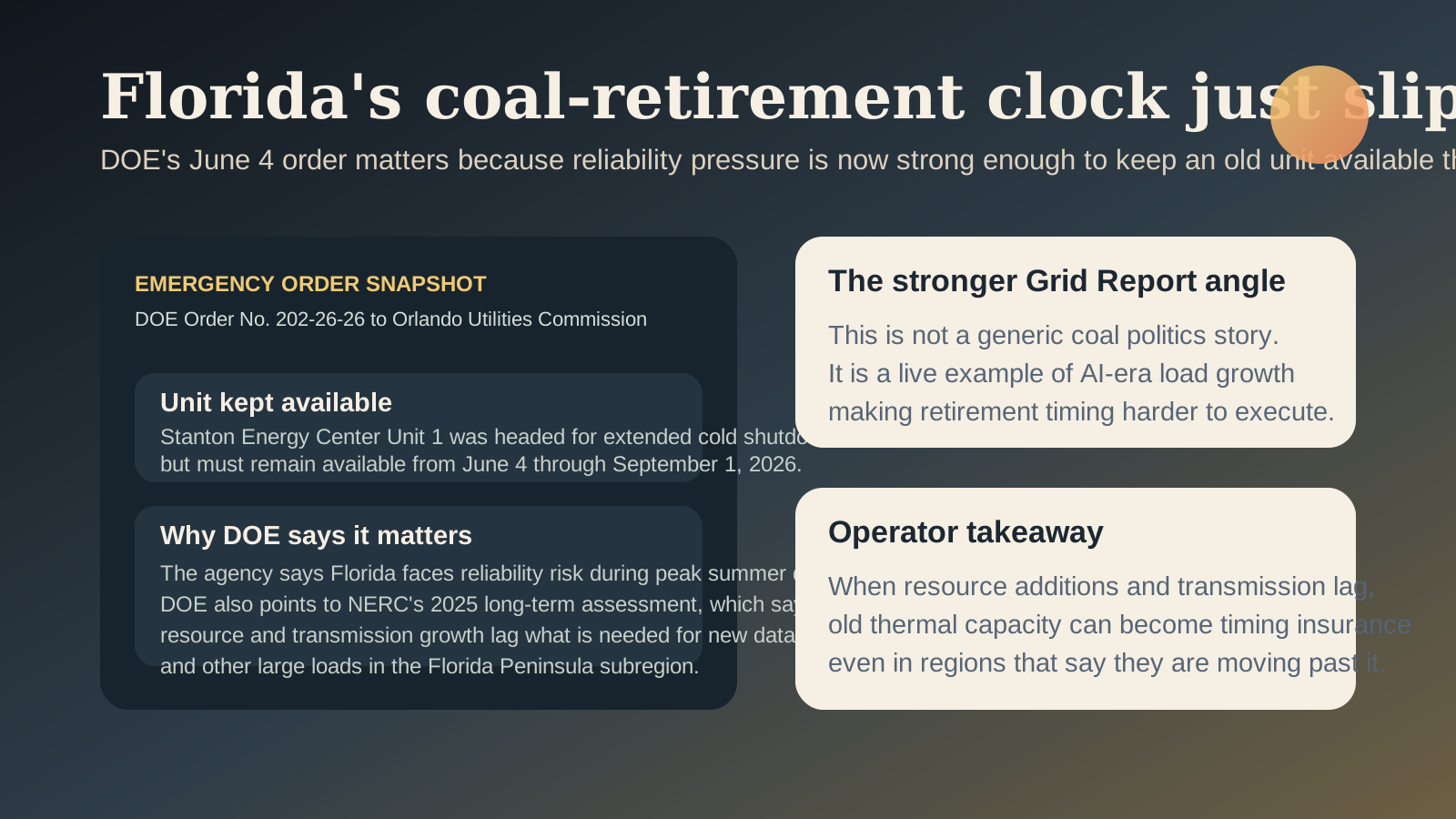
DOE’s June 4 emergency order to Orlando Utilities Commission is worth publishing because the useful signal is not simply that one coal unit stayed online. The stronger signal is that retirement timing is getting harder in places where large-load growth is running ahead of replacement capacity, transmission readiness, or both. That turns an old-plant decision into a live data-center reliability story.
The official facts are clear. DOE issued Order No. 202-26-26 under section 202(c) of the Federal Power Act directing OUC to ensure that Unit 1 at the Stanton Energy Center in Orlando remains available to operate. The order took effect on June 4, 2026 and runs through September 1, 2026. In its companion press release, DOE said the coal-fired unit had been slated to enter an extended cold shutdown in June 2026.
The useful Florida signal is not that coal won. It is that fast load growth and slow replacement capacity are starting to disrupt retirement timing.
What makes the release more useful than a normal emergency-order notice is the explicit large-load language. DOE cites NERC’s 2025 Long-Term Reliability Assessment and says that in the Florida Peninsula subregion, projections for resource and transmission growth lag what is needed to support new data centers and other large loads that are driving escalating demand forecasts. That is the part that turns the order into a real Grid Report signal rather than a generic fuel-politics headline.
This also clears the duplicate block against the site’s recent gas and backup-power stories. The June 4 diesel piece was about what future AI campuses are choosing for bridge and backup power. The Florida order is different. It is about what happens when legacy thermal capacity cannot leave on schedule because the system still needs timing insurance during a stressed growth phase.
For grid operators and developers, the practical implication is uncomfortable but straightforward. If new demand arrives faster than firm supply and transmission can be staged, the system does not get to retire old capacity on narrative alone. It may have to keep units available longer, even if those units sit awkwardly inside broader decarbonization plans or fuel-transition rhetoric.
For policymakers, the stronger read-through is that data-center growth can alter not only what gets built next, but also what fails to shut down on time. That is a different kind of infrastructure pressure. Instead of asking whether AI load justifies a new plant, a substation, or a tariff, the market is being forced to ask whether retirements were scheduled against an electricity system that no longer matches the demand outlook.
None of this means coal suddenly becomes the long-run answer for AI power. The useful interpretation is narrower. When the system is short on ready replacements, old thermal assets become a bridge whether planners like it or not. That is a timing story, not an ideological one, and it is likely to show up in more places as AI load, electrification, and reserve-margin pressure collide.
The Grid Report view is that this story is search-worthy because it answers a specific live question: why did DOE keep a Florida coal unit available in June 2026? The useful answer is that reliability pressure, including demand growth from data centers and other large loads, is now strong enough to interfere with retirement timing.
Sources
U.S. Department of Energy, “Federal Power Act Section 202(c): Orlando Utilities Commission (OUC) Order No. 202-26-26,” published June 4, 2026: https://www.energy.gov/ceser/federal-power-act-section-202c-orlando-utilities-commission-ouc-order-no-202-26-26
U.S. Department of Energy, “Energy Secretary Keeps Coal-Fired Power Generation Alive in Florida,” published June 4, 2026: https://www.energy.gov/articles/energy-secretary-keeps-coal-fired-power-generation-alive-florida
By Nawaz Lalani
The Grid Report is written by Nawaz Lalani and focuses on source-backed coverage of AI infrastructure, grid power demand, automation systems, and market signals.
Follow the signal, not just the headline.
Get the daily Grid brief for source-backed coverage on AI power demand, infrastructure timing, automation, and market signals.