- DOE’s June 4 Antares announcement is worth publishing because the useful signal is not another abstract claim that advanced nuclear will matter someday.
- The official milestone is concrete.
- The caveat matters just as much as the milestone.
- Section
- Energy
- Read time
- 5 min read
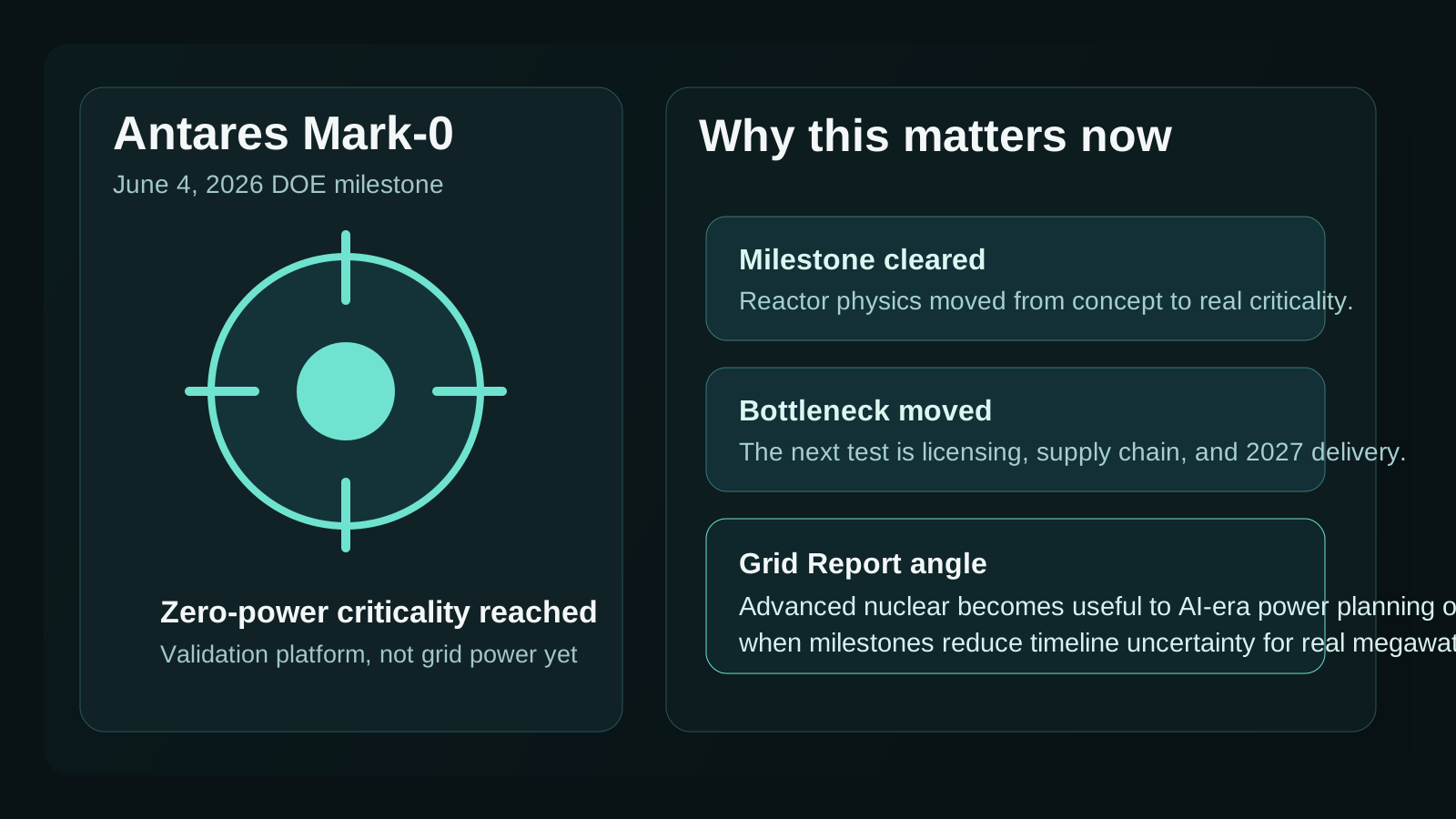
DOE’s June 4 Antares announcement is worth publishing because the useful signal is not another abstract claim that advanced nuclear will matter someday. The stronger signal is that one reactor design has now reached criticality in the real world, which moves the story from concept art into schedule credibility. That is a meaningful shift for anyone tracking future firm-power supply.
The official milestone is concrete. DOE said Antares Nuclear’s Mark-0 successfully completed a zero-power fueled criticality demonstration at Idaho National Laboratory as part of the Reactor Pilot Program. DOE also said the milestone establishes a basis that would allow subsequent reactors to produce electricity in 2027 and beyond, and described it as the first of multiple advanced reactors expected to go critical by the program’s July 4, 2026 target.
The real Antares milestone is not that advanced nuclear is finished. It is that the market can now judge one design on schedule credibility and commercialization follow-through instead of pure concept.
The caveat matters just as much as the milestone. DOE’s January 26 NEPA page says the Mark-0 configuration is a small, high-temperature heat-pipe reactor built for zero-power criticality testing and does not include power-conversion or heat-removal systems. In other words, this is not yet a megawatt-scale answer dropping onto the grid. It is a validation platform proving reactor physics and operating behavior before commercial power delivery.
That distinction is exactly why the event is useful. Advanced nuclear coverage often jumps straight from a reactor concept to implied grid impact. This milestone forces a more disciplined reading. One real bottleneck has now been cleared: the design reached criticality. The next bottlenecks are the ones that usually kill timelines anyway: licensing, supply chain repeatability, manufacturing discipline, and whether later units can convert a technical proof point into electricity on a commercially relevant schedule.
This is where the AI and data-center relevance becomes real rather than promotional. As large electrical loads push utilities, developers, and hyperscalers to look harder for firm power, the market does not just need promising technologies. It needs schedule-credible ones. A reactor milestone matters when it reduces uncertainty around when dependable megawatts could actually appear, not when it merely adds another slide to the long list of future options.
This clears the duplicate block against the site’s recent nuclear coverage because the thesis is different. The China nuclear story was about industrial build speed at national scale. The Crane waiver story was about deliverability rights and restart timing for an existing asset. This piece is about first-of-a-kind advanced-reactor credibility in the United States and whether a fast-track DOE pathway can convert a criticality milestone into real 2027-era power supply.
For operators and investors, the watch items are now clearer. Did the Mark-0 milestone materially improve Antares’ regulatory path? Do later units actually include the power-conversion systems needed for commercial output on the timeline DOE is signaling? And does the Reactor Pilot Program become a repeatable template for multiple projects, or stay a one-off acceleration lane that proves harder to scale than the announcement suggests?
The Grid Report view is that this clears the search bar because it answers a specific live question better than a generic “nuclear is back” article: what changed when Antares reached criticality? The useful answer is that advanced nuclear has moved one step closer to schedule credibility, but the market should now judge it on commercialization follow-through rather than on design ambition alone.
Sources
U.S. Department of Energy, “Department of Energy Celebrates First Advanced Reactor Criticality,” published June 4, 2026: https://www.energy.gov/articles/department-energy-celebrates-first-advanced-reactor-criticality
U.S. Department of Energy, “U.S. Department of Energy Reactor Pilot Program,” accessed June 6, 2026: https://www.energy.gov/ne/us-department-energy-reactor-pilot-program
U.S. Department of Energy Office of NEPA Policy and Compliance, “CX-035340: Antares R1 Mark-0 Reactor Experiment,” published January 26, 2026: https://www.energy.gov/nepa/articles/cx-035340-antares-r1-mark-0-reactor-experiment
By Nawaz Lalani
The Grid Report is written by Nawaz Lalani and focuses on source-backed coverage of AI infrastructure, grid power demand, automation systems, and market signals.
Follow the signal, not just the headline.
Get the daily Grid brief for source-backed coverage on AI power demand, infrastructure timing, automation, and market signals.