- FERC’s May 21 blanket-certificate overhaul is worth publishing because the useful signal is not simply that federal regulators want more gas infrastructure.
- The proposal is specific.
- That matters because this is not really a story about greenlighting giant new interstate pipelines overnight.
- Section
- Policy
- Read time
- 5 min read
FERC’s May 21 blanket-certificate overhaul is worth publishing because the useful signal is not simply that federal regulators want more gas infrastructure. The stronger signal is that the regulatory system is trying to make smaller gas projects move faster at exactly the moment AI-related load growth is pushing utilities, developers, and private-power operators to look for any bottleneck that sits between announced capacity and actual energization.
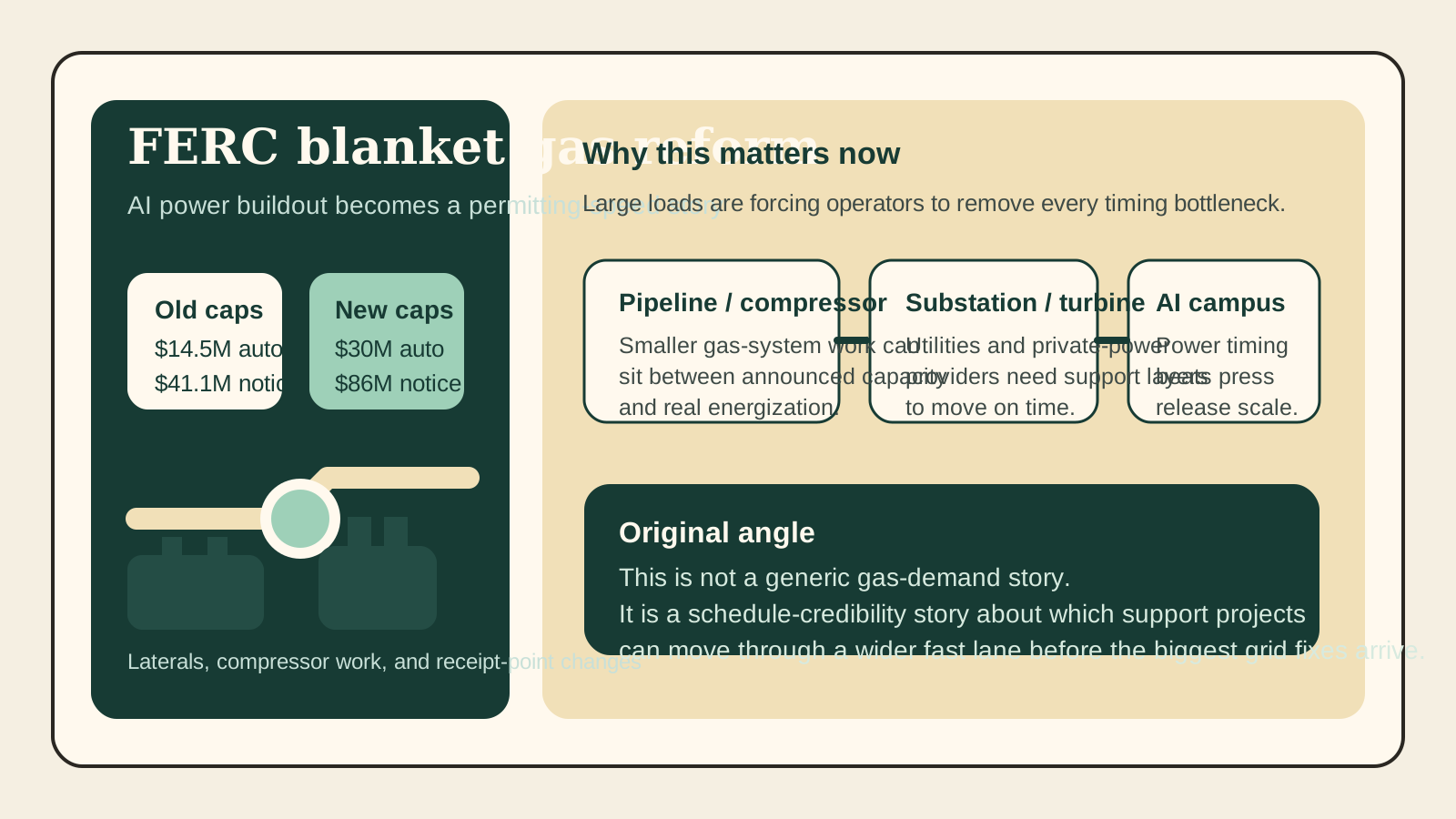
The proposal is specific. In its May 21 presentation, FERC said the Notice of Proposed Rulemaking would expand the scope of projects that natural gas companies may complete without a case-specific authorization under section 7 of the Natural Gas Act. The same presentation says FERC proposes to increase the automatic authorization cost limit from $14.5 million to $30 million, the prior-notice cost limit from $41.1 million to $86 million, and the annual cost limit for certain storage-related facilities from $7.9 million to $17 million. It also proposes a two-year in-service deadline instead of one year, use of the Handy-Whitman Index for annual adjustments, and several project-specific changes around compressor stations, receipt points, and abandonment rules.
FERC’s gas reform matters because AI power timelines can turn on whether smaller enabling pipeline and compressor projects stay stuck in slow review or move through a wider fast lane.
That matters because this is not really a story about greenlighting giant new interstate pipelines overnight. It is a story about moving a wider band of routine and medium-sized gas-system work into a faster regulatory lane. FERC’s release says the proposal would significantly broaden the types and sizes of projects that interstate natural gas pipelines can build without case-by-case approval, while a companion action extends temporary cost-limit waivers to May 31, 2028. For operators, that is a timing signal. The gas system changes most likely to matter for near-term reliability or data-center support may be the ones that were previously too large for the old blanket caps but too small to justify slow bespoke treatment.
This is where the AI and large-load relevance becomes real. The site has already covered diesel giving way to gas in AI-scale data centers and EIA’s view that stronger data-center demand shows up more clearly in 2027 gas burn than in 2026. FERC’s reform sits one layer earlier in that chain. If developers, utilities, or generation partners want to add or reinforce the gas infrastructure that supports turbines, peakers, reciprocating engines, or other thermal backup around large new loads, the permitting clock for smaller associated work matters more than another generic fuel-demand forecast.
FERC’s own summer reliability framing reinforces that read. In its May 21 Summer Energy Market and Electric Reliability Assessment, the commission said significant and concentrated growth of large, energy-intensive loads such as data centers and industrial facilities poses risks of sudden load loss, voltage instability, and cascading outages in parts of ERCOT. That does not mean gas is the universal answer. It does mean the physical support systems around large-load reliability are moving higher on the regulatory agenda, and gas infrastructure is one of those support layers in several markets.
The important nuance is that this proposal does not eliminate review. FERC is still asking for comment on the analysis supporting higher cost limits, protest procedures, environmental information for compressor-station expansions, and whether some mainline expansions should qualify for automatic authorization. It also proposes tougher disclosure around the purpose and beneficiaries of blanket projects and wider landowner notification requirements. So the real shift is not “anything goes.” It is a re-ranking of what FERC now considers routine enough to move faster.
This clears the duplicate block against the site’s recent coverage because the thesis is different. The EIA gas-for-power story was about when data-center demand starts showing up more clearly in gas burn. The diesel-replacement story was about how the backup stack is changing inside campuses. The FERC summer assessment was about reserve margins and operating stress. This article is about the permitting layer that can decide whether supporting gas infrastructure arrives in time to matter.
For operators, the practical takeaway is that AI power readiness is increasingly shaped by second-order infrastructure: laterals, compressor work, receipt and delivery modifications, and the regulatory lane those projects fall into. For investors and policymakers, the takeaway is that gas exposure is no longer just a commodity call. It is also a permitting-speed call. If smaller enabling projects can move faster, some AI-related power buildouts become more financeable and more schedule-credible even before the biggest grid bottlenecks are solved.
The Grid Report view is that this clears the search bar because it answers a useful question better than a generic FERC recap: what changed in the gas stack that could actually move AI-era power timelines? The useful answer is that FERC is trying to widen the fast lane for smaller gas infrastructure, which makes permitting speed part of the deployment math for large electrical loads.
Sources
Federal Energy Regulatory Commission, “FERC Unleashes Natural Gas Permit Reforms, Accelerating Infrastructure Upgrades for Affordable, Reliable Energy Nationwide,” published May 21, 2026: https://www.ferc.gov/news-events/news/ferc-unleashes-natural-gas-permit-reforms-accelerating-infrastructure-upgrades
Federal Energy Regulatory Commission, “Presentation | C-1: Revisions to the Blanket Certificate Program,” published May 21, 2026: https://www.ferc.gov/news-events/news/presentation-c-1-revisions-blanket-certificate-program
Federal Energy Regulatory Commission and U.S. Department of Energy, “2026 Summer Energy Market and Electric Reliability Assessment,” published May 21, 2026: https://www.ferc.gov/sites/default/files/2026-05/26_Summer%20Assessment_0521.pdf
By Nawaz Lalani
The Grid Report is written by Nawaz Lalani and focuses on source-backed coverage of AI infrastructure, grid power demand, automation systems, and market signals.
Follow the signal, not just the headline.
Get the daily Grid brief for source-backed coverage on AI power demand, infrastructure timing, automation, and market signals.