- New York’s June 5 data-center moratorium bill is worth publishing because the useful signal is not that another politician issued a skeptical press release.
- The official facts are specific.
- What makes the bill more important than a symbolic pause is everything attached to it.
- Section
- Policy
- Read time
- 5 min read
New York’s June 5 data-center moratorium bill is worth publishing because the useful signal is not that another politician issued a skeptical press release. The stronger signal is that a major load-growth state is trying to redesign the policy envelope around hyperscale AI infrastructure before the next permitting wave lands. Once a state starts talking about moratoriums, dedicated rate classes, environmental review, and host-community benefits in the same bill, the story is no longer just whether utilities can serve the load. It is whether the state wants a different bargain before approving it.
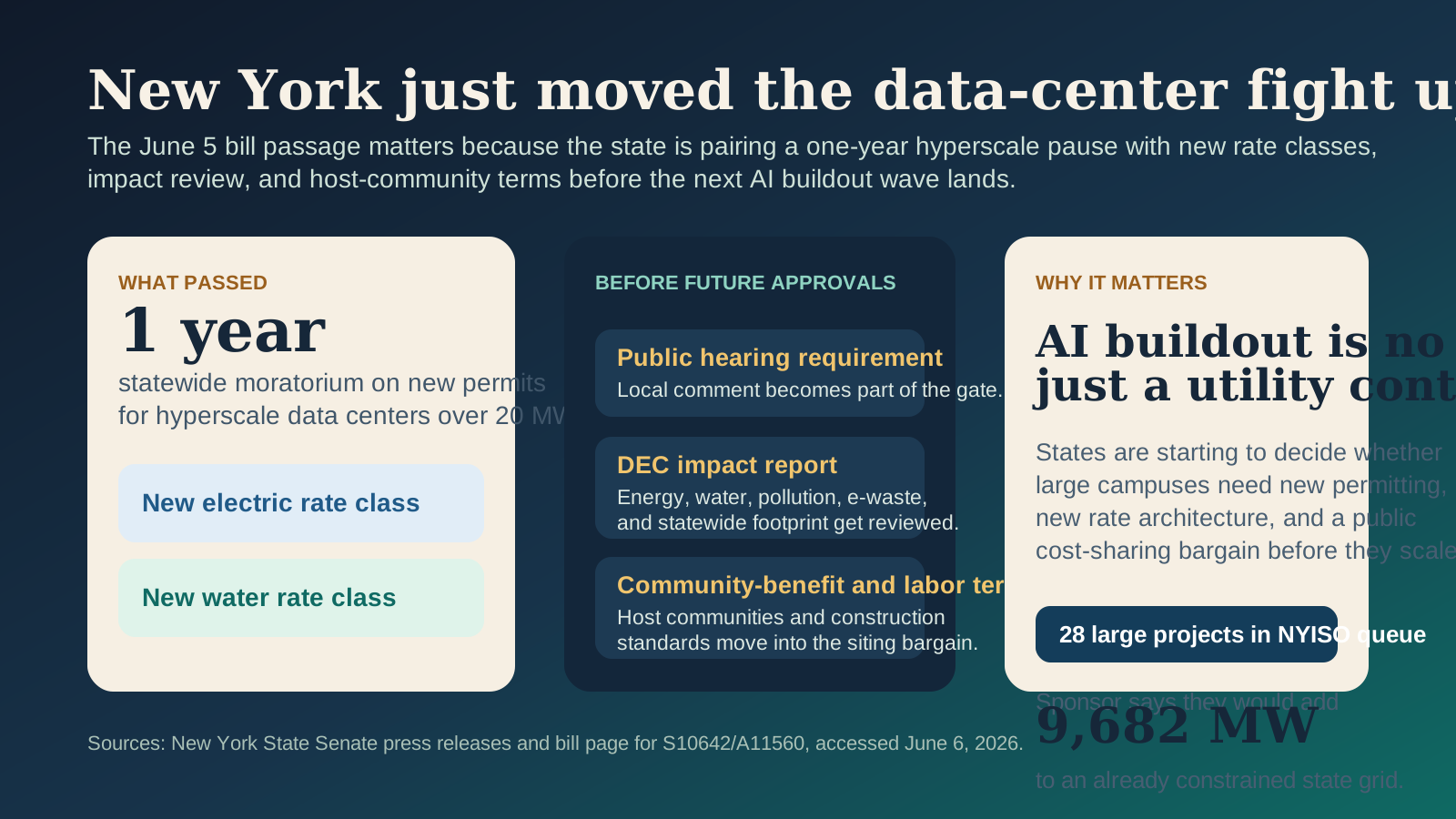
The official facts are specific. State Senator Kristen Gonzalez said on June 5 that the Responsible Data Center Development Act passed both the Senate and Assembly on June 4. The Senate bill page shows S10642 moving through the Assembly vehicle A11560 and recording a June 4 Senate floor vote. If signed, the measure would impose a one-year statewide moratorium on new permits for hyperscale data centers with peak load above 20 megawatts.
New York is no longer treating hyperscale AI campuses as an ordinary utility-service question. It is trying to redesign the permit and rate architecture before more projects land.
What makes the bill more important than a symbolic pause is everything attached to it. The Senate press materials say the legislation would require a public hearing before future permit approvals, direct the Department of Environmental Conservation to produce a statewide impact report on data centers, create new electric and water rate classes for facilities above 20 megawatts, establish efficiency goals for data centers above 5 megawatts, and require host-community benefits plus labor standards. That is not a narrow environmental protest. It is an attempt to build an entire approval framework around large computational loads.
This clears the duplicate block against the site’s recent policy coverage because the thesis is different. The PPL, Oregon, and FERC pieces were about tariffs, interconnection timing, market rules, and cost causation after projects enter the system. New York is moving one layer earlier. The state is asking whether hyperscale campuses should even keep getting permits under the existing structure while regulators, communities, and lawmakers decide what the right contract should be.
That distinction matters for operators and developers. A utility tariff can change the economics of a project that still has a path to service. A permitting moratorium changes the project pipeline itself. It can freeze land strategy, delay utility negotiations, complicate equipment planning, and push developers to re-rank states by political durability rather than only by tax incentives or power access. In practice, that means AI infrastructure siting is becoming a regulatory-risk trade as much as an interconnection trade.
The sponsor is also framing the bill around scale. Her June 5 release said there are 28 large data centers in the New York ISO queue that would add an estimated 9,682 megawatts to an already constrained grid. That figure is advocacy context, not an official NYISO planning order, but it helps explain why the policy response is now moving beyond case-by-case rate treatment. Once lawmakers believe a queue has become a statewide affordability, water, and permitting problem, they start trying to rewrite the rulebook instead of simply litigating individual projects.
For investors and infrastructure operators, the stronger implication is that the next bottleneck may not be power alone. It may be state permission architecture. A state that creates special electric and water rate classes, requires community-benefit payments, and pauses new permits is effectively saying that hyperscale AI campuses are no longer ordinary commercial development. They are becoming a governed infrastructure category with their own approval stack.
The Grid Report view is that this clears the search bar because it answers a specific and timely question: is data-center policy shifting from utility economics into statewide permitting restraint? In New York, the answer now looks like yes. If signed, S10642 and A11560 would make one of the clearest cases yet that the AI buildout is becoming a permit, rate-class, and public-bargain story before it becomes a construction story.
Sources
New York State Senate, “NY State Senator Kristen Gonzalez Passes Data Center Moratorium, First in the Nation If Signed,” published June 5, 2026: https://www.nysenate.gov/newsroom/press-releases/2026/kristen-gonzalez/ny-state-senator-kristen-gonzalez-passes-data-center
New York State Senate, Senate Bill S10642, accessed June 6, 2026: https://www.nysenate.gov/legislation/bills/2025/S10642
By Nawaz Lalani
The Grid Report is written by Nawaz Lalani and focuses on source-backed coverage of AI infrastructure, grid power demand, automation systems, and market signals.
Follow the signal, not just the headline.
Get the daily Grid brief for source-backed coverage on AI power demand, infrastructure timing, automation, and market signals.