- OpenAI’s June 11 agreement to acquire Ona is worth publishing because the useful signal is not that another AI company bought a startup.
- The primary-source facts are specific.
- That makes this a stronger Grid Report article than a generic acquisition rewrite.
- Section
- AI
- Read time
- 4 min read
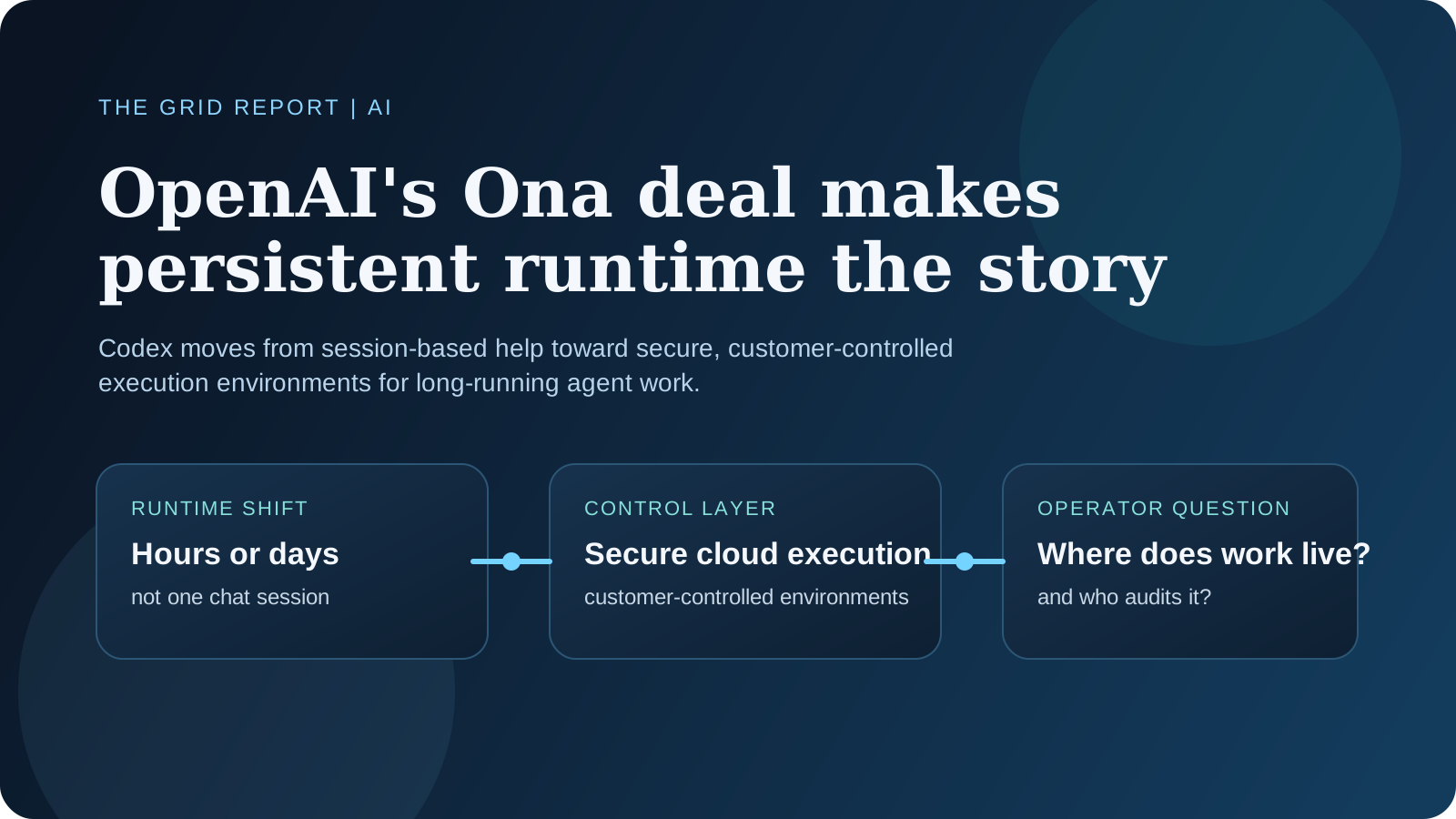
OpenAI’s June 11 agreement to acquire Ona is worth publishing because the useful signal is not that another AI company bought a startup. The stronger signal is that Codex is being pushed beyond the short-session assistant model and toward a persistent execution layer. OpenAI is explicitly saying that more valuable agent work now unfolds over hours or days, not minutes, and that users should be able to delegate that work without keeping it attached to the machine where it started.
The primary-source facts are specific. OpenAI said the Ona deal brings secure cloud execution and orchestration technology into the Codex ecosystem, expanding Codex with secure, customer-controlled cloud infrastructure for long-running agents across software and knowledge work. OpenAI also said more than 5 million people now use Codex each week, up 400% from earlier this year, and described the product’s trajectory as moving from developer tooling into broader research, analysis, building, and automation work.
The agent bottleneck is shifting from model output to runtime continuity: where delegated work lives, how long it can run, and who controls the environment while it does.
That makes this a stronger Grid Report article than a generic acquisition rewrite. The interesting change is architectural. The product problem is shifting from “can the model complete a task?” toward “where does the work live while it runs, who controls that environment, and how does it stay governed after the first prompt?” Ona matters because it points to a future where agent usefulness depends less on a clever interface and more on whether the system can keep state, maintain access, run securely, and survive beyond a single interactive session.
This clears the duplicate block against the site’s recent Codex, deployment, and data-locality stories because the thesis is different. The Codex knowledge-work report was about parallel operations leverage. The Deployment Company story was about forward-deployed implementation capacity. The Dell partnership was about bringing enterprise context closer to Codex through on-prem and hybrid data layers. Ona is different because it addresses the runtime substrate itself: persistent execution, orchestration, and customer control for long-running work.
For operators, the implication is straightforward. As agents move into code review, analytics, research, and multi-step internal work, the weak point becomes execution continuity. Teams need environments where tasks can run, pause, resume, be inspected, and be governed without becoming brittle or disappearing when a local session ends. That is a production-systems requirement, not just a model-quality requirement.
For buyers and investors, the stronger read-through is that enterprise agent competition is moving into infrastructure semantics. The winning platform may not simply be the one with the best reasoning benchmark. It may be the one that gives enterprises the cleanest answer to a harder question: where does delegated work run, how is it secured, and how can it be audited when the task lasts longer than the human who started it expected?
The search case is strong because the article answers a live and specific question better than a commodity M&A recap: why did OpenAI buy Ona, and what changes for Codex? Readers searching for OpenAI Ona acquisition, what Ona does, Codex long-running agents, or secure cloud execution for AI agents get a concrete product and infrastructure thesis instead of a vague expansion narrative.
Sources
OpenAI, “OpenAI to acquire Ona,” published June 11, 2026: https://openai.com/index/openai-to-acquire-ona/
OpenAI, “OpenAI launches the Deployment Company to help businesses build around intelligence,” published May 31, 2026: https://openai.com/index/openai-launches-the-deployment-company/
OpenAI, “OpenAI and Dell Technologies partner to bring Codex to hybrid and on-prem environments,” published May 29, 2026: https://openai.com/index/dell-codex-enterprise-partnership/
By Nawaz Lalani
The Grid Report is written by Nawaz Lalani and focuses on source-backed coverage of AI infrastructure, grid power demand, automation systems, and market signals.
Follow the signal, not just the headline.
Get the daily Grid brief for source-backed coverage on AI power demand, infrastructure timing, automation, and market signals.