- OpenAI’s June 2 Codex report is worth publishing because the useful signal is not that AI can help people work faster.
- The specifics make the story real enough to clear the bar.
- The original Grid Report angle is that AI automation is becoming a parallel-operations system.
- Section
- AI Automation
- Read time
- 5 min read
- Data included
- What changed in Codex usage on June 2
What changed in Codex usage on June 2
The strongest signal is not that Codex has grown. It is that knowledge-work use cases are becoming visible enough for OpenAI to break them out as a category.
OpenAI’s disclosed adoption signals
| Signal | OpenAI says | Why it matters |
|---|---|---|
| User scale | Codex has more than 5 million weekly active users | The product is large enough that changes in who uses it start to matter strategically. |
| Category mix | Knowledge workers represent about 20% of users | The tool is no longer confined to software engineering use cases. |
| Task expansion | Reports, spreadsheets, contracts, research, and data analysis are growing uses | Codex is moving from code generation into broader business-output production. |
| Interaction model | Users increasingly run multiple tasks in parallel | The product starts to look more like a managed operations queue than a single-chat assistant. |
Source: OpenAI’s June 2, 2026 Codex knowledge-work post and the supporting report it links.
OpenAI’s June 2 Codex report is worth publishing because the useful signal is not that AI can help people work faster. That claim is too broad to matter. The stronger signal is narrower and more operational: Codex is no longer being framed only as a coding tool. OpenAI says knowledge workers are increasingly using it to create reports, spreadsheets, presentations, contracts, and other work products, while also using it for research, data analysis, workflow automation, and lightweight tool-building that previously required engineering help.
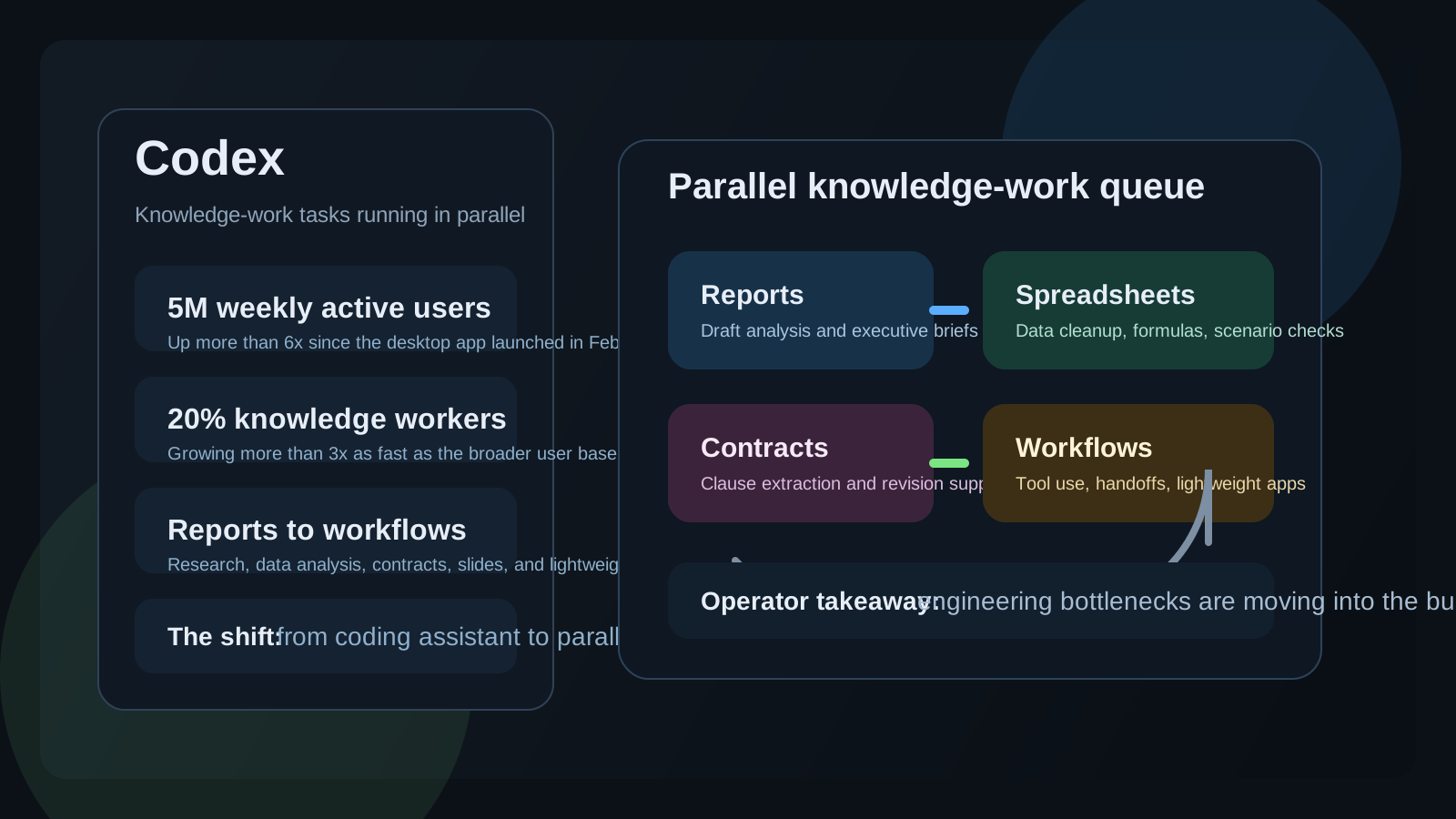
The specifics make the story real enough to clear the bar. OpenAI says Codex now has more than 5 million weekly active users, up more than 6x since the desktop app launched in February 2026. Developers remain the largest cohort, but OpenAI says knowledge workers now make up about 20 percent of users and are growing more than three times as fast. That is the publishable change. The tool is escaping its original user category.
The useful shift is not that Codex got bigger. It is that a coding agent is becoming a parallel work engine for non-engineering business tasks.
The original Grid Report angle is that AI automation is becoming a parallel-operations system. OpenAI says the fastest-growing knowledge-worker tasks are data analysis, research, and knowledge-artifact creation. It also says users are increasingly running multiple Codex tasks in parallel. That matters more than the headline user count because it suggests the tool is starting to function like a managed work queue. A user can investigate data, draft materials, and automate follow-up work at the same time instead of treating AI as a one-step chatbot.
That change has operator consequences. Many internal business tasks stall not because they are strategically difficult, but because they sit in queues waiting for analysis, formatting, spreadsheet cleanup, contract review support, or a simple internal utility that nobody wants to escalate to engineering. If Codex can reliably absorb more of that workload, then one of the real bottlenecks in knowledge work shifts. The constraint becomes less “can we get technical help for this?” and more “do we have a clear operating process, review standard, and owner for the output?”
This is what makes the story materially different from the site’s recent systems coverage. The Braintrust article was about coding agents collapsing customer feedback into preview branches. The OpenAI Deployment Company piece was about frontier labs moving upstream into enterprise workflow redesign services. The one-person research desk article was about a solo operator stack. This Codex report is different. It is about category expansion: a coding agent becoming a broader execution layer for business operators who are not primarily software engineers.
It also clears the duplicate block against the site’s older workspace-agent and user-control pieces. Those stories focused on governance and product design for shared agents. OpenAI’s June 2 report is narrower and more search-worthy. It answers a concrete live question: what are knowledge workers actually using Codex for now, and what changed in the user mix? That makes it more useful than a generic “AI changes work” rewrite.
There is still a caveat worth stating plainly. The report is OpenAI’s own account of Codex adoption, so the numbers should be read as product-company claims rather than independent market measurement. But even with that limitation, the operational direction is clear enough to matter. If reports, spreadsheets, contracts, and workflow automation are becoming normal Codex use cases, then the boundary between coding agents and general business execution is getting weaker fast.
For search performance, the article is strong because it serves specific intent instead of broad AI commentary. Readers searching for OpenAI Codex knowledge work, Codex weekly active users, whether non-developers are using Codex, or what tasks Codex now handles get a direct answer and a sharper operating thesis.
Sources
OpenAI, “Codex is becoming a productivity tool for everyone,” published June 2, 2026: https://openai.com/index/codex-for-knowledge-work/
OpenAI, “The Next Era of Knowledge Work,” linked by OpenAI on June 2, 2026 as the supporting report for Codex usage trends: https://cdn.openai.com/pdf/the-next-era-of-knowledge-work.pdf
OpenAI, “How Braintrust turns customer requests into code with Codex,” published May 29, 2026: https://openai.com/index/braintrust/
By Nawaz Lalani
The Grid Report is written by Nawaz Lalani and focuses on source-backed coverage of AI infrastructure, grid power demand, automation systems, and market signals.
Follow the signal, not just the headline.
Get the daily Grid brief for source-backed coverage on AI power demand, infrastructure timing, automation, and market signals.