- OpenAI’s May 11 launch of the OpenAI Deployment Company is worth publishing because the useful signal is not simply that OpenAI wants more enterprise revenue.
- The core facts in OpenAI’s announcement are unusually specific.
- That is what makes the story more useful than a generic “enterprise AI adoption” recap.
- Section
- AI Automation
- Read time
- 6 min read
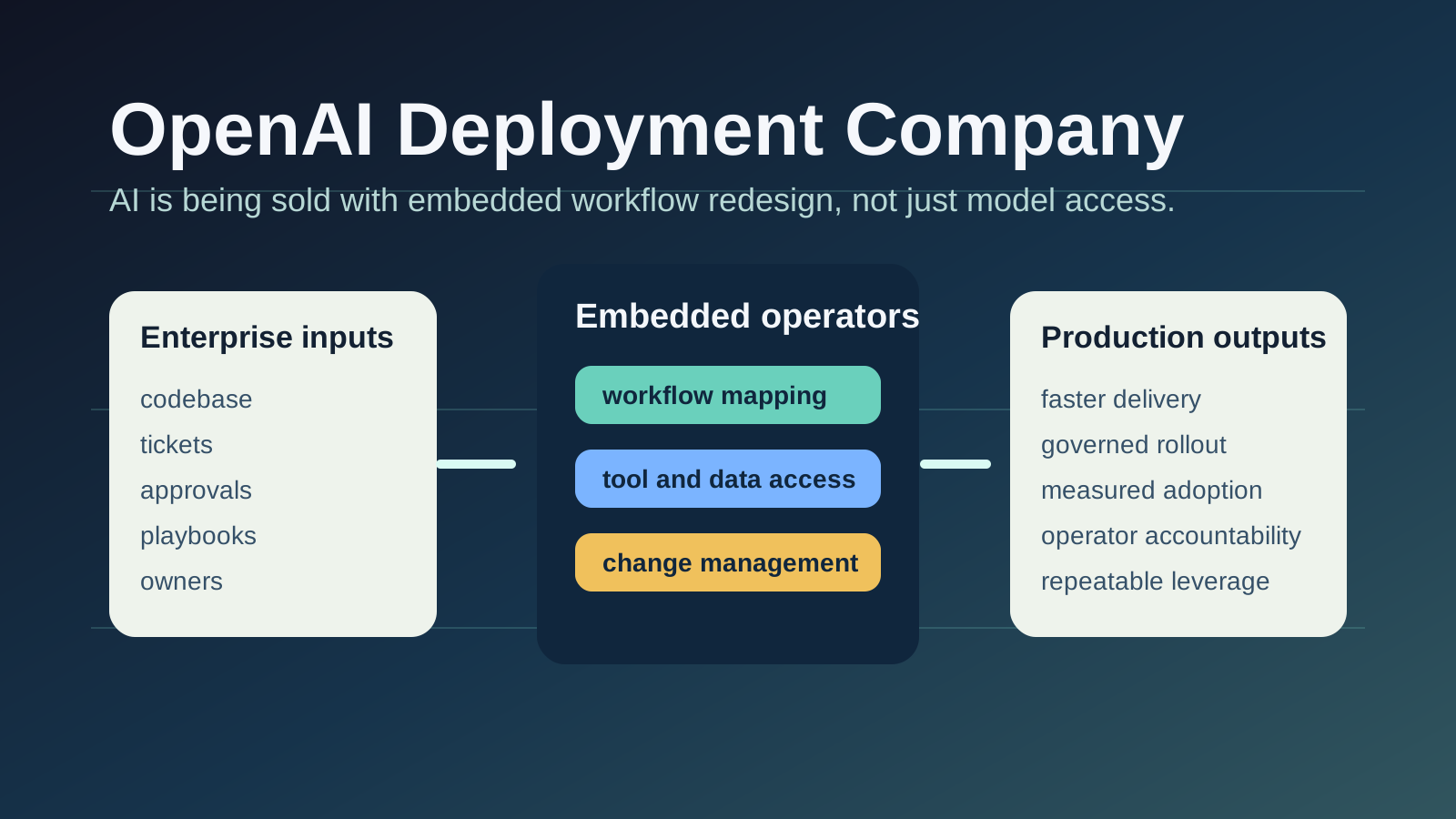
OpenAI’s May 11 launch of the OpenAI Deployment Company is worth publishing because the useful signal is not simply that OpenAI wants more enterprise revenue. The stronger signal is structural. Frontier model vendors are starting to build an embedded services layer that sits inside the customer’s operating model and helps redesign workflows around AI systems that can reason, act, and connect to real tools.
The core facts in OpenAI’s announcement are unusually specific. OpenAI says the Deployment Company will embed Forward Deployed Engineers, or FDEs, inside organizations working on complex problems, and that those teams will work with business leaders, operators, and frontline staff to identify high-value workflows, redesign them, and turn those changes into durable production systems. OpenAI also says it has agreed to acquire Tomoro, an applied AI consulting and engineering firm, bringing about 150 experienced FDEs and deployment specialists into the business from day one.
The next enterprise AI control point may not be the model alone. It may be the team that rewires the workflow around it.
That is what makes the story more useful than a generic “enterprise AI adoption” recap. OpenAI is not describing a customer-success team with better branding. It is describing a direct workflow-rewiring business. The published engagement model starts with a diagnostic, narrows to a small set of priority workflows, then connects OpenAI models to the customer’s data, tools, controls, and business processes so the system can operate reliably in day-to-day work. That is much closer to systems integration and operating redesign than to ordinary software onboarding.
The original Grid Report angle is that deployment is becoming a control point in the enterprise AI stack. For the last year, the market has spent most of its time arguing about model quality, seat expansion, and whether coding or agent products can save labor. OpenAI’s move suggests the next competitive layer is the team that gets inside the workflow, decides where model calls actually belong, and hardens the surrounding control plane enough that the deployment survives contact with reality.
The capital structure reinforces that read. OpenAI says the Deployment Company is majority-owned and controlled by OpenAI, launches with more than $4 billion of initial investment, and includes a partner base spanning TPG, Advent, Bain Capital, Brookfield, Goldman Sachs, SoftBank Corp., Bain & Company, Capgemini, and McKinsey. That is not how a company funds a sidecar consulting experiment. It is how it builds a scaled deployment channel that can move through portfolio companies, operating transformations, and system-integration pipelines quickly.
This clears the site’s duplicate block. It is not the same thesis as the OpenAI and Dell data-locality article, which was about where coding agents run and how enterprises keep sensitive development work closer to internal systems. It is not the same as the Anthropic containment story, which focused on blast-radius design for agent safety. And it is not the same as Broadridge’s production-systems article, which was about one operator shipping agentic automation inside regulated finance. This story is about the business model around deployment itself.
For operators, the lesson is practical. If model vendors are moving upstream into workflow selection, integration design, and change management, enterprise buyers need to ask harder questions about ownership. Who defines the target workflow, who controls the connectors and governance model, who owns the resulting playbook, and how hard is it to swap vendors later? The deployment layer can create leverage, but it can also become a lock-in layer.
For investors, the read-through is that enterprise AI may support a bigger services-and-transformation revenue pool than a pure API narrative implies. If the durable value sits in redesigning critical processes around frontier models, then the companies that control deployment patterns may capture more of the economic stack than those selling access alone.
The reason to publish this now is that it is specific, search-worthy, and materially more useful than a soft trend piece about “AI adoption.” OpenAI has effectively admitted that model capability is not enough. The next stage of enterprise AI is a workflow-redesign business.
Sources
OpenAI, “OpenAI launches the OpenAI Deployment Company to help businesses build around intelligence,” published May 11, 2026: https://openai.com/index/openai-launches-the-deployment-company/
OpenAI, “OpenAI and Dell Technologies partner to bring Codex to hybrid and on-premises enterprise environments,” published May 18, 2026: https://openai.com/index/openai-and-dell-technologies-partner-to-bring-codex-to-hybrid-and-on-premises-enterprise-environments/
By Nawaz Lalani
The Grid Report is written by Nawaz Lalani and focuses on source-backed coverage of AI infrastructure, grid power demand, automation systems, and market signals.
Follow the signal, not just the headline.
Get the daily Grid brief for source-backed coverage on AI power demand, infrastructure timing, automation, and market signals.