- OpenAI’s Economic Research Exchange is worth publishing because the useful signal is not simply that another frontier lab wants to sponsor outside research.
- That matters because the AI labor debate is still full of claims that outrun the measurement stack.
- The June 8 announcement and request for proposals make the structure unusually concrete.
- Section
- AI
- Read time
- 5 min read
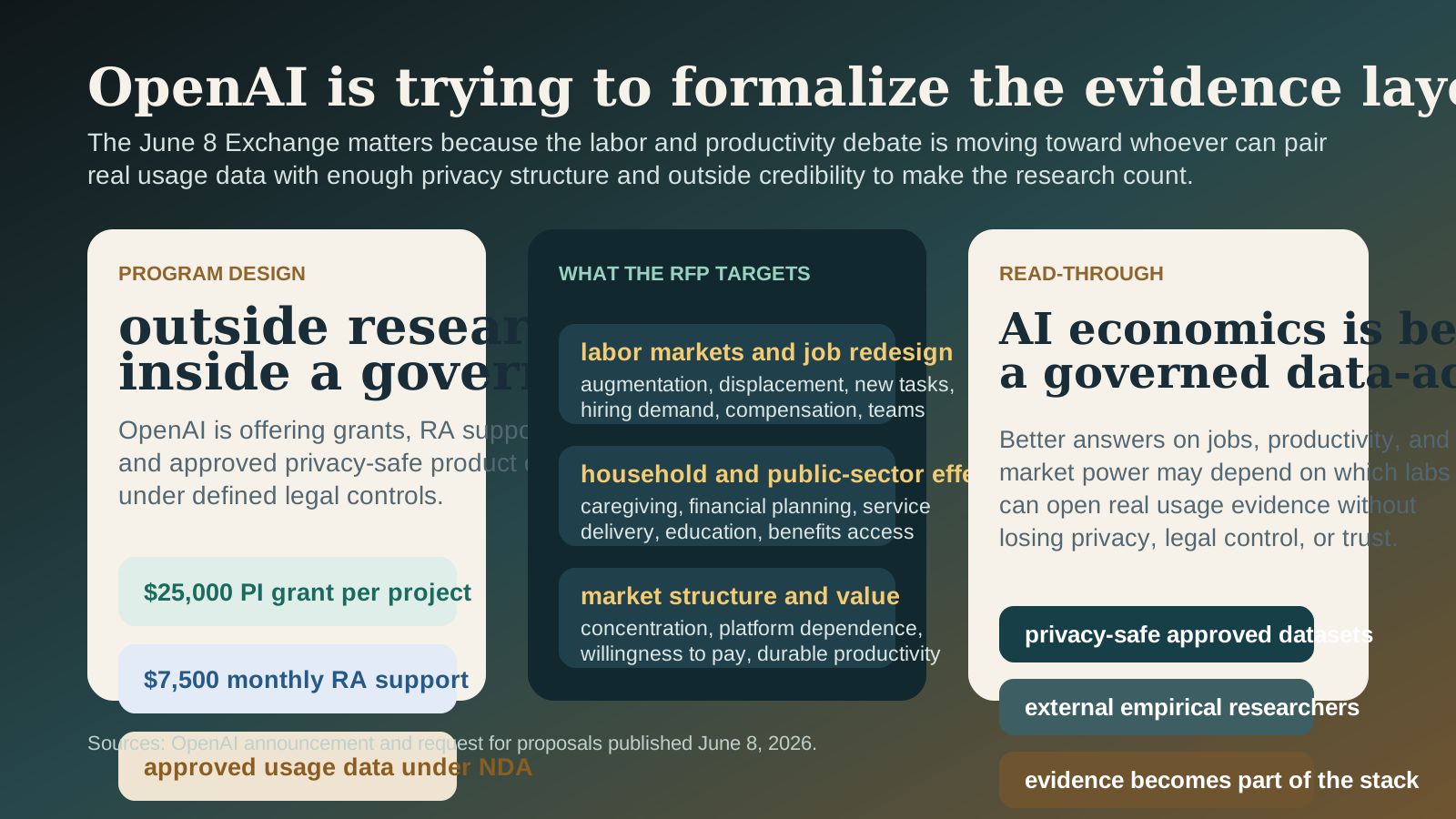
OpenAI’s Economic Research Exchange is worth publishing because the useful signal is not simply that another frontier lab wants to sponsor outside research. The stronger signal is structural. OpenAI is formalizing a model where selected researchers get grants, RA support, and privacy-safe access to approved product and usage data so they can study how AI is affecting workers, firms, households, public institutions, and market structure with something closer to real operating evidence.
That matters because the AI labor debate is still full of claims that outrun the measurement stack. People talk about exposure, disruption, augmentation, and productivity gains, but a lot of the evidence still depends on surveys, narrow pilots, public anecdotes, or datasets that cannot directly observe how frontier tools are actually being used. OpenAI is now saying that one part of the answer is a governed research channel where external economists can work with approved usage data under privacy, legal, and security constraints.
The useful OpenAI signal is not one more research grant program. It is that the battle over AI’s economic effects is shifting toward who can provide governed access to real usage data.
The June 8 announcement and request for proposals make the structure unusually concrete. OpenAI says selected projects will receive a $25,000 one-time research grant, $7,500 per month for RA or contractor support, and access to approved privacy-safe product and usage data under NDA. The RFP also lays out specific target questions around labor-market effects, employer behavior, household welfare, education, unequal access, small businesses, public-sector productivity, innovation, market structure, and how to measure AI’s economic value.
The original Grid Report angle is that this turns evidence infrastructure into part of the AI stack. The site’s recent OpenAI coverage has already touched frontier governance, enterprise deployment, public-market optionality, and Codex as a knowledge-work tool. This story clears the duplicate block because it is about the measurement layer underneath those debates. If the best evidence on AI’s economic effects increasingly depends on access to governed product data, then the institutions that control that access gain soft power over how the market, regulators, and the public understand the technology.
For policymakers, that cuts both ways. The upside is that better data can move the conversation beyond broad “AI will change everything” narratives toward sharper questions about job redesign, wage effects, time savings, task substitution, public-service delivery, and who is not benefiting. The harder part is that the strongest empirical work may increasingly depend on cooperation from the platforms generating the usage trails in the first place. That makes research independence, reproducibility, and data-governance design more important, not less.
For operators and investors, the read-through is that AI adoption is entering an evidence competition. Companies will not only market models and copilots. They will also want credible proof that the systems improve output, reduce costs, change team design, or widen access in measurable ways. The firms that can support outside measurement without blowing up privacy or legal risk may end up shaping the next round of enterprise and policy trust.
The Grid Report view is that this clears the search bar because it answers a more useful question than “OpenAI launches a research program.” The useful answer is that the economic argument over AI is becoming a governed data-access battle, where the strongest evidence will come from whoever can pair real usage signals with enough privacy structure and outside credibility to make the results count.
Sources
OpenAI, “Introducing the OpenAI Economic Research Exchange,” published June 8, 2026: https://openai.com/index/economic-research-exchange/
OpenAI, “OpenAI Economic Research Exchange: Request for proposals,” published June 8, 2026: https://openai.com/index/economic-research-exchange-request-for-proposals/
By Nawaz Lalani
The Grid Report is written by Nawaz Lalani and focuses on source-backed coverage of AI infrastructure, grid power demand, automation systems, and market signals.
Follow the signal, not just the headline.
Get the daily Grid brief for source-backed coverage on AI power demand, infrastructure timing, automation, and market signals.