- OpenAI’s June 3 frontier-governance blueprint is worth publishing because the useful signal is not merely that another major lab says government should get involved.
- The official outline is unusually specific.
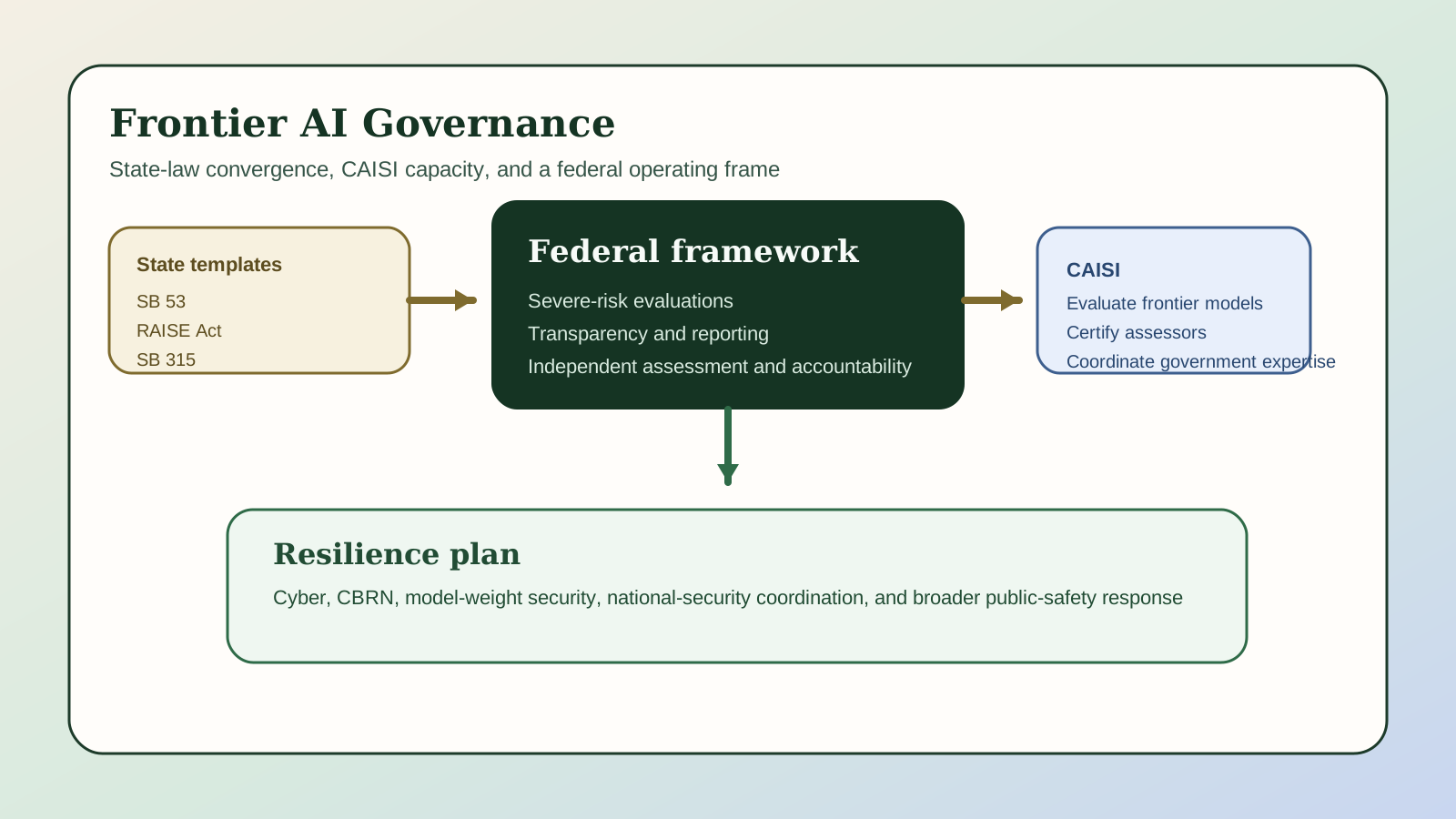
- The most useful term in the blueprint is “reverse federalism.” OpenAI argues that California’s SB 53, New York’s RAISE Act, and Illinois’s SB 315 have already done some of the early design work by surfacing common elements around severe-risk evaluations, transparency, independent assessment, incident reporting, weight security, whistleblower protection, and meaningful accountability.
- Section
- Policy
- Read time
- 5 min read
- Why this page exists
- The Grid Report publishes operator-grade coverage on AI, power, infrastructure, automation, and markets.
OpenAI’s June 3 frontier-governance blueprint is worth publishing because the useful signal is not merely that another major lab says government should get involved. The stronger signal is that one of the most important frontier developers is sketching a concrete institutional design for what comes next: use state frontier-safety laws as the starting template, convert that convergence into federal law, preempt overlapping state rules in the core safety domain, and build a better technical state apparatus before capability growth makes today’s patchwork untenable.
The official outline is unusually specific. OpenAI says a durable federal framework should do three things: build a national regime from the emerging consensus reflected in state frontier-safety laws, strengthen CAISI as the federal government’s primary institution for frontier AI safety, and mobilize a wider resilience plan across government for national-security and public-safety risks. That is a very different message from vague “AI should be regulated” rhetoric. It is a proposal for who writes the rules, who measures compliance, and which institution becomes the technical nerve center.
OpenAI’s blueprint matters because the frontier-AI debate is shifting from vague safety rhetoric to who gets the evaluation mandate, who preempts whom, and whether the federal government can build real technical capacity in time.
The most useful term in the blueprint is “reverse federalism.” OpenAI argues that California’s SB 53, New York’s RAISE Act, and Illinois’s SB 315 have already done some of the early design work by surfacing common elements around severe-risk evaluations, transparency, independent assessment, incident reporting, weight security, whistleblower protection, and meaningful accountability. The company’s position is that Congress should now absorb that emerging consensus into one national framework rather than leaving labs to navigate a growing stack of overlapping state obligations.
That matters because the blueprint also says the federal government should eventually preempt state laws that regulate the same frontier-safety risks once a national framework exists. That is the buried power move in the document. The argument is not only for stronger safeguards. It is for stronger safeguards combined with regulatory certainty for the biggest developers. In practice, that means the next policy fight may be less about whether frontier AI gets governed at all and more about whether the governing center sits in Sacramento, Albany, Springfield, Washington, or some layered hybrid that industry can still live with.
The second major signal is institutional, not legislative. OpenAI wants CAISI to become the world’s premier frontier-AI evaluation and standards body, with statutory authority, dedicated funding, flexible hiring, access to national-security expertise, and classified compute for serious evaluations. The blueprint says the most capable frontier models should eventually go through a mandatory CAISI evaluation before public release, though CAISI would recommend mitigations rather than formally approve or block deployment. That distinction matters. The proposed model is closer to a technical safety checkpoint than a licensing bureau, but it would still increase the federal government’s real-time visibility into frontier capabilities.
This is where the original angle becomes stronger than a generic policy recap. The frontier-governance bottleneck is no longer just writing smarter rules. It is building state capacity fast enough to evaluate models, certify assessors, handle sensitive risk information, and coordinate across agencies before recursive self-improvement, cyber risk, or model-weight security failures force sloppier emergency responses later. OpenAI’s blueprint is effectively saying that the United States needs a stronger technical bureaucracy for frontier AI, not just another round of principles.
For operators and enterprise buyers, the practical implication is that frontier-model governance may become more standardized, audited, and institutionally legible rather than purely vendor-defined. For policymakers, the tradeoff is sharper: a single federal framework could reduce fragmentation, but it could also centralize enormous agenda-setting power in whichever institution gets the evaluation mandate. For investors, the signal is that frontier safety is starting to look like an operating requirement and compliance layer, not just a PR posture. Companies that can survive deeper evaluation, reporting, and security demands may enjoy more durable access to enterprise and government channels than labs that rely on voluntary commitments alone.
The Grid Report view is that this clears the search bar because it answers a timely question better than a generic OpenAI policy summary: what is actually being proposed? The useful answer is that OpenAI is pushing for a frontier-governance structure built on state-law convergence, federal preemption in the core safety lane, and a more capable CAISI that can turn model oversight into an operating function instead of a periodic talking point.
Sources
OpenAI, “A blueprint for democratic governance of frontier AI,” published June 3, 2026: https://openai.com/index/frontier-safety-blueprint/
OpenAI, “Democratic Governance of Frontier AI: A blueprint for a federal framework,” dated June 2, 2026: https://cdn.openai.com/pdf/25752ecb-0e5c-47f9-b9e4-c0f4d76f8d3d/a-blueprint-for-a-federal-framework.pdf
The White House, “Promoting Advanced Artificial Intelligence Innovation and Security,” published June 2, 2026: https://www.whitehouse.gov/presidential-actions/2026/06/promoting-advanced-artificial-intelligence-innovation-and-security/
NIST, CAISI overview, accessed June 7, 2026: https://www.nist.gov/caisi
Nawaz Lalani
Nawaz Lalani is the creator of The Grid Report and writes about AI infrastructure, grid power demand, automation systems, and the market signals shaping the physical AI economy. His focus is translating technical and industrial shifts into practical coverage for operators, investors, builders, and teams making real deployment decisions.
B.S. in Geology from UT Arlington. Covers AI infrastructure, energy systems, grid constraints, automation workflows, and market signals.
Stories are built from primary sources, utility and infrastructure signals, company disclosures, filings, and operator-grade context. The goal is to explain what changed, why it matters now, and what it means for builders, investors, utilities, and teams making real deployment decisions.
Follow the lane, not just the headline.
The strongest value in The Grid Report comes from following how AI, infrastructure, power, automation, and markets connect over time.