- Anthropic’s May 30 acquisition of Stainless is worth publishing because the real signal is not that another frontier lab bought a developer-tools company.
- Anthropic says Stainless has powered every official Anthropic SDK since 2024 and that the team will now help build a more integrated developer experience across the Anthropic API, Claude Code, and MCP tooling.
- That is the original Grid Report angle.
- Section
- AI
- Read time
- 6 min read
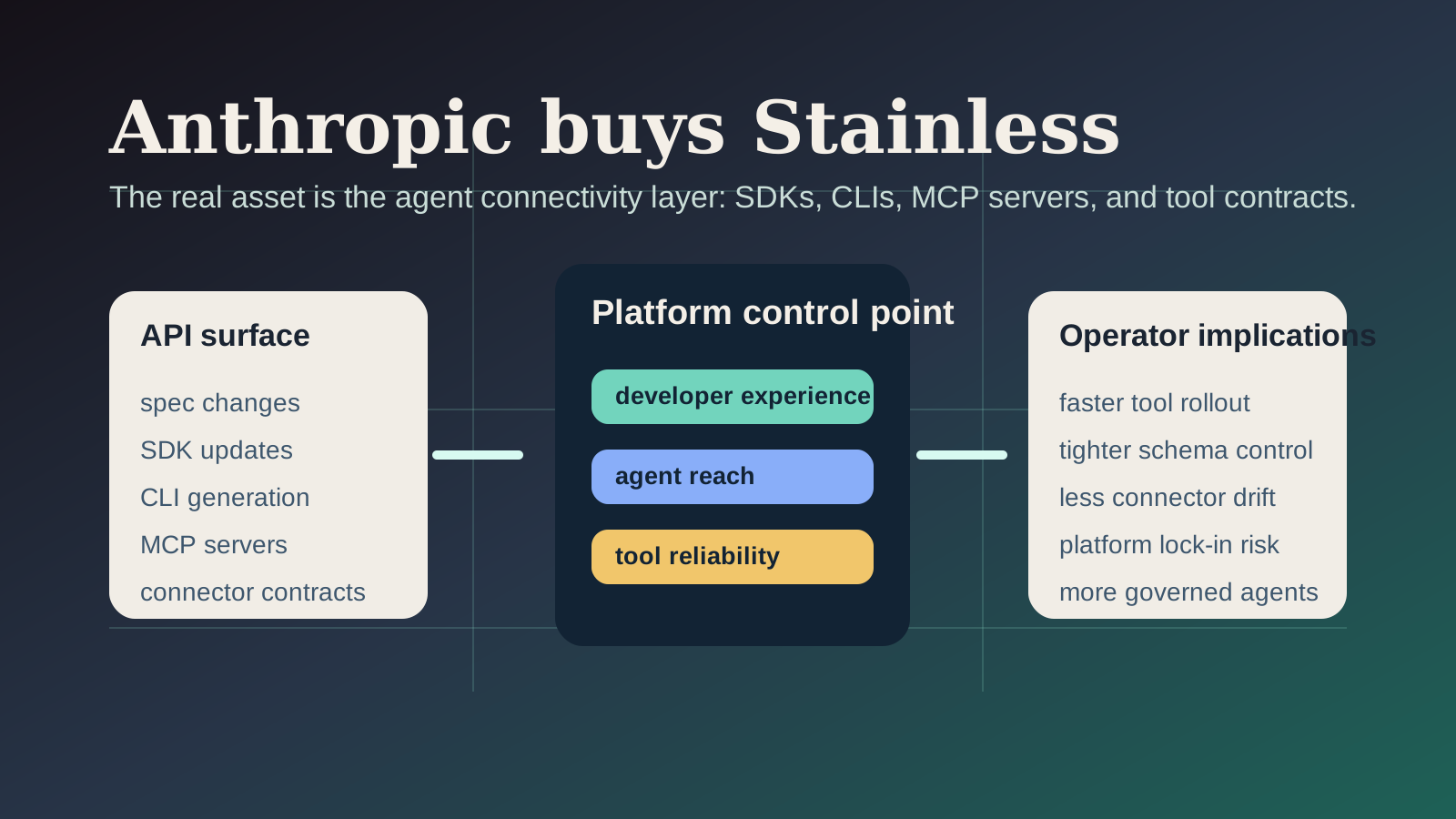
Anthropic’s May 30 acquisition of Stainless is worth publishing because the real signal is not that another frontier lab bought a developer-tools company. The better signal is that Anthropic is moving closer to the SDK, CLI, and MCP-server layer that determines whether agents can reach real systems cleanly enough to be trusted in production. That makes the story about platform control, not simple feature expansion.
Anthropic says Stainless has powered every official Anthropic SDK since 2024 and that the team will now help build a more integrated developer experience across the Anthropic API, Claude Code, and MCP tooling. Stainless itself says hundreds of companies already use its platform to generate SDKs, MCP servers, and other API-facing tools. That matters because the connective tissue around an agent often becomes the bottleneck before the model does.
In agent platforms, the model may win the demo, but the SDK, schema, and MCP layer decides whether the system stays usable in production.
That is the original Grid Report angle. Once agents are expected to call tools, access APIs, and operate inside governed environments, the contract layer around those actions becomes strategic. If the SDK is brittle, the auth flow is messy, or the tool schema drifts, the model may still be strong while the product remains unreliable. In other words, the platform advantage is increasingly showing up in the machinery around action, not only in the model weights.
Anthropic’s own MCP signal makes the acquisition more important. In December the company said it was donating MCP to the newly formed Agentic AI Foundation and said the ecosystem already included more than 10,000 active public MCP servers, 75-plus first-party and third-party connectors, and over 97 million monthly SDK downloads across Python and TypeScript. That makes the Stainless deal easier to read: Anthropic is not buying a side utility. It is tightening its grip on a rapidly scaling tool-access standard.
This clears the site’s duplicate block because it is materially different from the recent Anthropic containment story and the OpenAI-Dell Codex piece. Those articles were about blast-radius engineering and enterprise data locality. This one is about the tool contract layer that decides whether an agent platform can distribute reliable access to real systems at scale.
For operators, the implication is practical. The next reliability question for agent deployments is not only which model performs best on a benchmark. It is whether the platform can keep SDKs, tool schemas, auth, and MCP endpoints stable enough that teams are not rebuilding integrations every time a workflow expands. Tooling discipline becomes part of operational uptime.
For investors and platform builders, the read-through is that the value chain is moving down-stack. Frontier labs are increasingly incentivized to own more of the interface between model, developer, and external system because that is where lock-in, switching cost, and product reliability begin to compound. The model gets attention, but the integration layer keeps customers from churning.
The reason to publish this now is that it is specific, current, and more useful than a generic acquisition rewrite. Anthropic is showing that agent competition is being fought through protocols, SDKs, and tool access paths as much as through model quality. That is a better search and operator story than another vague “AI platform expands ecosystem” headline.
Sources
Anthropic, “Anthropic acquires Stainless,” published May 30, 2026: https://www.anthropic.com/news/anthropic-acquires-stainless
Anthropic, “Donating the Model Context Protocol to the Agentic AI Foundation,” published December 9, 2025: https://www.anthropic.com/news/donating-the-model-context-protocol-to-the-agentic-ai-foundation
Stainless, “Anthropic acquires Stainless,” published May 30, 2026: https://www.stainless.com/blog/anthropic-acquires-stainless
By Nawaz Lalani
The Grid Report is written by Nawaz Lalani and focuses on source-backed coverage of AI infrastructure, grid power demand, automation systems, and market signals.
Follow the signal, not just the headline.
Get the daily Grid brief for source-backed coverage on AI power demand, infrastructure timing, automation, and market signals.