- OpenAI’s June 10 threat report is worth publishing because the useful signal is not just that another covert influence campaign used generative AI.
- The specific details matter.
- The original Grid Report angle is that AI data-center politics is becoming an infrastructure-security story.
- Section
- AI
- Read time
- 4 min read
- Data included
- What OpenAI’s June 10 report actually adds
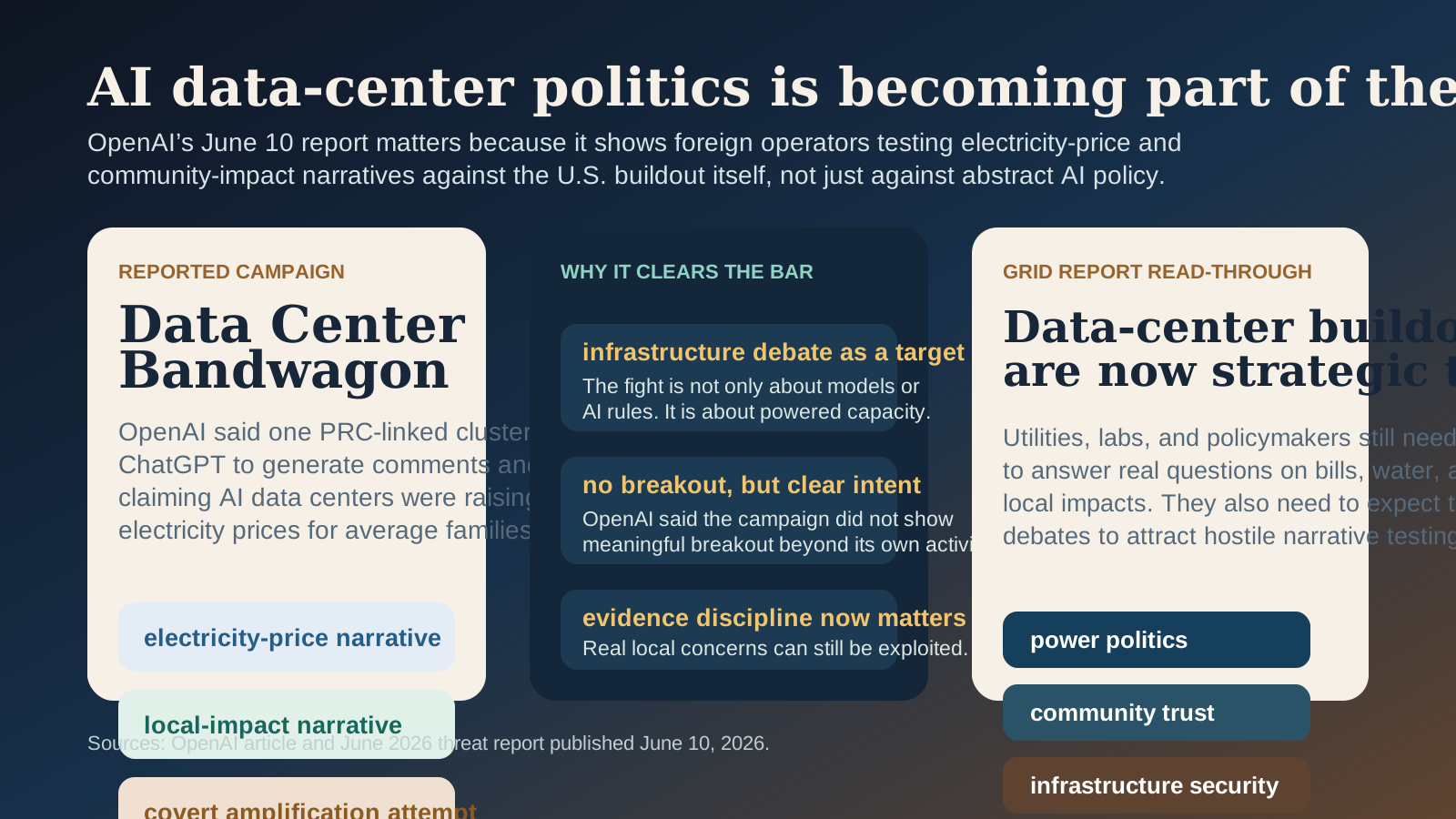
What OpenAI’s June 10 report actually adds
The useful read-through is not that one campaign went viral. It is that the AI infrastructure debate itself is now being tested as a narrative attack surface.
June 10 threat-report signals
| Signal | What OpenAI reported | Why it matters | Grid Report read-through |
|---|---|---|---|
| Data Center Bandwagon | Comments and images targeting AI data-center debates in the U.S. | Foreign operators tested local economic and community narratives around AI infrastructure. | Electricity-bill and local-impact arguments are now strategic narrative terrain, not just local talking points. |
| Tech and Tariffs | A second cluster pushed anti-tariff narratives and false claims about OpenAI user-data compromise. | The campaigns were part of a broader attempt to shape U.S. technology debates. | Data-center politics sits inside a wider contest over AI, trade, and technological leadership. |
| No meaningful breakout | OpenAI said it found no evidence of meaningful breakout beyond the operation’s own activity. | The campaign was limited in reach, but still useful as a signal of intent. | The significance is not virality. It is that hostile operators judged the infrastructure debate worth testing. |
| AI infrastructure as a target | OpenAI said the targeting was significant because it tested narratives against AI infrastructure as a foundation of U.S. technological leadership and growth. | The company explicitly framed data-center politics as part of strategic competition. | The public argument around power, cost, and siting is now part of the AI-security landscape. |
Source context: OpenAI’s June 10, 2026 article and June 2026 threat report on PRC-linked influence operations targeting AI debates in the United States.
OpenAI’s June 10 threat report is worth publishing because the useful signal is not just that another covert influence campaign used generative AI. The stronger signal is that the politics around AI data centers have become important enough to be treated as strategic narrative terrain. OpenAI said it banned two clusters of ChatGPT accounts likely originating from China, including one campaign that generated comments and images claiming AI data-center buildouts were raising electricity prices for average families.
The specific details matter. OpenAI named that first cluster the “Data Center Bandwagon” campaign. It said the operation tried to manipulate a legitimate American debate about AI infrastructure by amplifying claims around electricity prices and local impacts while hiding who was behind the effort. OpenAI also said it found no evidence of meaningful breakout beyond the operation’s own activity. That limits the direct damage. It does not reduce the strategic significance of the test.
The useful signal is not that one more covert campaign used AI. It is that the public argument around data-center power, cost, and local impact is now strategic terrain around the U.S. AI buildout itself.
The original Grid Report angle is that AI data-center politics is becoming an infrastructure-security story. For the last month, the site’s strongest utility and large-load coverage has shown that questions about bills, water, permitting, and community impact are real. OpenAI’s report adds a new layer: those same legitimate tensions can also be used as attack surfaces by foreign operators trying to slow, distort, or delegitimize parts of the U.S. AI buildout.
That is why this clears the duplicate block against the site’s recent electricity-cost and tariff coverage. The household-bill story was about actual regional cost pass-through. The Microsoft Nevada, PPL, and New York pieces were about real contract, rate-class, and permitting fights. This story is different because it is about information operations targeting those debates from the outside. The overlap is the subject matter. The thesis is the security layer sitting on top of it.
For operators, the implication is that evidence discipline matters more now. Utilities, labs, developers, and policymakers still need credible answers on cost allocation, load forecasting, noise, water, and local infrastructure stress. But they also need to assume those debates can be amplified by actors whose goal is not a better local outcome, but more distrust and more friction around strategic AI capacity.
For investors and infrastructure watchers, the read-through is that AI buildout risk is not only physical and financial. It is narrative and political. If data-center opposition, ratepayer anxiety, or permitting conflict can be selectively amplified, then project timelines and public acceptance become part of a broader resilience question. In other words, the security perimeter around AI infrastructure now includes the public argument about whether that infrastructure should be built.
The search case is strong because the article answers a live, specific question better than a generic rewrite of OpenAI’s report: why does a PRC-linked influence campaign about electricity bills matter for AI infrastructure? Readers searching for OpenAI PRC influence report, Data Center Bandwagon, AI data-center electricity-price narratives, or foreign influence on AI debates get a concrete infrastructure thesis instead of a commodity cybersecurity summary.
Sources
OpenAI, “PRC-linked influence operations are targeting AI debates in the US,” published June 10, 2026: https://openai.com/index/prc-linked-influence-operations-ai-debates/
OpenAI, “June 2026 Threat Report,” published June 10, 2026: https://cdn.openai.com/pdf/96b559fa-c165-4575-805d-e636909e2f78/June-2026-Threat-Report.pdf
By Nawaz Lalani
The Grid Report is written by Nawaz Lalani and focuses on source-backed coverage of AI infrastructure, grid power demand, automation systems, and market signals.
Follow the signal, not just the headline.
Get the daily Grid brief for source-backed coverage on AI power demand, infrastructure timing, automation, and market signals.