- NYISO’s 2026 Power Trends report is worth publishing because the useful signal is not simply that New York expects more electricity demand.
- The report is unusually explicit.
- The Grid Report angle that clears the search bar is the planning method.
- Section
- Energy
- Read time
- 5 min read
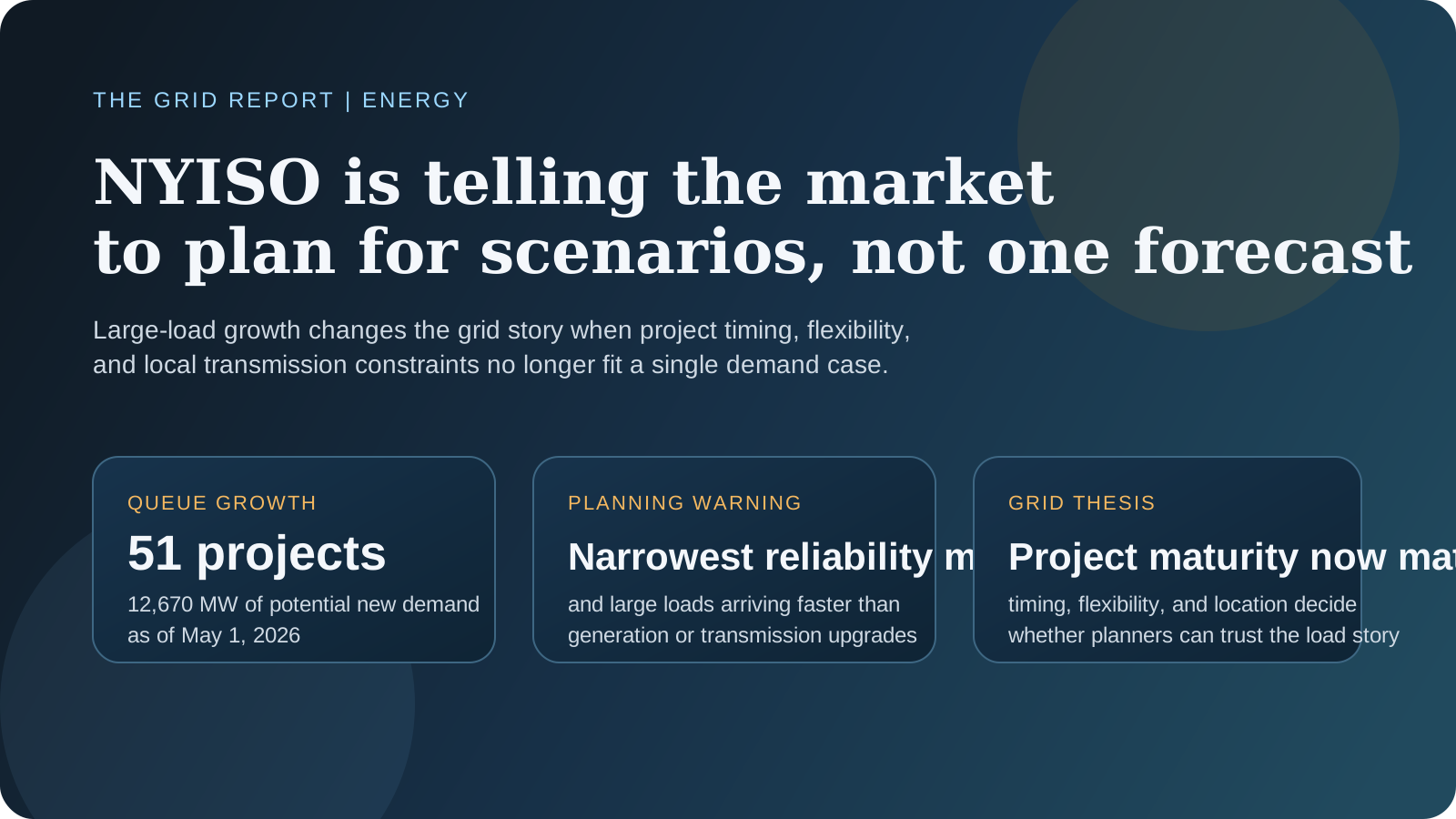
NYISO’s 2026 Power Trends report is worth publishing because the useful signal is not simply that New York expects more electricity demand. The stronger signal is that the state’s grid operator is now treating large-load growth, including data centers, as a planning problem defined by uncertainty rather than a demand problem solved by one baseline forecast. That is a meaningful shift in how operators, utilities, and developers should read grid readiness.
The report is unusually explicit. NYISO says New York’s electric system is operating with the narrowest reliability margins in recent years, that electricity demand is rising and becoming harder to forecast, and that data centers and advanced semiconductor manufacturing are part of the pressure. It also says six large-load projects in 2022 represented 1,045 MW in the queue, while as of May 1, 2026 there are 51 large-load projects representing nearly 12,670 MW of potential demand. At the same time, NYISO’s load forecasters expect roughly 2,880 MW of that demand to be on the system by 2040.
NYISO’s useful warning is not just that large loads are growing. It is that grid planners can no longer trust one clean demand forecast when project timing, flexibility, and local transmission stress vary this much.
The Grid Report angle that clears the search bar is the planning method. NYISO is not telling the market that all 12,670 MW is about to hit the grid. It is saying that planners now need to model a range of plausible outcomes because large-load projects arrive unevenly, often on faster timelines than generation or transmission upgrades, and can have local impacts that do not show up cleanly in a single statewide forecast. That is why the report leans so hard into scenario-based analysis.
This clears the duplicate block against the site’s recent New York moratorium, CAISO transmission, ERCOT load-model, and FERC large-load stories because the thesis is different. The moratorium article was about state politics and host-community leverage. The CAISO story was about transmission capex as a signal. The ERCOT article was about power-electronics behavior and load modeling. This NYISO piece is different because it shows a major grid operator reframing data-center growth as a reliability-planning discipline built around project maturity, flexibility assumptions, and infrastructure timing.
For operators and developers, the practical implication is that “we have a project in the queue” no longer carries much analytical value by itself. NYISO notes that large-load requests are studied individually, that not all projects proceed, and that planners now need project-specific judgment about maturity, demand growth speed, and whether a facility can actually reduce load under strained conditions. In other words, flexibility claims and construction timing are becoming part of grid credibility.
For policy watchers and investors, the stronger read-through is that future cost and siting fights may increasingly turn on planning confidence. If a state can no longer rely on one central demand case, then the value of flexible load design, staged energization, transmission timing, and mature project evidence rises. The winner is not simply the largest project. It is the project that can best fit into a stressed system without forcing planners to guess.
The search case is strong because the article answers a specific live question better than a generic reliability summary: what did NYISO actually say about data-center and large-load growth, and why does it matter? Readers searching for NYISO Power Trends 2026, New York data-center power demand, or large-load queue growth in New York get numbers, planning context, and a clearer operator thesis instead of a vague warning about electrification.
Sources
New York Independent System Operator, “Power Trends 2026,” published June 2026: https://www.nyiso.com/documents/d/guest/2026-power-trends
NPCC, “NPCC 2026 Summer Reliability Assessment Forecasts Adequate Electricity Supplies Across Northeastern North America,” published June 10, 2026: https://www.npcc.org/news/npcc-2026-summer-reliability-assessment-forecasts-adequate-electricity-supplies-across-northeastern-north-america
Utility Dive, “Transmission projects bolster New York, New England summer reliability: NPCC,” published June 11, 2026, used as secondary context only: https://www.utilitydive.com/news/transmission-projects-new-york-new-england-summer-reliability-npc/822623/
By Nawaz Lalani
The Grid Report is written by Nawaz Lalani and focuses on source-backed coverage of AI infrastructure, grid power demand, automation systems, and market signals.
Follow the signal, not just the headline.
Get the daily Grid brief for source-backed coverage on AI power demand, infrastructure timing, automation, and market signals.