- Google and Pacific Gas & Electric are about to test a different answer to the AI power problem: instead of waiting only for a new plant, transmission project, or utility rate case, a large electricity buyer can pay to turn thousands of existing household devices into a measurable grid resource.
- The useful distinction is who is buying the capacity and who carries the experiment.
- PG&E already has a large pool of devices that can respond.
- Section
- Energy
- Read time
- 7 min read
- Data included
- The SHARE capacity contract that operators should measure
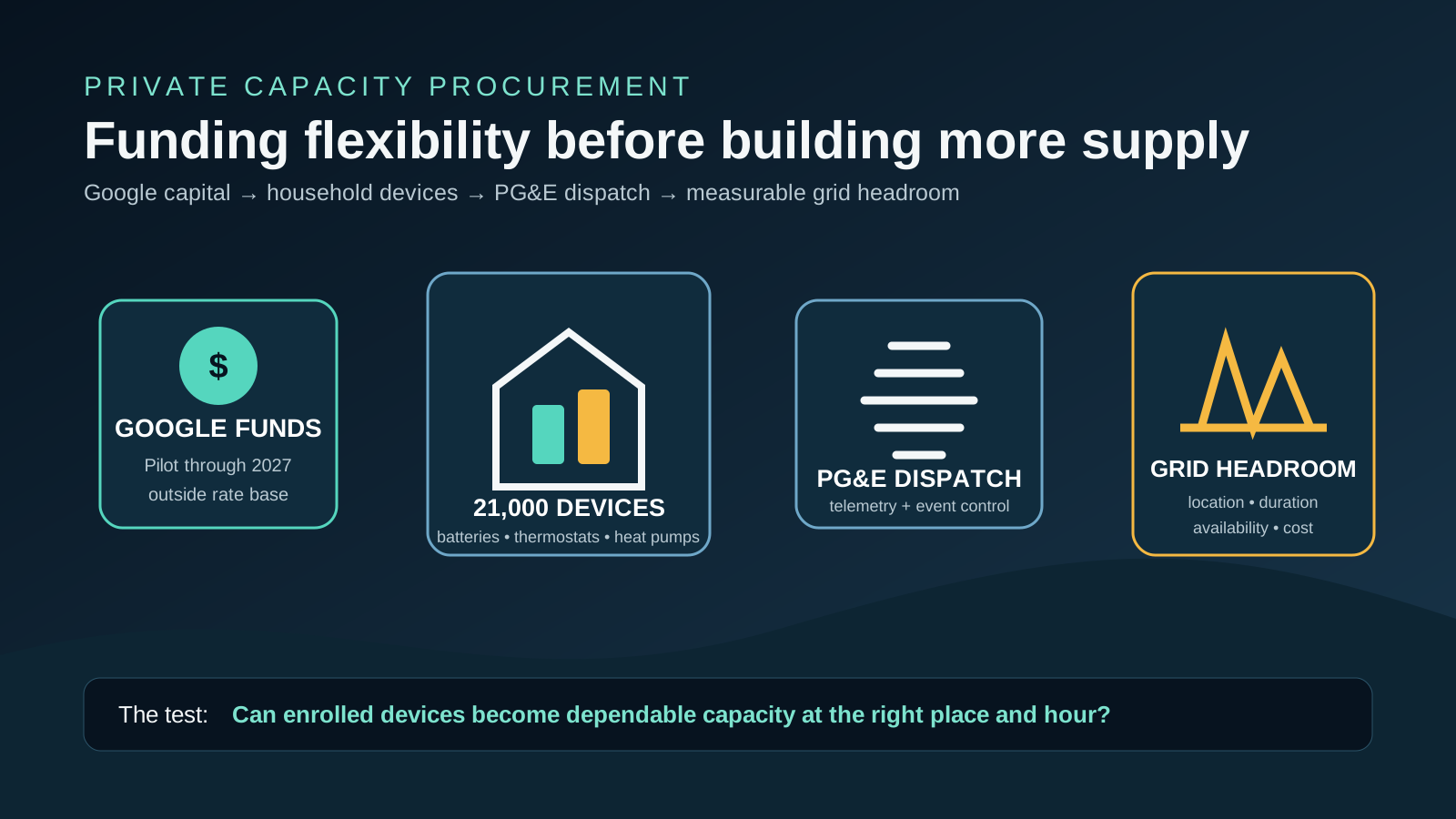
The SHARE capacity contract that operators should measure
Enrollment is only the input. The procurement case depends on converting devices into dependable, locational grid capacity.
| Contract layer | What SHARE is testing | Decision metric |
|---|---|---|
| Capital | Google funds the pilot outside the utility rate base | All-in cost per dependable kilowatt |
| Resource | Nearly 21,000 batteries, thermostats, and flexible devices | Available MW by location, hour, and duration |
| Operations | PG&E and Demand Side Analytics coordinate dispatch | Response time, telemetry quality, and event performance |
| Customer | Households provide flexibility through partner aggregators | Retention, opt-outs, bill savings, and equipment impacts |
| Scale | Potential expansion to commercial, industrial, and utility assets | Repeatable capacity without double counting |
Sources: PG&E and Utility Dive. Program results are expected later in 2026 or early 2027.
Google and Pacific Gas & Electric are about to test a different answer to the AI power problem: instead of waiting only for a new plant, transmission project, or utility rate case, a large electricity buyer can pay to turn thousands of existing household devices into a measurable grid resource. PG&E says its new SHARE virtual power plant will begin enrolling nearly 21,000 residential batteries, thermostats, and other flexible devices in two Northern California counties this fall, with Google fully funding the proof of concept through 2027.
The useful distinction is who is buying the capacity and who carries the experiment. Traditional utility programs recover approved costs from customers and are judged through a regulatory process. SHARE is privately financed by a hyperscaler whose own growth is part of the demand problem. That makes the pilot a test of whether large-load customers can procure grid headroom directly—while households receive bill benefits and the utility operates the aggregated resource—without asking the general rate base to finance the first deployment.
The relevant denominator is dollars per dependable kilowatt—not devices signed up or theoretical flexible load.
PG&E already has a large pool of devices that can respond. Utility Dive reports that about 4.7 gigawatts of residential flexible capacity is enrolled across PG&E programs, roughly three quarters batteries and one quarter thermostats. SHARE’s initial enrollment is much smaller than that headline number, but the existing fleet reduces one of the hardest adoption barriers: the pilot can start by coordinating devices already installed in homes rather than waiting for a new generation project and interconnection queue.
That does not make every enrolled kilowatt equivalent to a gas turbine or a firm power contract. A battery has a limited discharge duration; a thermostat’s response depends on weather and customer comfort; device availability varies by hour; and opt-outs can erode performance at the moment the grid needs it most. The commercially important output is therefore not enrollment. It is the dependable megawatts SHARE can deliver during defined events, for a defined duration, after accounting for customer behavior, communications failures, rebound demand, and baseline uncertainty.
Google’s involvement creates a sharper measurement standard. A hyperscaler deciding whether to repeat this model needs to compare the all-in cost of dependable demand reduction with alternatives such as utility upgrades, new generation, storage contracts, or slower data-center energization. The relevant denominator is dollars per accredited or reliably dispatched kilowatt—not devices signed up, marketing impressions, or theoretical flexible load. PG&E says initial findings will be shared publicly later in 2026 or early 2027, giving operators an unusually useful chance to see whether the resource survives that conversion.
The pilot also broadens what an AI power procurement team might buy. Corporate energy teams have historically focused on annual renewable-energy matching and long-term power-purchase agreements. A VPP contract is closer to an operating product: local capacity available at particular hours and locations, backed by telemetry, dispatch rules, customer incentives, and performance settlement. If SHARE works, procurement can move from matching megawatt-hours on paper toward buying the timing and grid behavior that determines whether incremental load is actually serviceable.
Location matters as much as scale. Distributed assets relieve constraints only when they sit behind the relevant portions of the distribution and transmission system and respond during the relevant peaks. A national portfolio of household devices cannot automatically solve a feeder, substation, or local-capacity constraint near a data-center campus. Buyers should ask PG&E how the two-county footprint was selected, which grid constraints the devices can address, and whether dispatch value is measured at a system, substation, or feeder level.
The household economics deserve the same scrutiny. SHARE is supposed to reduce participants’ net electricity bills and put downward pressure on rates, but that outcome depends on incentive design, equipment costs, cycling degradation, comfort impacts, and the value assigned to grid services. Carrier is expected to support deployment of new resources, including variable-speed heat pumps with integrated battery capacity, while Tesla, Sunrun, and Renew Home will help enroll existing devices. That mix tests whether a capacity buyer can finance both aggregation of installed assets and the creation of new flexible load.
There is a policy implication if the model scales. Regulators increasingly want data centers to pay for the generation and network upgrades required to serve them. A privately funded VPP offers another compliance path, but only if its output is verifiable and additional. Regulators will need to prevent double counting between existing utility programs, resource-adequacy credits, customer incentives, and a hyperscaler’s claimed load offset. They will also need rules for what happens when the contracted resource underperforms during a system emergency.
SHARE is deliberately a proof of concept, not evidence that distributed flexibility can absorb the full growth of AI campuses. Its initial fleet is residential, its duration is limited, and PG&E says later versions could expand to commercial, industrial, and utility-scale assets. The strong signal is the procurement architecture: a large-load customer supplies the capital, a utility supplies grid visibility and dispatch integration, aggregators supply devices and customers, and public results determine whether the capacity is repeatable.
For utilities and large-load buyers, the next milestone is a contract that converts this structure into an enforceable service. It should specify the locational need, dispatch window, response time, minimum duration, telemetry standard, availability target, baseline method, nonperformance terms, and who owns any capacity or environmental attributes. Those details will decide whether SHARE remains an interesting pilot or becomes a template for making new AI demand bring a portfolio of flexible capacity with it.
Sources
Pacific Gas and Electric Company, “PG&E Teams with Google, Rewiring America and Industry Leaders on Innovative Virtual Power Plant,” published September 3, 2026: https://www.pge.com/en/newsroom/press-release-details.4ccbca6c-2bd3-4e80-b72d-df3ef829e61a.html
Utility Dive, “Google bankrolls PG&E virtual power plant,” published September 10, 2026: https://www.utilitydive.com/news/google-virtual-power-plant-vpp-pge/830036/
U.S. Department of Energy, “Pathways to Commercial Liftoff: Virtual Power Plants,” accessed September 10, 2026: https://liftoff.energy.gov/vpp/
By Nawaz Lalani
The Grid Report is written by Nawaz Lalani and focuses on source-backed coverage of AI infrastructure, grid power demand, automation systems, and market signals.
Follow the signal, not just the headline.
Get the daily Grid brief for source-backed coverage on AI power demand, infrastructure timing, automation, and market signals.