- A new federal order has turned the security of grid batteries into a procurement and project-execution problem.
- The important detail for developers is that the order does not stop at physical equipment or a simple country-of-origin test.
- For storage projects, this creates a new diligence stack before the implementing rules are even published.
- Section
- Energy
- Read time
- 7 min read
- Data included
- The new battery-project diligence stack
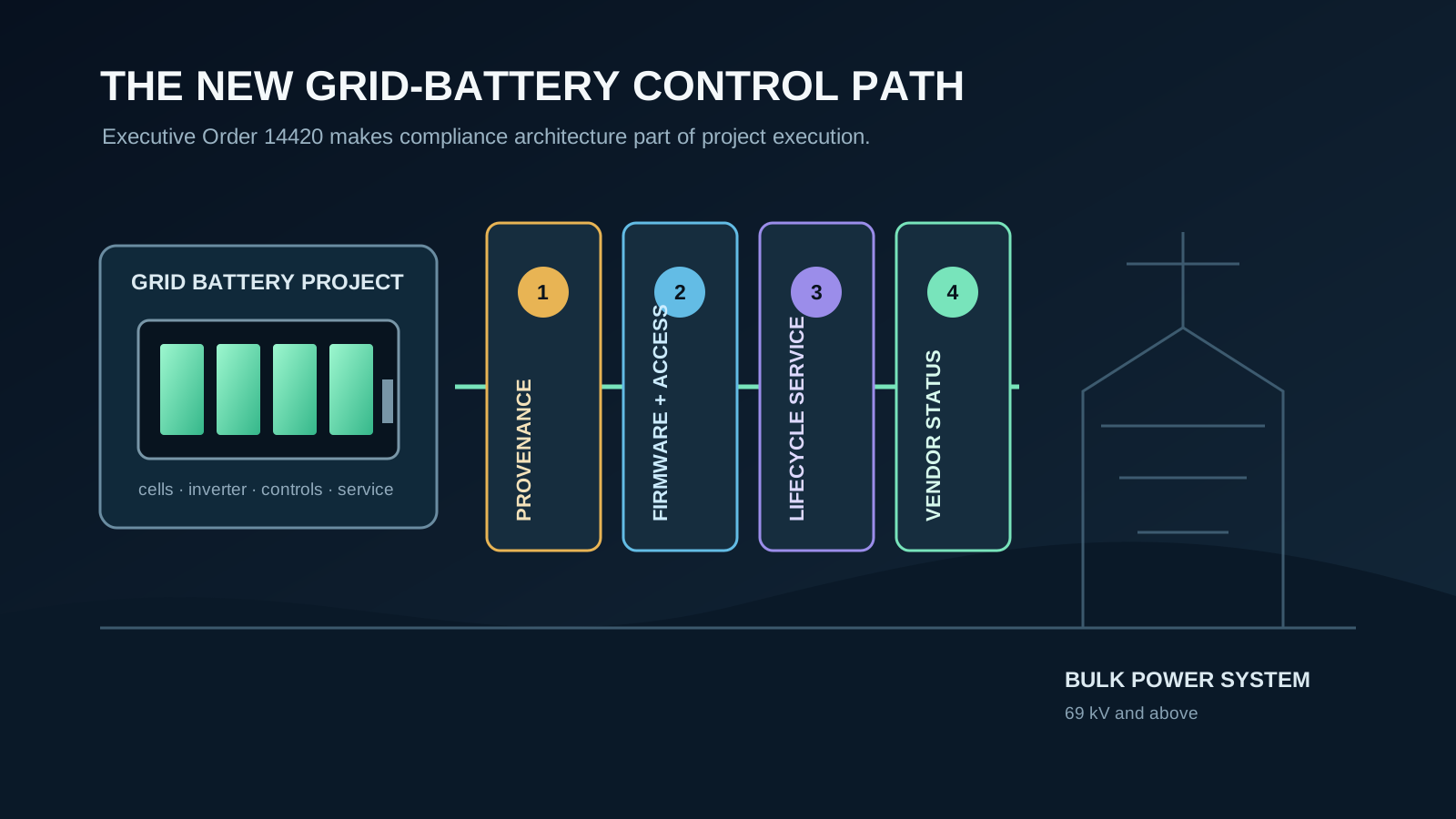
The new battery-project diligence stack
The order moves supply-chain security from a vendor questionnaire into the project schedule, operating model, and financing package.
| Control layer | Evidence projects may need | Commercial exposure |
|---|---|---|
| Equipment provenance | Bill of materials, manufacturing and ownership records | Vendor eligibility and replacement risk |
| Digital control | Firmware inventory, update path, telemetry and remote-access map | Cyber review, commissioning, and ongoing operating approval |
| Lifecycle support | Patch commitments, audit rights, access logs, mitigation clauses | Warranty, insurance, financing, and forced-remediation cost |
| Federal qualification | Pre-qualified vendor status or license and mitigation record | Procurement timing, supplier competition, and bankability |
Framework synthesized from Executive Order 14420, especially sections 2, 3, and 5.
A new federal order has turned the security of grid batteries into a procurement and project-execution problem. Executive Order 14420, signed August 26, gives the Energy secretary authority to prohibit or condition transactions involving foreign-produced bulk-power equipment when a covered foreign interest creates unacceptable sabotage, remote-access, supply-disruption, or national-security risk. The definition explicitly includes battery energy storage systems and grid-connected inverters.
The important detail for developers is that the order does not stop at physical equipment or a simple country-of-origin test. It also reaches critical components, software, firmware, digital services, maintenance services, and remote-access capabilities. That puts the full operating chain in view: who built the inverter, who can update the battery-management system, where telemetry travels, which technicians retain privileged access, and whether a vendor can keep supporting the asset after commissioning.
For U.S. battery projects, hardware provenance, software control, and service access are becoming schedule and finance variables.
For storage projects, this creates a new diligence stack before the implementing rules are even published. Procurement teams will need a defensible bill of materials, beneficial-ownership and supplier records, software and firmware inventories, remote-access architecture, update and patch controls, and replacement plans for components that could later be restricted. A low-cost equipment bid can become expensive quickly if it cannot survive that review or if financing and insurance providers price the uncertainty into project terms.
The order also authorizes the Energy secretary to identify, isolate, monitor, secure, disconnect, replace, or remove covered equipment that was already installed, while considering reliability, replacement availability, and continuity of service. That makes lifecycle support material to underwriting. Developers and owners cannot treat compliance as a one-time import check; they may need contracts that preserve audit rights, log access, constrain remote maintenance, guarantee update support, and allocate the cost of mandated mitigation or replacement.
The potential pre-qualified-vendor mechanism may become just as consequential as the prohibition authority. If the Department of Energy publishes a usable list or process, qualification could become a bankability shortcut: lenders, utilities, tax-equity providers, and offtakers may prefer equipment that arrives with a clearer federal risk posture. If qualification is slow or opaque, the same mechanism could narrow the supplier pool, extend lead times, and raise installed costs precisely when storage is being asked to support fast load growth and grid reliability.
There is still real uncertainty. The order directs implementing rules within 120 days and allows the government to define covered entities, scrutinized equipment, licenses, and mitigation procedures. It does not impose a blanket ban on every imported battery or name specific battery suppliers. Project teams should therefore avoid treating the current order as a final blacklist. The immediate signal is narrower and more useful: hardware provenance, software control, and service access are becoming schedule and finance variables.
That is why this is more than a trade-policy story. Grid storage has often been evaluated through dollars per kilowatt-hour, duration, interconnection position, warranty strength, and expected market revenue. Executive Order 14420 adds another screen: whether the project can prove that its equipment and control path are secure enough to remain operable under a changing federal qualification regime. For U.S. battery development, compliance architecture may now sit on the critical path alongside transformers, permits, and interconnection.
Sources: The White House, “Declaring a National Emergency to Secure the United States Bulk-Power System,” Executive Order 14420, August 26, 2026: https://www.whitehouse.gov/presidential-actions/2026/08/declaring-a-national-emergency-to-secure-the-united-states-bulk-power-system/; The White House, “Fact Sheet: President Donald J. Trump Declares a National Emergency to Secure America’s Bulk-Power System,” August 26, 2026: https://www.whitehouse.gov/fact-sheets/2026/08/fact-sheet-president-donald-j-trump-declares-national-emergency-secure-americas-bulk-power-system/
By Nawaz Lalani
The Grid Report is written by Nawaz Lalani and focuses on source-backed coverage of AI infrastructure, grid power demand, automation systems, and market signals.
Follow the signal, not just the headline.
Get the daily Grid brief for source-backed coverage on AI power demand, infrastructure timing, automation, and market signals.