- NVIDIA’s June 22 Eco Wave Power profile clears the publish bar because it is not just another clean-energy supplier saying AI needs more power.
- That matters because AI power constraints are usually discussed as a bulk-megawatt procurement problem.
- The physical design is the first reason the story is interesting.
- Section
- Infrastructure
- Read time
- 4 min read
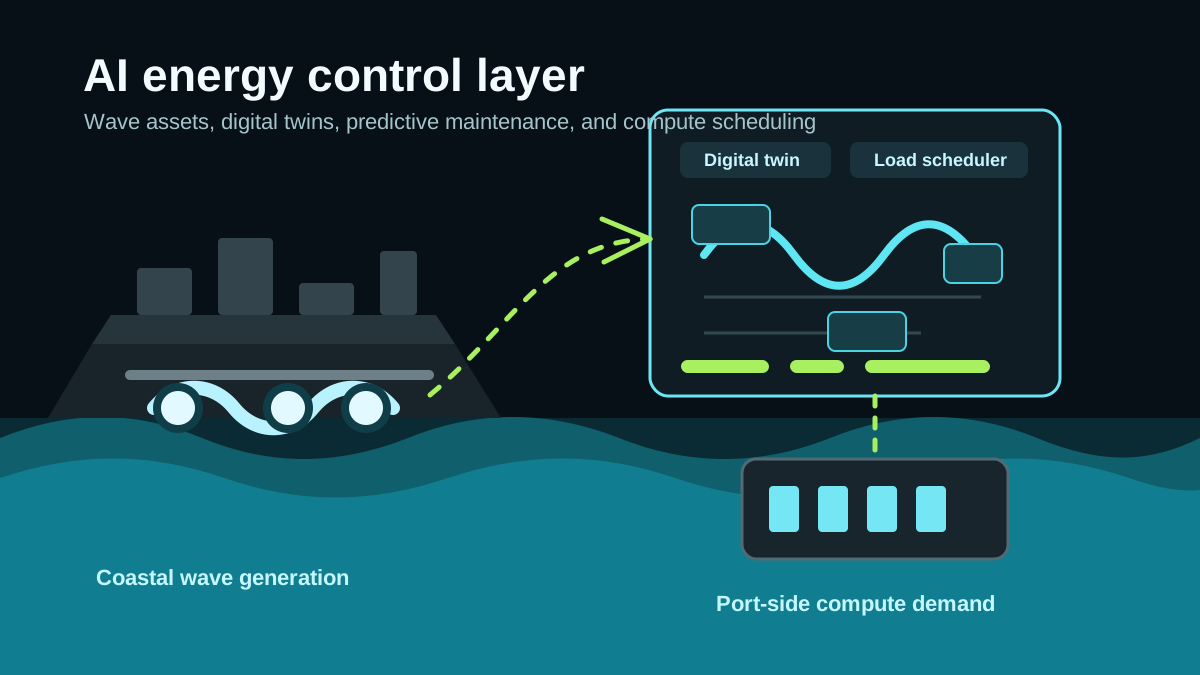
NVIDIA’s June 22 Eco Wave Power profile clears the publish bar because it is not just another clean-energy supplier saying AI needs more power. The more useful signal is that AI infrastructure tools are being pulled upstream into the energy asset itself. Eco Wave Power is using NVIDIA AI infrastructure and digital twins to model wave conditions, simulate deployment choices, monitor equipment, and optimize how wave-energy systems operate against real coastal conditions.
That matters because AI power constraints are usually discussed as a bulk-megawatt procurement problem. This story is smaller, but more Grid-native: it shows how the operating layer around energy assets is becoming more intelligent. If a project can forecast wave strength, model structural behavior, detect anomalies, and schedule energy-intensive work around expected production, then the relevant product is no longer only electricity. It is a managed energy-and-compute system.
The useful signal is not that wave power solves AI demand. It is that AI energy assets are starting to become simulated, monitored, and scheduled like software systems.
The physical design is the first reason the story is interesting. Eco Wave Power attaches floaters to existing marine infrastructure such as breakwaters, sea walls, piers, and port assets, while keeping computers, sensors, hydraulic conversion equipment, and electrical components on land. That architecture matters because it tries to avoid one of wave power’s historical failure modes: putting expensive hardware directly in the water and then asking it to survive harsh conditions.
The second reason is the digital twin layer. NVIDIA said Eco Wave Power is using NVIDIA Omniverse libraries and accelerated compute to build virtual representations of wave patterns and floating infrastructure. Those models can test wave conditions, structural behavior, deployment configurations, and operating scenarios before hardware is installed. In practical terms, AI is being used to de-risk a physical energy project before it becomes a capital mistake.
The operational layer is where the AI infrastructure angle gets sharper. NVIDIA described real-time optimization through predictive analytics, anomaly detection, environmental forecasting, and predictive maintenance. Eco Wave Power’s own May announcement said its U.S. subsidiary joined NVIDIA Inception to accelerate AI-driven applications for renewable energy infrastructure and intelligent energy management, including digital twin modeling, ocean and weather-data analysis, predictive maintenance, and energy management for coastal and port infrastructure.
The stronger read-through is that renewable power for AI may need more than new generation. It may need software that knows when energy is available and how to route compute around it. NVIDIA’s post says Eco Wave Power is exploring AI software as a control layer for a data-center pilot, using expected wave strength to plan compute tasks around available power. That is not a complete answer to hyperscale demand. But it is a useful example of where energy-aware computing could move: from abstract efficiency talk into actual workload scheduling.
This is also why the coastal angle matters. Eco Wave Power already points to projects or planned projects in Israel, the Port of Los Angeles, Portugal, Taiwan, and India. Ports and coastal industrial zones are plausible homes for edge compute, logistics automation, and some data-center workloads because they already concentrate infrastructure, water access, and industrial demand. If wave-energy systems can plug into those environments without waiting for a full greenfield grid buildout, the product becomes speed and locality, not just clean electrons.
There are limits, and they are important. Wave energy is still early compared with wind, solar, batteries, gas, and grid-scale transmission. The NVIDIA and Eco Wave Power materials are company-sourced, and a pilot-scale concept should not be treated as proof that ocean power can carry the AI buildout. The right conclusion is narrower: AI is beginning to change how renewable assets are designed, monitored, and coordinated with compute demand.
That narrower conclusion is still worth publishing. The AI power story is often framed as a collision between data centers and the grid. Eco Wave points to a second track: energy assets themselves becoming more software-defined, more simulated, and more tightly linked to the workloads they may eventually support.
Sources
NVIDIA Blog, “Eco Wave Power Turns Waves Into Watts With NVIDIA AI Infrastructure and Digital Twins,” published June 22, 2026: https://blogs.nvidia.com/blog/eco-wave-power-ai-digital-twins/
Eco Wave Power, “Eco Wave Power U.S. Joins NVIDIA Inception Program to Advance AI-Driven Renewable Energy Infrastructure,” published May 18, 2026: https://www.ecowavepower.com/eco-wave-power-u-s-joins-nvidia-inception-program-to-advance-ai-driven-renewable-energy-infrastructure/
Eco Wave Power, “Eco Wave Power Featured for Second Time in NVIDIA Founder and CEO Jensen Huang’s GTC Keynote, as Company Advances Taiwan Wave Energy Project,” published June 2, 2026: https://www.ecowavepower.com/eco-wave-power-featured-for-second-time-in-nvidia-founder-and-ceo-jensen-huangs-gtc-keynote-as-company-advances-taiwan-wave-energy-project/
By Nawaz Lalani
The Grid Report is written by Nawaz Lalani and focuses on source-backed coverage of AI infrastructure, grid power demand, automation systems, and market signals.
Follow the signal, not just the headline.
Get the daily Grid brief for source-backed coverage on AI power demand, infrastructure timing, automation, and market signals.