- Verse’s June 18 announcement clears the publish bar because it sharpens an infrastructure shift that still does not get covered well enough.
- The original angle is that AI infrastructure bottlenecks are starting to move from physical scarcity alone into coordination software.
- That distinction matters.
- Section
- Infrastructure
- Read time
- 5 min read
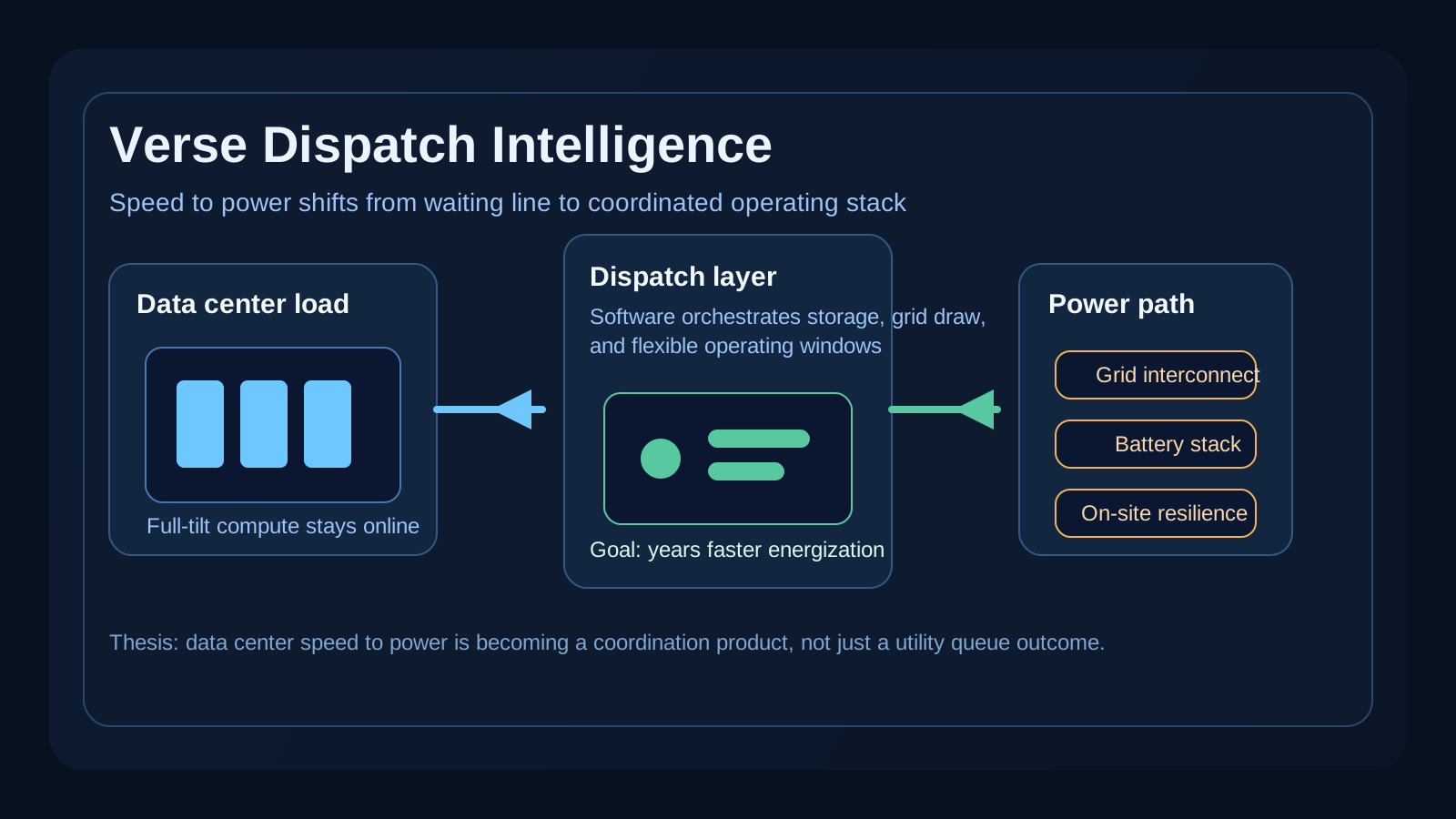
Verse’s June 18 announcement clears the publish bar because it sharpens an infrastructure shift that still does not get covered well enough. The company says its new Dispatch Intelligence offering, launched alongside a $54 million Series B and a partnership with Calibrant Energy, is designed to help data center developers bring capacity online up to three years faster by coordinating on-site energy resources with existing grid infrastructure. The important signal is not merely that another startup raised money around AI power. It is that speed to power is being packaged as an operating layer.
The original angle is that AI infrastructure bottlenecks are starting to move from physical scarcity alone into coordination software. The market already understands that grid queues, transmission bottlenecks, and generation shortages are slowing AI data centers. Verse is arguing that part of the answer is not waiting passively for the utility clock to run out. It is using batteries and other behind-the-meter assets to change how the project behaves from the grid’s perspective while keeping compute fully utilized.
Speed to power is starting to look like a coordination stack built from software, storage, and grid behavior, not just a place in the utility queue.
That distinction matters. A lot of “flexible load” discussion implicitly assumes the data center has to throttle workloads or accept a performance tradeoff. Verse is claiming a different model: keep the GPU campus running hard, but use physical storage and energy controls to shape net grid draw during the windows that matter for interconnection and system stress. If that model works in practice, the bottleneck is no longer only whether power exists. It is whether the developer has the intelligence layer and capital partner to present a more grid-compatible load profile quickly enough.
The partnership structure makes the story stronger. Verse provides the orchestration software, while Calibrant brings on-site energy project development and financing. That is the interesting commercial combination. It suggests the next AI-infrastructure stack may need to include not only land, utility relationships, and switchgear, but also a software-plus-storage layer that lets a campus function like a flexible energy asset during its path to full grid service.
This is why the story belongs in infrastructure rather than a generic climate-tech bucket. Verse is not mainly selling emissions accounting or battery optimization to a broad enterprise audience. It is targeting the exact pressure point that now defines whether many AI campuses can convert announced demand into energized capacity on the timeline investors and hyperscalers want. In that sense, speed to power is becoming a product category.
There are still reasons to stay disciplined. Verse’s numbers and timelines are company claims, and the model will have to prove itself across real projects, real regulators, and real utility processes. It also does not make the interconnection problem disappear. Storage orchestration cannot replace missing transmission, weak substations, or inadequate generation forever. But that is not the bar for publishing. The bar is whether this announcement exposes a meaningful change in how the market is trying to solve the problem, and it does.
The stronger reading is that AI data center competition is increasingly about controlled energization, not just signed megawatts. Verse’s June 18 launch matters because it turns speed to power into a software-and-storage coordination story.
Sources
Verse, “Verse Raises $54M and Launches ‘Dispatch Intelligence’ to Accelerate Speed to Power for Data Center Developers in Partnership with Calibrant Energy,” published June 18, 2026: https://verse.inc/newsroom/series-b
Verse, “Power at the Speed of AI,” published June 18, 2026: https://verse.inc/company/founders-letter
Data Center Dynamics, “Verse raises $54m in Series B funding round for platform to expedite data center connections,” published June 19, 2026: https://www.datacenterdynamics.com/en/news/verse-raises-54m-in-series-b-funding-round-for-platform-to-expedite-data-center-connections/
By Nawaz Lalani
The Grid Report is written by Nawaz Lalani and focuses on source-backed coverage of AI infrastructure, grid power demand, automation systems, and market signals.
Follow the signal, not just the headline.
Get the daily Grid brief for source-backed coverage on AI power demand, infrastructure timing, automation, and market signals.