- Britain’s June 8 AI Hardware Plan is worth publishing because the useful signal is not that another government says it wants sovereign AI.
- The official release is specific enough to support that reading.
- That early-customer structure is the most useful angle in the announcement.
- Section
- Infrastructure
- Read time
- 5 min read
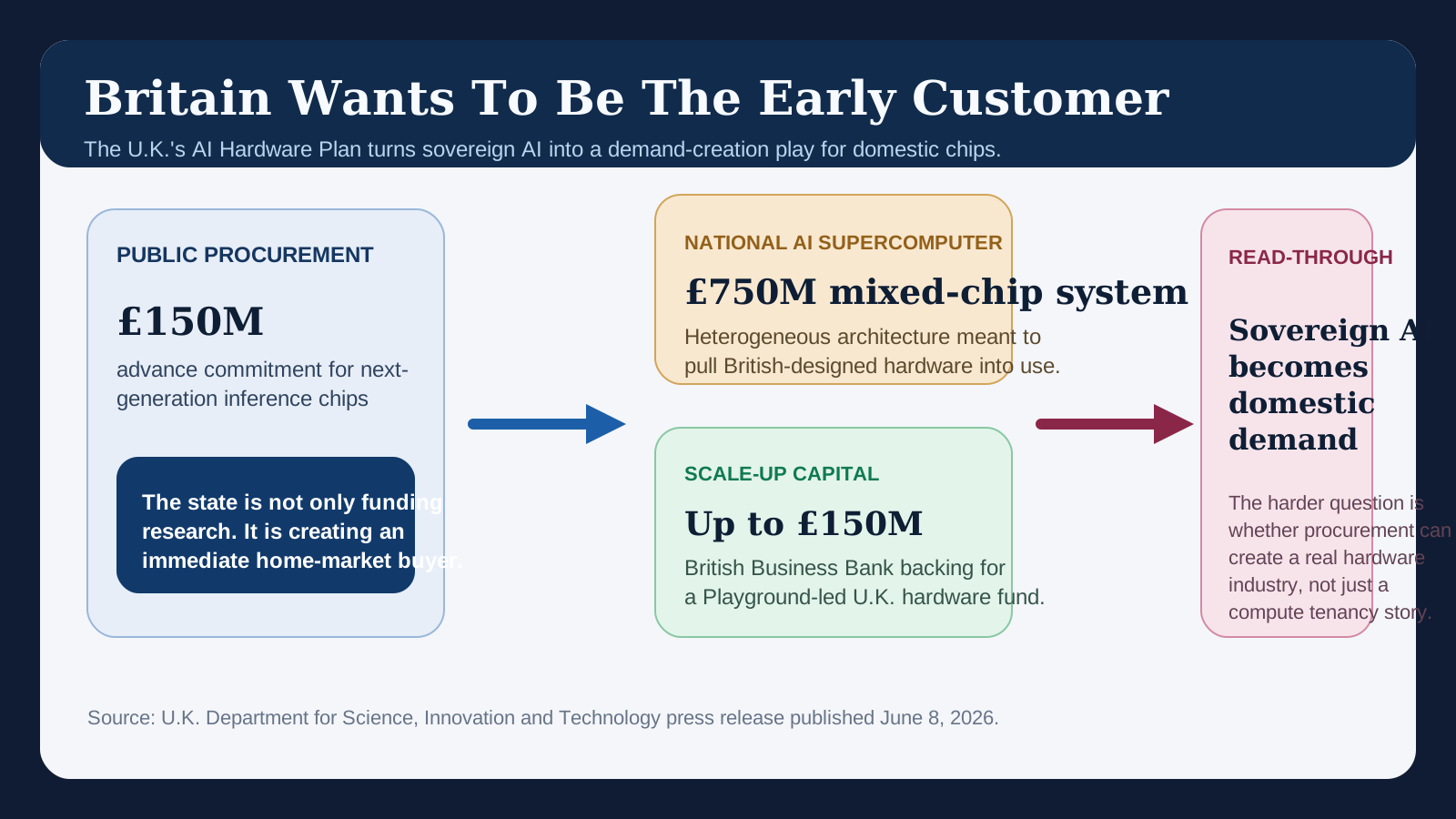
Britain’s June 8 AI Hardware Plan is worth publishing because the useful signal is not that another government says it wants sovereign AI. The stronger signal is that the U.K. is trying to act like a first buyer. Instead of treating sovereignty as a branding exercise or a pure cloud-capacity problem, the plan ties public procurement, startup financing, and workforce support into a practical attempt to create domestic demand for British AI hardware.
The official release is specific enough to support that reading. The Department for Science, Innovation and Technology says the package includes £750 million for a new national AI supercomputer, with £400 million earmarked for next-generation chips and £150 million of that set aside as an advance commitment to buy novel inference chips this summer. That matters because the government is not only subsidizing research. It is trying to make itself a real customer for hardware that British firms might otherwise struggle to commercialize at scale.
The useful U.K. signal is that sovereign AI is moving from “we need compute” rhetoric toward a harder question: who will be the first real customer for domestic AI chips?
That early-customer structure is the most useful angle in the announcement. Governments often talk about building domestic chip ecosystems, but the harder question is who actually buys the first production systems. London is trying to answer that directly. If domestic startups know there is a near-term procurement path for inference chips, the bottleneck shifts from “can we get attention?” to “can we deliver hardware that clears the performance, reliability, and deployment bar?”
The supercomputer design reinforces that thesis. The government says the new machine will use a heterogeneous mixed-chip architecture and that it wants British-designed chips to form a crucial part of the system. That is not just a capacity buildout. It is an attempt to turn national compute infrastructure into a commercialization platform, where procurement decisions shape which domestic chip architectures get a real operating environment, customer feedback, and institutional credibility.
The capital stack matters too. The release says Playground Global will lead a new U.K. hardware fund backed by up to £150 million from the British Business Bank, which it describes as the bank’s largest fund investment so far. Put that beside the procurement commitment and the supercomputer plan, and the structure becomes clearer: Britain is trying to cover multiple failure points at once, from early demand and technical validation to scale-up capital and talent formation.
This clears the duplicate bar against the site’s June 6 U.K. sovereign-AI story because the thesis is different. The NVIDIA article was about named GPU reservations, cloud offtake, and power-ready campuses. This one is about something earlier in the chain: how a government tries to create domestic chip demand before sovereignty collapses into dependence on imported systems and foreign cloud channels.
For operators and investors, the practical implication is that sovereign AI policy may start to matter less as a general compute ambition and more as an industrial-customer strategy. The useful question is not only whether a country funds startups. It is whether it can create enough real buying activity to help those startups survive the valley between design credibility and scaled deployment. Britain is now trying to use public procurement to bridge that gap.
The Grid Report view is that this clears the search bar because it answers a more useful question than “what did the U.K. announce?” The better question is how a country tries to build a domestic AI hardware base when frontier compute is already concentrated elsewhere. Britain’s answer is to become an early customer for the hardware it wants to exist.
Sources
U.K. Department for Science, Innovation and Technology, “A decisive shift to power British AI: new £1.1 billion plan to back chip firms, boost computing power and skills for the AI revolution,” published June 8, 2026: https://www.gov.uk/government/news/a-decisive-shift-to-power-british-ai-new-11-billion-plan-to-back-chip-firms-boost-computing-power-and-skills-for-the-ai-revolution
U.K. Department for Science, Innovation and Technology, “A decisive shift to power British AI” press release details section, accessed June 8, 2026: https://www.gov.uk/government/news/a-decisive-shift-to-power-british-ai-new-11-billion-plan-to-back-chip-firms-boost-computing-power-and-skills-for-the-ai-revolution
By Nawaz Lalani
The Grid Report is written by Nawaz Lalani and focuses on source-backed coverage of AI infrastructure, grid power demand, automation systems, and market signals.
Follow the signal, not just the headline.
Get the daily Grid brief for source-backed coverage on AI power demand, infrastructure timing, automation, and market signals.