- Analog Devices’ $1.5 billion agreement to acquire Empower Semiconductor is worth publishing because the useful signal is not generic dealmaking in semiconductors.
- ADI says that directly in the announcement.
- That is a materially different infrastructure angle from the site’s recent STMicroelectronics coverage.
- Section
- Infrastructure
- Read time
- 5 min read
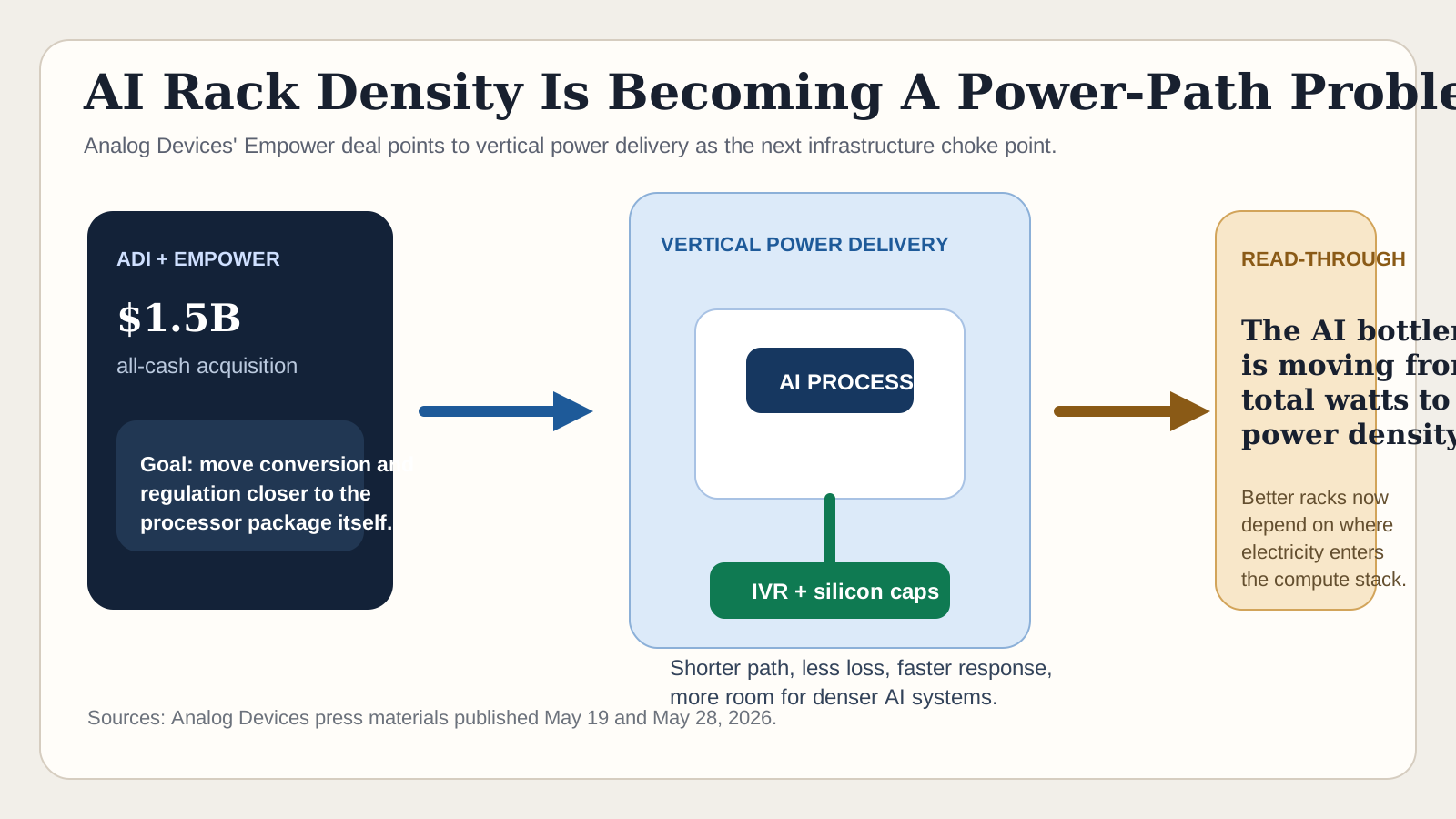
Analog Devices’ $1.5 billion agreement to acquire Empower Semiconductor is worth publishing because the useful signal is not generic dealmaking in semiconductors. The stronger signal is that AI infrastructure is now pushing the power problem closer to the processor itself. Once rack densities keep rising, the bottleneck is no longer only how much electricity reaches the data center. It is how efficiently that electricity is converted, regulated, and delivered at the point of compute.
ADI says that directly in the announcement. The company frames the acquisition around a “critical challenge in AI” tied to high-density, energy-efficient compute as power and thermal demands limit system scale. It also says the combined portfolio is aimed at integrated voltage regulator and silicon-capacitor solutions that let power conversion happen closer to the processor, shortening the power delivery path and improving efficiency. That is the important shift. The AI buildout is moving from a total-watts conversation toward a path-length and power-density conversation.
The useful ADI-Empower signal is that AI rack density is starting to depend on where power conversion sits, not just on how much power a campus can source.
That is a materially different infrastructure angle from the site’s recent STMicroelectronics coverage. The ST story was about AI capex widening into power and control silicon. The ADI deal is about where that supporting silicon has to sit in the stack. If conversion and regulation move closer to the package, then power architecture itself becomes a performance lever for the next generation of dense racks, not just a supporting subsystem.
ADI’s own May 28 MGX post sharpens the point further. The company says AI factories built around NVIDIA MGX are moving toward 800 VDC rack-level architectures because older 48-volt designs cannot keep up with megawatt-class rack targets. That matters because it links the Empower acquisition to a wider shift in the electrical design of AI systems. Higher-voltage rack distribution, hot-swap control, telemetry, and vertical power delivery are all starting to converge into one design problem.
The useful read-through is that compute density is becoming inseparable from electrical layout. If power conversion happens farther away, more energy is lost, more board space is consumed, and thermal penalties stack up faster. If it happens closer to the processor, designers may gain better transient response, tighter footprints, and more room for the compute hardware that actually earns revenue. That is why power-path design is becoming strategic instead of invisible.
This also clears the duplicate bar against the site’s cooling, storage, and utility-to-rack stories. Modine was about reserved thermal capacity. Siemens and Fluence were about productizing the electrical path from utility connection to rack interface. The AI storage article was about rack power consequences downstream of denser boxes. ADI-Empower is different. It is about a bottleneck inside the server power architecture itself, where electrical distance from the processor can now cap what the rack is able to do.
For operators and investors, the implication is that the AI bill of materials keeps widening into more technical and less obvious layers. The next category winner may not always be the firm shipping the accelerator. It may be the company solving the constraint that lets a denser accelerator platform operate safely and efficiently once it reaches production scale.
The Grid Report view is that this clears the search bar because it answers a more useful question than “why did ADI buy Empower?” The better question is where AI rack density is colliding with physics next. In this case, the answer is the power-delivery path between the rack and the processor.
Sources
Analog Devices, “Analog Devices to Acquire Empower Semiconductor, Expanding its Next-Generation High-Density Power Portfolio for the AI Era,” published May 19, 2026: https://www.analog.com/en/newsroom/press-releases/2026/5-19-2026-adi-to-acquire-empower-semiconductor.html
Analog Devices, “Powering the Next Generation of NVIDIA AI Factories with MGX,” published May 28, 2026: https://www.analog.com/en/newsroom/press-releases/2026/5-28-2026-powering-next-generation-nvidia-ai-factories-mgx.html
By Nawaz Lalani
The Grid Report is written by Nawaz Lalani and focuses on source-backed coverage of AI infrastructure, grid power demand, automation systems, and market signals.
Follow the signal, not just the headline.
Get the daily Grid brief for source-backed coverage on AI power demand, infrastructure timing, automation, and market signals.