- NVIDIA’s June 8 LG Group announcement is worth publishing because the useful signal is not that another industrial brand wants in on physical AI.
- NVIDIA’s own description is specific enough to support that reading.
- The first layer is physical AI.
- Section
- Infrastructure
- Read time
- 5 min read
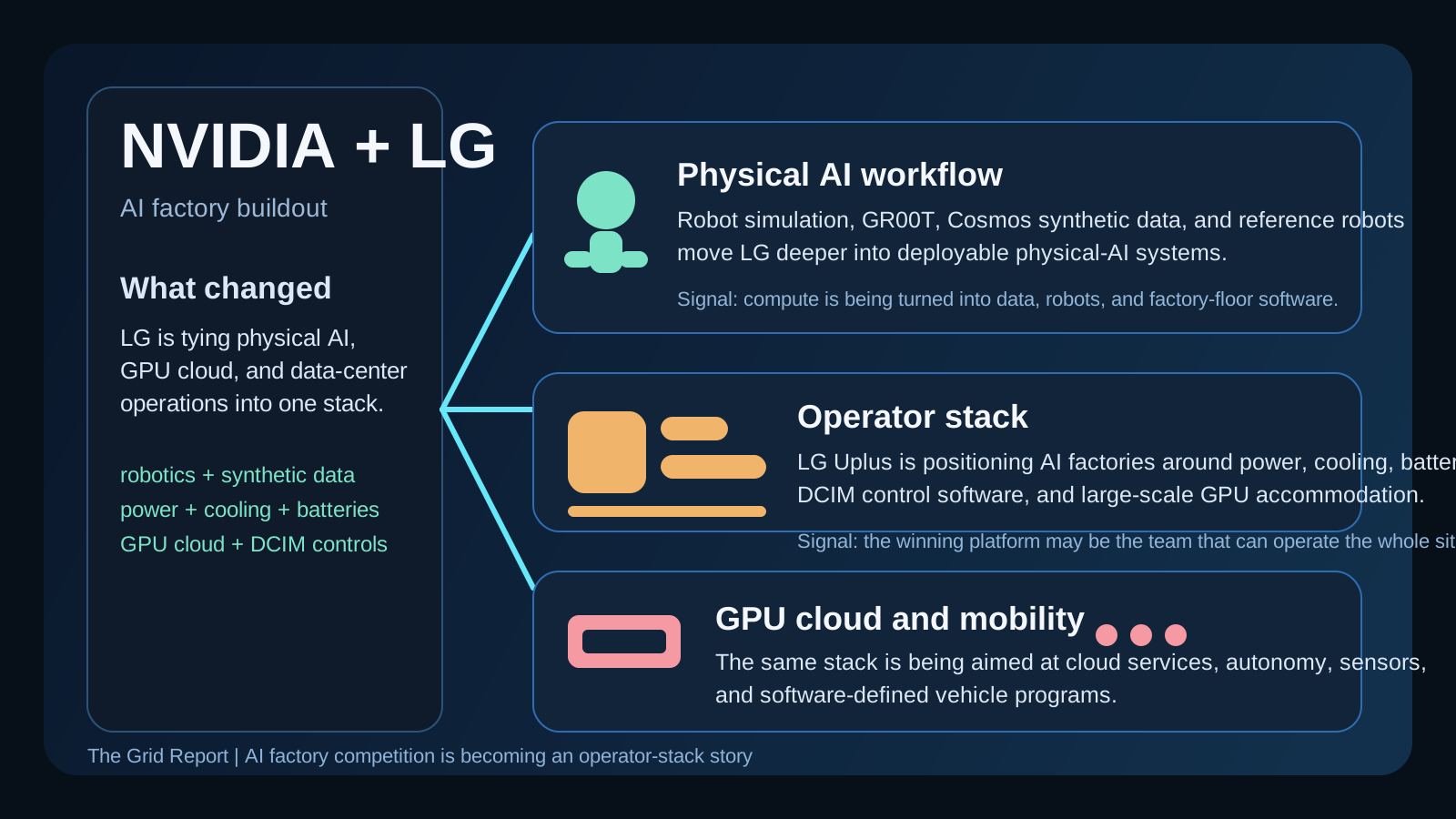
NVIDIA’s June 8 LG Group announcement is worth publishing because the useful signal is not that another industrial brand wants in on physical AI. The stronger signal is that AI-factory competition is starting to look like an operator-stack contest. LG is trying to tie together robot development, synthetic-data generation, GPU cloud services, and the hard operational layer of AI data centers so that compute, cooling, power, and control software move as one system rather than as disconnected procurement lines.
NVIDIA’s own description is specific enough to support that reading. The company says the new AI factory will serve as the foundation for LG Group businesses spanning robotics, autonomous driving, data-center technologies, and GPU cloud services. It also says the collaboration connects AI model development, physical-AI data generation, robot simulation and training, edge deployment, and factory-scale digital twins into one workflow. That matters because the AI-factory unit is getting defined less by a pile of GPUs and more by the ability to move from model work to real-world deployment inside one coordinated environment.
The useful LG Group signal is that AI-factory competition is moving beyond GPU access and toward the ability to operate power, cooling, control software, and physical-AI workflows as one stack.
The first layer is physical AI. NVIDIA says LG Electronics is integrating Isaac Sim and Isaac Lab into robot development workflows, exploring Isaac GR00T for home and modular robots, and building a physical AI data factory using Cosmos world foundation models for synthetic-data generation and augmentation. LG Innotek is adding sensing components optimized for NVIDIA environments, and LG CNS is pushing NVIDIA robotics tooling into manufacturing and logistics through its PhysicalWorks platform. That is not just a robotics press-release stack. It is an attempt to turn compute into more training data, more validated robots, and faster floor-level deployment.
The more Grid-native angle sits in the infrastructure layer. NVIDIA says LG Uplus, in collaboration with LG Electronics and LG Energy Solution, plans to build scalable, power-efficient AI factories based on NVIDIA DSX, combining accelerated computing with LG infrastructure, energy, and telecommunications capabilities. On the same day, LG Uplus said it wants to become an “AI Factory Operator,” not merely a landlord for servers. Its June 8 release describes a 200-megawatt Paju AI data center, in-house DCIM control software, integrated power and battery systems, hybrid air-and-liquid cooling, and a direct-to-chip liquid-cooling setup that improved energy efficiency by about 24% in LG’s own tests.
That operating posture is what makes the story useful now. Too many AI infrastructure headlines still imply that securing GPUs is the whole game. LG Uplus is describing a different bottleneck map: GPUs may be sourced in months, but the AI data center that can reliably host them still takes years to build, power, cool, and operate. Once that becomes the constraint, the strategic asset is not only silicon access. It is operator competence across construction speed, site power, thermal management, control software, and uptime assurance.
This also clears the duplicate bar against the site’s recent NVIDIA coverage. The Doosan piece was about widening the AI-factory map into robotics, power systems, and board materials. The SK hynix piece was about memory codevelopment and fab autonomy. The U.K. sovereign-AI story was about capacity reservations and public-private procurement. This LG story is different. It is about who can run the full stack once the hardware arrives, and how a national or regional player tries to translate group-level industrial capability into a repeatable AI-factory operating model.
For operators, the implication is that the winning AI infrastructure platform may look less like a traditional colocation provider and more like a vertically integrated site operator that owns the thermal, electrical, software, and service layers together. For investors, the useful signal is that value may accrue to companies that can convert infrastructure complexity into a managed product, not only to the companies that sell chips into the campus. For policymakers, the read-through is that domestic AI competitiveness may depend as much on who can operate a 200-megawatt site with stable cooling and power controls as on who can announce another sovereign model or robot demo.
The Grid Report view is that this clears the search bar because it answers a better question than “who announced an AI factory?” The useful question is what kind of capability is actually being assembled. In this case, the answer is an operator stack where robotics workflows, synthetic-data tools, GPU cloud services, and AI data-center operations are being packaged into one infrastructure product.
Sources
NVIDIA, “NVIDIA and LG Group Build an AI Factory to Advance Physical AI, Mobility and AI Infrastructure,” published June 8, 2026: https://blogs.nvidia.com/blog/nvidia-and-lg-group-ai-factory/
LG Uplus, “LG U+ ‘2030년 AIDC 5조원 수주…AI 인프라 표준 제시,’” published June 8, 2026: https://news.lguplus.com/21965
LG Uplus, “LG U+, ‘ONE LG’로 글로벌 최고 수준 AI데이터센터 만든다,” published February 24, 2026: https://www.lguplus.com/biz/insight/trend/862
By Nawaz Lalani
The Grid Report is written by Nawaz Lalani and focuses on source-backed coverage of AI infrastructure, grid power demand, automation systems, and market signals.
Follow the signal, not just the headline.
Get the daily Grid brief for source-backed coverage on AI power demand, infrastructure timing, automation, and market signals.