- NVIDIA’s June 7 Doosan announcement is worth publishing because the useful signal is not that another conglomerate attached itself to the physical-AI theme.
- NVIDIA’s own description is specific enough to matter.
- The more original infrastructure angle sits in the power layer.
- Section
- Infrastructure
- Read time
- 5 min read
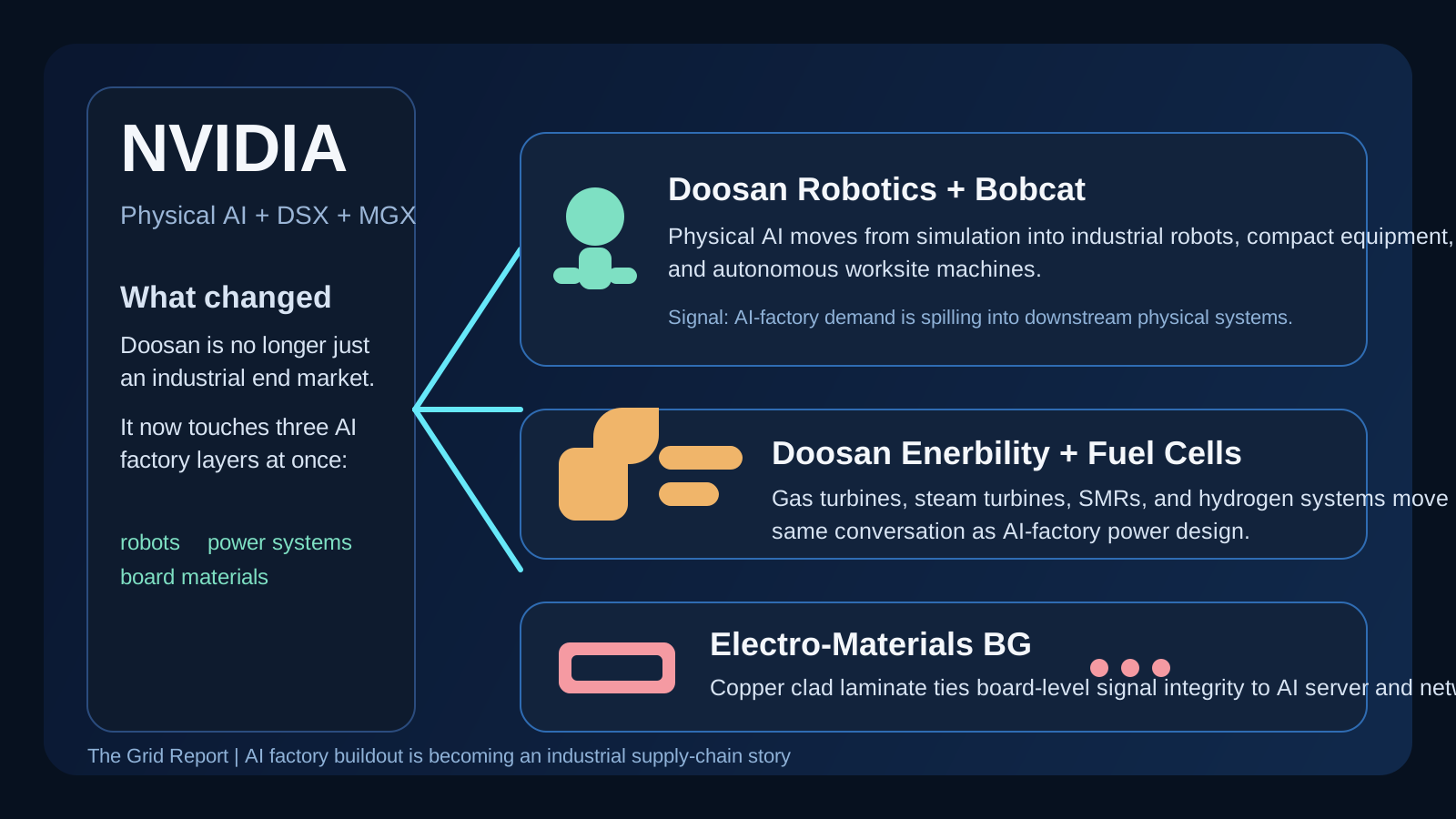
NVIDIA’s June 7 Doosan announcement is worth publishing because the useful signal is not that another conglomerate attached itself to the physical-AI theme. The stronger signal is that the AI-factory buildout is widening into a full industrial supply-chain story. Doosan is now being positioned across three different layers at once: robotics and autonomous equipment, large-scale power systems for AI facilities, and board-level materials that sit inside high-performance server and networking hardware.
NVIDIA’s own description is specific enough to matter. The company said the expanded collaboration spans Doosan Robotics, Doosan Bobcat, Doosan Enerbility, and Doosan Corporation Electro-Materials BG. On the robotics side, Doosan Robotics is integrating Isaac Sim, Isaac Lab, Cosmos, the Newton physics engine, and Jetson Thor into its Agentic Robot OS. Doosan Bobcat is exploring the same physical-AI stack for construction, landscaping, agriculture, and material-handling equipment. That matters because physical AI is moving from a lab and demo story toward a fleet-and-equipment deployment story.
The useful NVIDIA-Doosan signal is that AI-factory buildout is no longer only a rack and chip story. It is widening into robots, power systems, and board materials.
The more original infrastructure angle sits in the power layer. NVIDIA said Doosan Enerbility is exploring opportunities to support NVIDIA AI factories and the DSX platform through gas turbines, steam turbines, small modular reactors, and Doosan Fuel Cell hydrogen systems. That is not a generic sustainability paragraph. It means one industrial group is trying to position itself inside the same speed-to-power bottleneck already shaping AI campus siting, bridge power, and co-located generation decisions.
The third layer is easier to miss but analytically important. Doosan Corporation Electro-Materials BG is being tied to copper clad laminate for printed circuit boards used in AI accelerators, AI server motherboards, and networking equipment. Once the AI-factory race moves down to board materials, the supply-chain question stops being only who has GPUs or racks. It becomes who can keep the deeper electronic and manufacturing substrate moving as bandwidth, signal integrity, and thermal demands climb.
That is why this clears the duplicate block even with several recent NVIDIA stories already on the site. The Siemens and Fluence piece was about turning the utility-to-rack electrical path into a control architecture. The Taiwan ecosystem piece was about rack-manufacturing throughput. The TSMC piece was about yield and cycle time inside semiconductor fabs. This Doosan story is different. It widens the AI-factory map into an industrial-conglomerate stack where heavy equipment, turbine fleets, and PCB materials all become part of the same deployment chain.
For operators, the practical implication is that future AI infrastructure vendors may look less like pure data-center specialists and more like cross-disciplinary industrial suppliers. For investors, the useful signal is that AI capex is leaking into adjacent businesses that can solve real deployment bottlenecks: not only compute and networking, but equipment autonomy, generation hardware, and electronic materials. For infrastructure builders, the message is sharper still: the next competitive edge may come from how many layers of the stack can be packaged together before the site even breaks ground.
The Grid Report view is that this clears the search bar because it answers a better question than “what partnership got announced?” The useful question is what changed in the AI-factory buildout map. The answer is that the map is getting wider, and industrial groups with exposure to robots, onsite power, and board materials are moving closer to the center of it.
Sources
NVIDIA, “NVIDIA and Doosan Group Collaborate to Advance Physical AI and AI Factory Infrastructure,” published June 7, 2026: https://blogs.nvidia.com/blog/nvidia-and-doosan-group-physical-ai/
NVIDIA Newsroom archive entry for June 7, 2026, highlighting the Doosan collaboration: https://nvidianews.nvidia.com/news/nvidia-and-sk-hynix-announce-multiyear-technology-partnership-to-advance-memory-for-ai-factories
Doosan Enerbility, “Doosan Enerbility Signs Supplier Contract with U.S. Company for Seven Gas Turbines,” published March 6, 2026: https://www.doosan.com/en/media-center/press-release_view?id=20172774
Doosan Group, “Doosan and NVIDIA Forge Strategic Partnership to Accelerate Physical AI Integration,” published October 31, 2025: https://www.doosan.com/en/media-center/press-release_view/?id=20172738&page=0
By Nawaz Lalani
The Grid Report is written by Nawaz Lalani and focuses on source-backed coverage of AI infrastructure, grid power demand, automation systems, and market signals.
Follow the signal, not just the headline.
Get the daily Grid brief for source-backed coverage on AI power demand, infrastructure timing, automation, and market signals.