- NVIDIA’s June 1 Taiwan announcements are worth publishing because they shift the AI infrastructure conversation away from chip demand alone and toward a more operational constraint: how fast the supply chain can turn silicon into working racks, cooled systems, tested assemblies, and real deployable capacity.
- The most useful number in NVIDIA’s update is not a valuation or benchmark.
- The original Grid Report angle is that AI capacity is becoming a rack-manufacturing throughput story.
- Section
- Infrastructure
- Read time
- 6 min read
- Data included
- What NVIDIA’s Taiwan update says about the next AI bottleneck
What NVIDIA’s Taiwan update says about the next AI bottleneck
The useful shift is from “how many chips exist” to “how much rack-scale AI capacity the industrial system can actually build and validate.”
June 1 throughput signals
| Constraint layer | Why it now matters for AI capacity |
|---|---|
| Rack integration | Component availability does not become revenue until systems are assembled, cooled, and qualified. |
| Factory automation | Manufacturers are using AI and digital twins internally because manual throughput is no longer enough. |
| Validation and burn-in | Testing speed determines how quickly large clusters move from build status to deployable infrastructure. |
Sources: NVIDIA’s Taiwan ecosystem update and NVIDIA AI Cloud ecosystem update, published May 31, 2026.
NVIDIA’s June 1 Taiwan announcements are worth publishing because they shift the AI infrastructure conversation away from chip demand alone and toward a more operational constraint: how fast the supply chain can turn silicon into working racks, cooled systems, tested assemblies, and real deployable capacity.
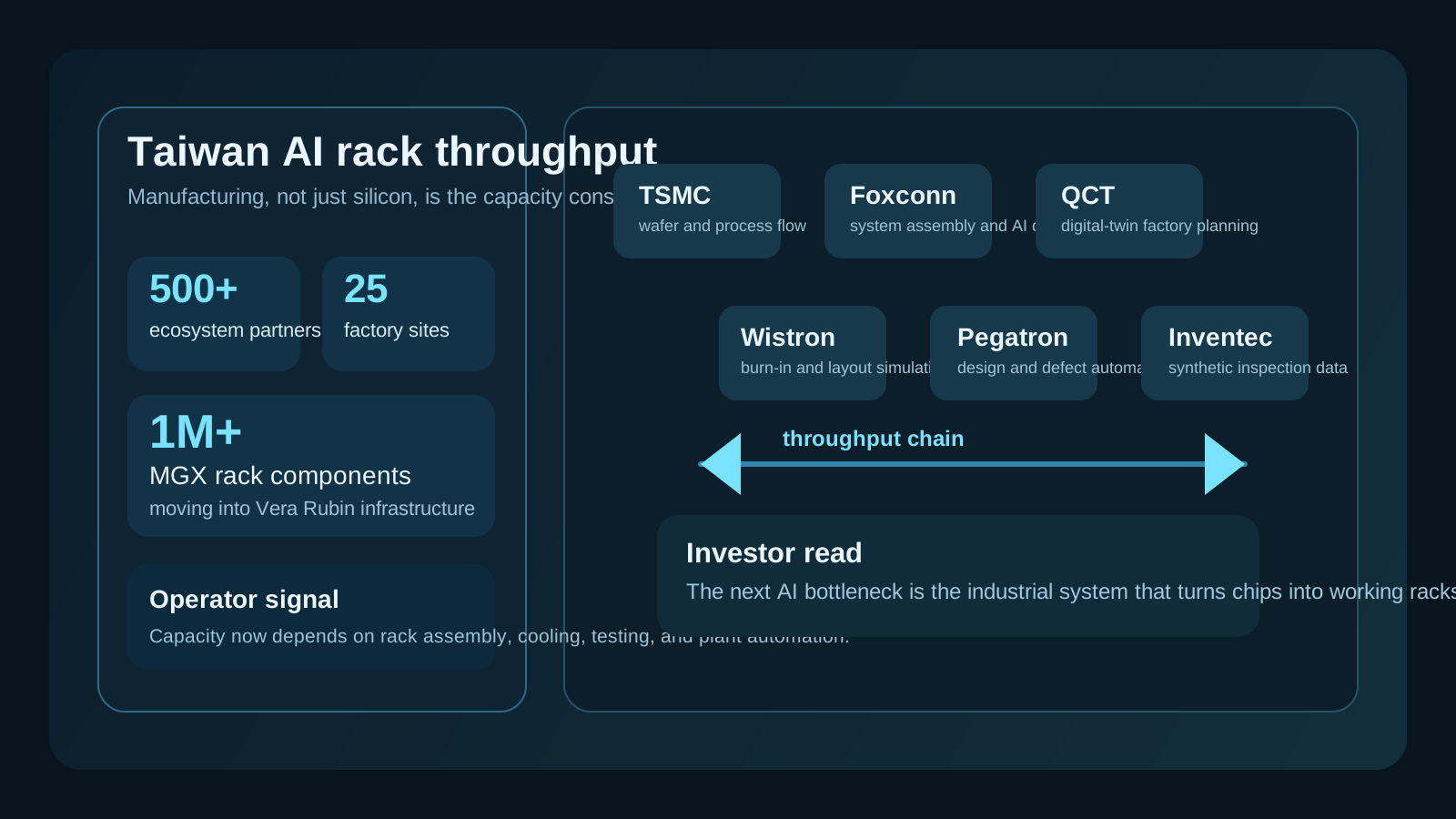
The most useful number in NVIDIA’s update is not a valuation or benchmark. It is that more than 1 million NVIDIA MGX rack components for Vera Rubin infrastructure are coming together in Taiwan across 25 factory sites, inside an ecosystem of more than 500 partners. That is the physical stack underneath the next wave of agentic AI capacity.
The next AI bottleneck is not only who has chips. It is who can turn chips into validated rack capacity fast enough to matter.
The original Grid Report angle is that AI capacity is becoming a rack-manufacturing throughput story. The industry already understands that advanced packaging, memory, and networking matter. What NVIDIA’s Taiwan cluster makes clearer is that assembly, validation, burn-in, thermal design, plant automation, and cross-company coordination now matter just as much for how quickly capacity actually reaches customers.
That is why the factory-floor details matter. NVIDIA says Foxconn is using the company’s Factory Operations Blueprint and agent tooling inside its own plants, while Quanta Cloud Technology is using Omniverse-based digital twins for factory planning, Wistron is simulating burn-in environments across manufacturing sites, and Pegatron and Inventec are using synthetic-data and defect-generation workflows to speed inspection and deployment. This is not only vendors selling into AI. It is the AI infrastructure supply chain trying to automate itself to keep up.
For operators, this reframes what “capacity online” really means. A hyperscaler or AI cloud may announce GPUs, but the path to revenue depends on whether rack integration, cooling, factory QA, and logistics can hold together across a broad manufacturing network. That makes the supply chain look less like a simple chip funnel and more like an industrial throughput system.
For investors, the read-through is broader than NVIDIA alone. The winners in this phase are not only model companies or GPU designers. They also include the server integrators, thermal suppliers, factory-automation vendors, testing workflows, and manufacturing partners that reduce the time between component delivery and energizable rack capacity.
This is materially different from the site’s earlier AMD advanced-packaging story. Packaging is still a bottleneck, but NVIDIA’s Taiwan announcement shows the next choke point moving downstream. Once chips and substrates exist, the next question is whether the industrial base can build, verify, and stage complete AI systems fast enough for the AI cloud ecosystem NVIDIA is simultaneously trying to expand across six continents.
The reason to publish this now is that June 1 produced a specific, fresh infrastructure signal with real operator relevance. If more than 1 million MGX components and 25 factory sites are now part of the public capacity story, the AI buildout has become an industrial execution race as much as a semiconductor race.
Sources
NVIDIA Blog, “Taiwan’s Industry Titans Turbocharge World’s AI Infrastructure Buildout With NVIDIA,” May 31, 2026: https://blogs.nvidia.com/blog/taiwan-ecosystem-ai-infrastructure/
NVIDIA Blog, “NVIDIA AI Cloud Ecosystem Expands Worldwide to Meet Global AI Compute Demand,” May 31, 2026: https://blogs.nvidia.com/blog/ai-cloud-ecosystem/
By Nawaz Lalani
The Grid Report is written by Nawaz Lalani and focuses on source-backed coverage of AI infrastructure, grid power demand, automation systems, and market signals.
Follow the signal, not just the headline.
Get the daily Grid brief for source-backed coverage on AI power demand, infrastructure timing, automation, and market signals.