- One of the few AI stories that still clears the bar today is NVIDIA turning Vera from a GTC concept into a real production-infrastructure narrative.
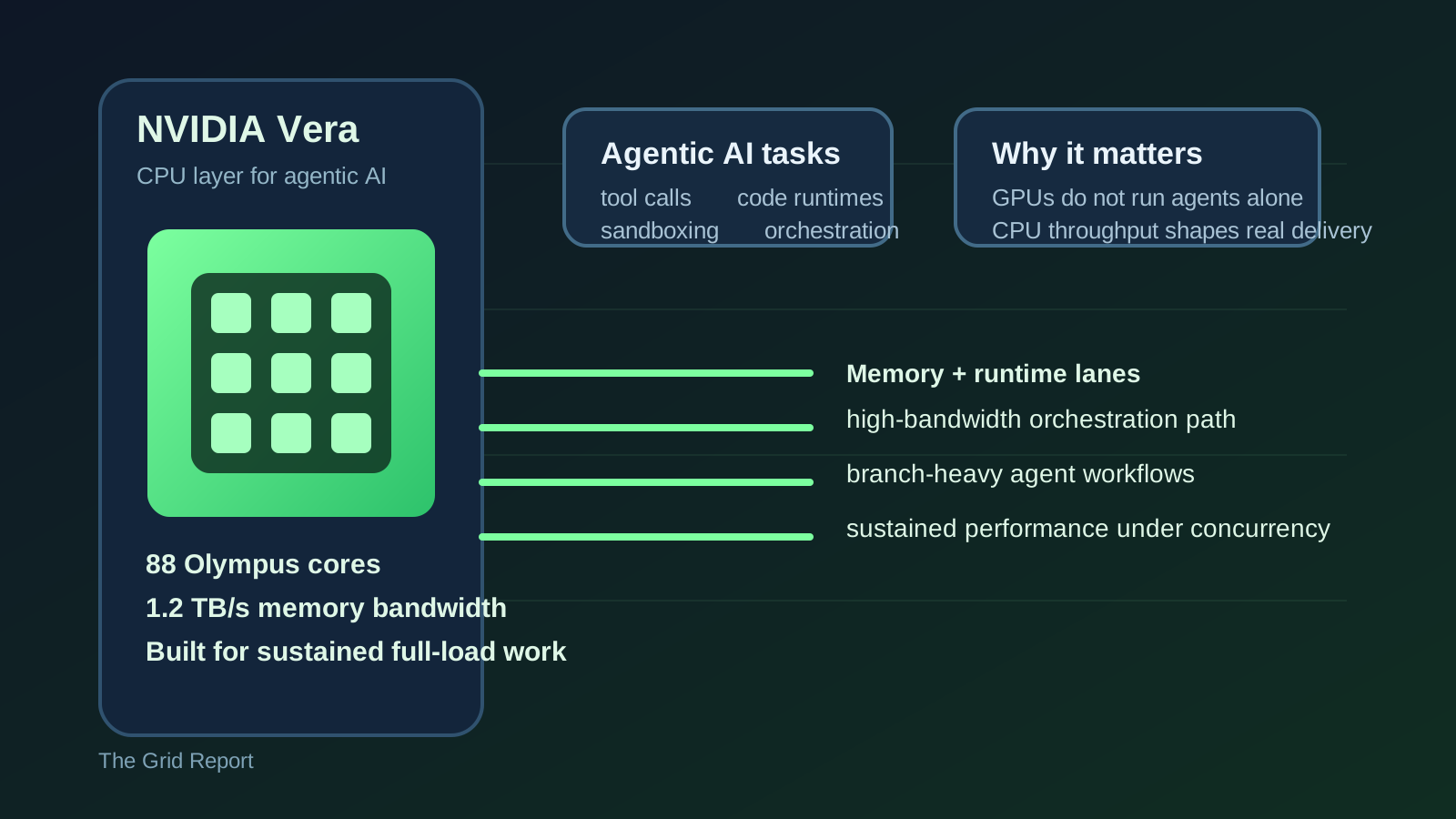
- According to NVIDIA’s May 26 benchmark post, Vera uses 88 custom Olympus cores, delivers 1.2 terabytes per second of memory bandwidth, and was designed for the branch-heavy sequential work underneath agentic AI: code runtimes, tool calls, data processing, orchestration, and sandboxed execution.
- The second May 26 NVIDIA post is what makes this more than a benchmark story.
- Section
- AI
- Read time
- 5 min read
One of the few AI stories that still clears the bar today is NVIDIA turning Vera from a GTC concept into a real production-infrastructure narrative. The publishable signal is not simply that NVIDIA posted another benchmark. It is that the company is explicitly reframing the CPU as a critical layer in agentic AI, then putting the first Vera systems into the hands of Anthropic, OpenAI, Oracle Cloud Infrastructure, and SpaceXAI.
According to NVIDIA’s May 26 benchmark post, Vera uses 88 custom Olympus cores, delivers 1.2 terabytes per second of memory bandwidth, and was designed for the branch-heavy sequential work underneath agentic AI: code runtimes, tool calls, data processing, orchestration, and sandboxed execution. NVIDIA says Phoronix testing showed a 1.6x geometric-mean gain over Grace, while Michael Larabel wrote that Vera outperformed AMD’s EPYC 9575F on a geometric-mean basis and delivered unusually strong sustained memory performance. Those details matter because agentic systems are full of CPU-bound work that does not disappear just because the model layer gets more powerful.
Agentic AI does not just create more demand for GPUs. It pulls the CPU and memory-orchestration layer back into the center of the AI factory.
The second May 26 NVIDIA post is what makes this more than a benchmark story. Ian Buck hand-delivered the first Vera CPU systems to Anthropic, OpenAI, Oracle Cloud Infrastructure, and SpaceXAI, with OCI saying it plans to deploy hundreds of thousands of Vera CPUs beginning in 2026. That changes the article from lab theater to deployment signal. Once large AI operators are evaluating or planning production rollout around a new CPU architecture built specifically for agents, the CPU is no longer a background component. It becomes part of the product thesis for the next AI stack.
The original Grid Report angle is that agentic AI is creating a CPU moment inside the AI factory. The market spent the last two years treating GPUs as the obvious bottleneck. That remains true at the accelerator layer, but agents bring back another constraint: every sandbox, scheduler, retrieval pass, runtime, code compile, and tool chain still has to move through the CPU and memory system reliably. If that orchestration layer stalls, more GPU capacity alone does not solve the problem.
This clears the site’s duplicate block. The Grid Report has already published on OpenAI’s Deployment Company, Dell’s enterprise coding-agent stack, and AMD’s packaging push. This article is materially different because it is not about model adoption, consulting, or accelerator supply. It is about the CPU layer reasserting itself as agentic AI becomes more operational and more concurrent.
For operators, the implication is practical. AI infrastructure planning now has to account for the non-GPU side of agentic throughput: fast cores, high sustained memory bandwidth, predictable latency under parallel load, and how well the orchestration layer keeps agents fed. For investors, the signal is that the next AI-infrastructure repricing may extend into CPU and system-level architecture once the market sees which vendors are best positioned to support high-throughput reasoning workloads.
The Grid Report view is that this article is publishable because it has a same-day company hook, a distinct thesis, strong search value around NVIDIA Vera, and a clear operator takeaway. The important shift is not just a new processor. It is the CPU layer becoming a first-class agentic AI bottleneck again.
Sources
NVIDIA, “NVIDIA Vera CPU Is ‘Packing a Heavy-Hitting Punch’ Against Competition,” May 26, 2026: https://blogs.nvidia.com/blog/vera-cpu-phoronix/
NVIDIA, “Vera Arrives: NVIDIA’s First CPU Built for Agents Lands at Top AI Labs,” May 26, 2026: https://blogs.nvidia.com/blog/vera-cpu-delivery/
By Nawaz Lalani
The Grid Report is written by Nawaz Lalani and focuses on source-backed coverage of AI infrastructure, grid power demand, automation systems, and market signals.
Follow the signal, not just the headline.
Get the daily Grid brief for source-backed coverage on AI power demand, infrastructure timing, automation, and market signals.