- TeraWulf’s May 26 acquisition of the Muskie Data Campus in Eastern Kentucky is worth publishing because the strongest signal is not simply that another operator wants to build a gigawatt-scale AI campus.
- In TeraWulf’s release, the key details are unusually specific.
- That is the original Grid Report angle.
- Section
- Infrastructure
- Read time
- 6 min read
- Why this page exists
- The Grid Report publishes operator-grade coverage on AI, power, infrastructure, automation, and markets.
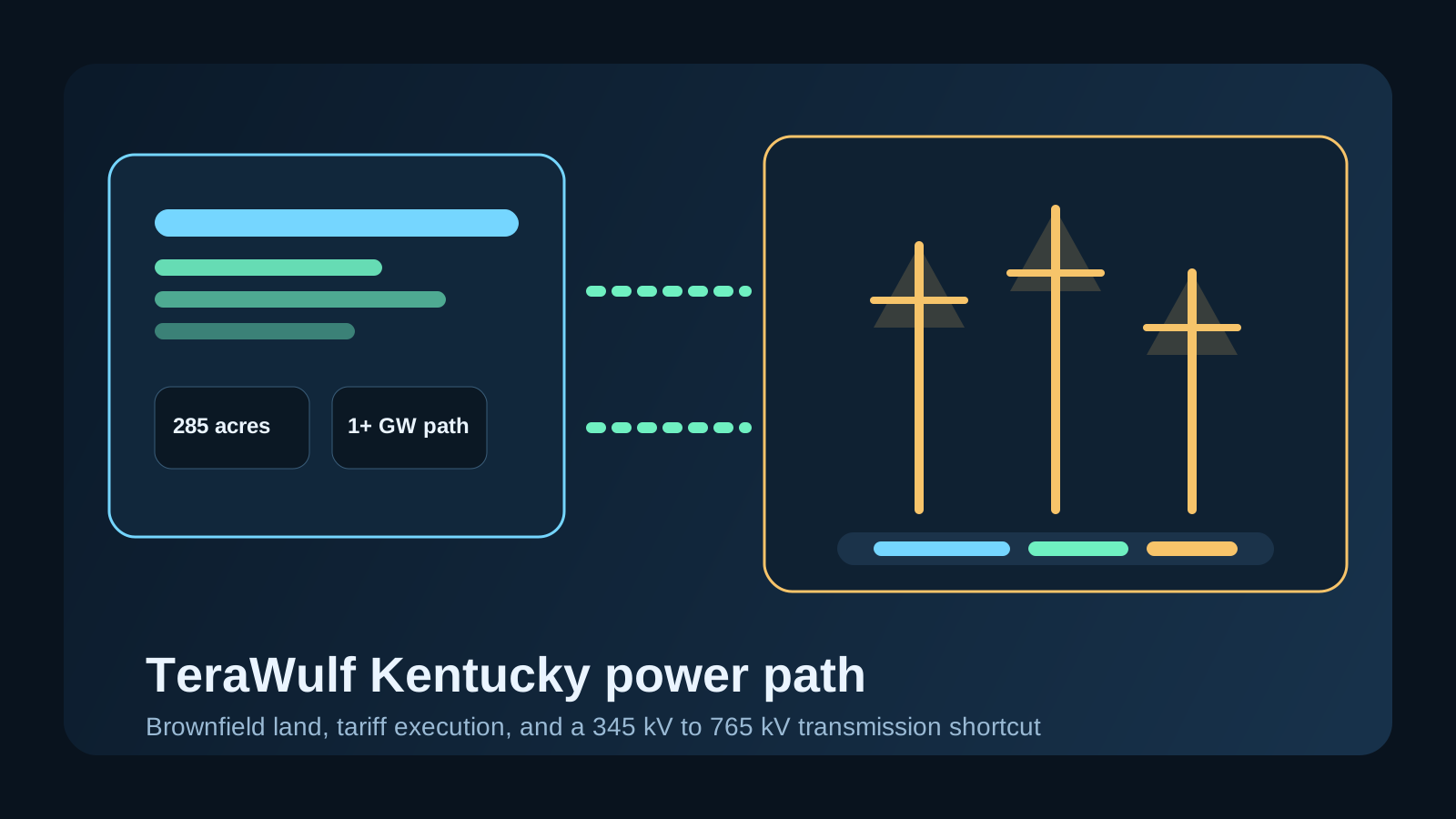
TeraWulf’s May 26 acquisition of the Muskie Data Campus in Eastern Kentucky is worth publishing because the strongest signal is not simply that another operator wants to build a gigawatt-scale AI campus. The useful signal is that AI site selection is becoming a transmission-and-tariff problem. The company is not selling generic land optionality. It is buying an industrial site that already carries a clearer path to utility-scale power delivery, zoning, permitting momentum, and limited site-prep friction.
In TeraWulf’s release, the key details are unusually specific. The company says the site can support more than 1 gigawatt of data center capacity over time, with the first 500 megawatts expected to ramp beginning in the second half of 2028 and another 500 megawatts targeted for the second half of 2030. More important than the delivery schedule is the electrical setup behind it. Kentucky Power, an AEP company, is constructing a 345 kV substation connected to the existing 765 kV transmission network, and TeraWulf says transmission infrastructure and energy service agreements were executed concurrently under the applicable Industrial General Service tariff structure for large loads.
The next AI site-selection edge is not only acreage. It is how much of the transmission, tariff, and permitting path is already de-risked before the first rack arrives.
That is the original Grid Report angle. In the next phase of the AI buildout, not all gigawatt announcements are equivalent. A brownfield industrial location with a defined transmission backbone and tariff path is a different asset from a greenfield site with only conceptual utility interest. The real scarcity is shifting toward projects that can compress the time between land control and energizable capacity.
This is why the EastPark detail matters. The campus sits inside a long-developed industrial park rather than a blank-slate parcel that still needs zoning fights, major entitlement work, or basic power-roadmap definition. TeraWulf says the site is already zoned for intended use, permitting activities are underway, and only limited site work is required before data center construction. For developers and infrastructure investors, that is not background color. It is part of the value proposition.
The story also clears the site’s recent overlap filters. It is not the same thesis as the IREN power-readiness piece, which was about a global 5 GW deployment relationship. It is not the same as the Constellation Freestone meter-boundary story, which focused on the regulatory structure around serving a Texas campus. And it is not the same as the DigitalBridge-ArcLight article, which was about owning power control through capital structure. This TeraWulf story is narrower and more site-specific: AI campuses are increasingly being assembled by repurposing legacy industrial transmission logic into a deployment shortcut.
There is also a strategic read-through for crypto-native infrastructure operators. TeraWulf already framed itself as a vertically integrated digital infrastructure company, but this acquisition pushes it further from a simple mining identity and deeper into the market for shovel-ready AI and HPC campuses. That matters because some of the best-positioned developers may be the ones that already understand substations, interconnection sequencing, long-duration power contracts, and local economic-development politics.
For operators, the lesson is practical. The winning site may not be the one with the biggest eventual megawatt number. It may be the one that arrives with fewer transmission surprises, fewer tariff unknowns, and a cleaner line of sight to construction. For investors, the lesson is similar: brownfield transmission posture is starting to look like a first-class AI infrastructure asset.
The reason to publish this now is that it is specific, timely, and more useful than a commodity data-center expansion rewrite. TeraWulf effectively answered a better question than “how big is the campus?” It answered how much of the power path is already de-risked before the first AI hall is built.
Sources
TeraWulf investor press release, “TeraWulf Expands Infrastructure Platform with Acquisition of 1+ GW Eastern Kentucky HPC Campus,” published May 26, 2026: https://investors.terawulf.com/news-events/press-releases/detail/140/terawulf-expands-infrastructure-platform-with-acquisition-of-1-gw-eastern-kentucky-hpc-campus
TeraWulf Form 8-K exhibit filing carrying the May 26, 2026 press release: https://www.sec.gov/Archives/edgar/data/1083301/000108330126000109/wulfeasternkypr5-26x26.htm
American Electric Power overview of 765 kV transmission capability: https://www.aep.com/about/businesses/transmission/765kv/
Nawaz Lalani
Nawaz Lalani is the creator of The Grid Report and writes about AI infrastructure, grid power demand, automation systems, and the market signals shaping the physical AI economy. His focus is translating technical and industrial shifts into practical coverage for operators, investors, builders, and teams making real deployment decisions.
B.S. in Geology from UT Arlington. Covers AI infrastructure, energy systems, grid constraints, automation workflows, and market signals.
Stories are built from primary sources, utility and infrastructure signals, company disclosures, filings, and operator-grade context. The goal is to explain what changed, why it matters now, and what it means for builders, investors, utilities, and teams making real deployment decisions.
Follow the lane, not just the headline.
The strongest value in The Grid Report comes from following how AI, infrastructure, power, automation, and markets connect over time.