- NVIDIA’s May 31 TSMC announcement is worth publishing because the useful signal is not that another semiconductor company adopted more AI tooling.
- The official facts are concrete.
- What makes this more than a tooling story is where the gains sit.
- Section
- Infrastructure
- Read time
- 5 min read
NVIDIA’s May 31 TSMC announcement is worth publishing because the useful signal is not that another semiconductor company adopted more AI tooling. The stronger signal is that the AI capacity race is moving deeper into the fab itself. Once chip demand is large enough, the constraint is no longer just GPU design wins, packaging lines, or data-center capex. It is whether leading-edge fabs can move faster, waste less, and make better decisions before physical changes are locked in.
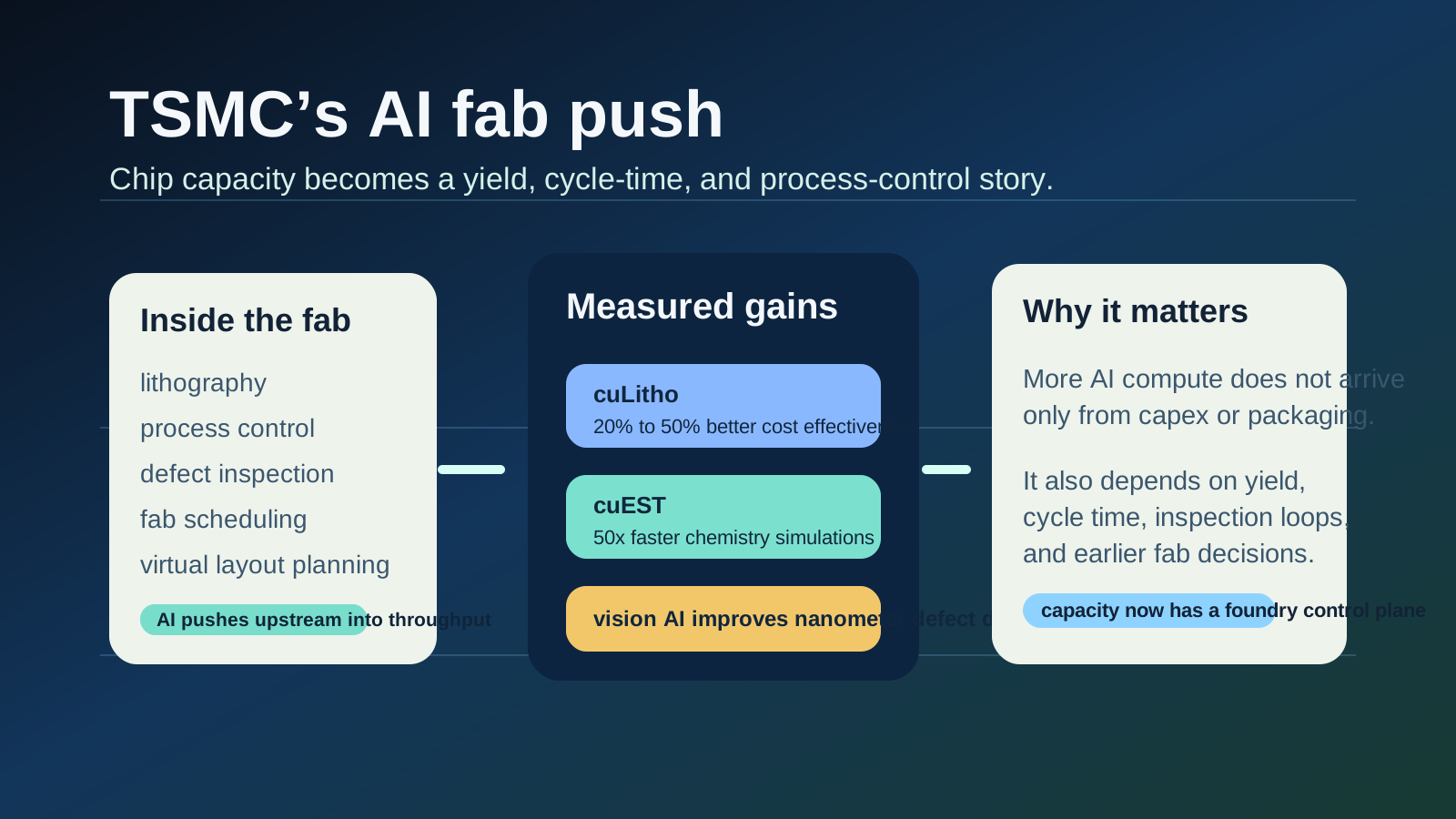
The official facts are concrete. NVIDIA said TSMC is using accelerated computing and AI across lithography, transistor and process simulation, advanced process control, fab operations optimization, defect inspection, and virtual fab planning. NVIDIA also said TSMC is using cuLitho for computational lithography, cuEST for semiconductor material simulation, cuML for process analytics, Metropolis and TAO Toolkit for defect classification, and Omniverse libraries to explore a virtual FabTwin environment.
The useful TSMC signal is that AI capacity is now being won inside the fab, where lithography speed, process control, and defect detection determine how fast real supply appears.
What makes this more than a tooling story is where the gains sit. NVIDIA said cuLitho can improve cost effectiveness or cycle time by 20% to 50% versus CPU-based lithography, while cuEST delivers average chemistry-simulation speedups of 50x for semiconductor material design. It also said GPU-accelerated scheduling on H200 systems is improving fab productivity and that vision AI is helping TSMC detect nanometer-scale defects while reducing repeated labeling and retraining. Those are not cosmetic improvements. They are throughput, yield, and execution variables.
That matters because advanced-node chip supply is increasingly an operating-systems problem. The usual market narrative still treats AI capacity as if it mostly depends on how many accelerators hyperscalers order or how many data centers get financed. This announcement points one layer upstream. If process variation stays high, if inspection loops are slow, or if fab layouts are optimized too late, then the real bottleneck sits inside manufacturing operations rather than in downstream demand.
This clears the duplicate block against the site’s recent Taiwan and packaging coverage because the thesis is different. The earlier stories focused on rack manufacturing throughput, sovereign AI buildouts, or advanced packaging as a scale constraint. This story is about the control plane inside the foundry. It asks how much of future AI chip supply will be won through better process analytics, better scheduling, and virtual-first plant design before wafers ever leave the fab.
For operators across the AI stack, the practical read-through is that compute supply will increasingly depend on manufacturing intelligence, not just capital deployment. A fab that can shorten decision cycles, reduce process drift, improve defect classification, and simulate tool layouts before construction can turn the same physical footprint into more usable output. That changes how suppliers, cloud buyers, and investors should think about who is actually compounding capacity.
For investors, the stronger implication is that the semiconductor value chain is getting more software-like in its operating leverage. If AI can raise yield, improve tool utilization, and compress cycle time inside advanced fabs, then part of the next AI margin story may sit in manufacturing productivity rather than only in model demand or downstream server shipments.
The Grid Report view is that this clears the bar because it answers a specific search-worthy question: what does AI actually do inside a leading-edge chip fab? The useful answer is that it is becoming part of lithography, process control, defect inspection, scheduling, and digital-twin planning. In other words, the next layer of AI infrastructure competition is increasingly about fab execution, not just fab ownership.
Sources
NVIDIA Newsroom, “NVIDIA and TSMC Bring AI Into Fabs to Advance Semiconductor Design and Manufacturing,” published May 31, 2026: https://nvidianews.nvidia.com/news/nvidia-and-tsmc-bring-ai-into-fabs-to-advance-semiconductor-design-and-manufacturing
Taiwan Semiconductor Manufacturing Company, 2025 Annual Report, published May 2026: https://investor.tsmc.com/sites/ir/annual-report/2025/2025%20Annual%20Report_E.pdf
By Nawaz Lalani
The Grid Report is written by Nawaz Lalani and focuses on source-backed coverage of AI infrastructure, grid power demand, automation systems, and market signals.
Follow the signal, not just the headline.
Get the daily Grid brief for source-backed coverage on AI power demand, infrastructure timing, automation, and market signals.