- DayOne’s June 5 Series C close is worth publishing because the useful signal is not the headline dollar figure by itself.
- The official facts are straightforward.
- What makes this more than a funding headline is the way the capital stack has been built.
- Section
- Infrastructure
- Read time
- 5 min read
- Why this page exists
- The Grid Report publishes operator-grade coverage on AI, power, infrastructure, automation, and markets.
DayOne’s June 5 Series C close is worth publishing because the useful signal is not the headline dollar figure by itself. The stronger signal is that AI-ready data-center scale is increasingly being financed as a private platform business rather than a one-campus story. When a company can stitch together multibillion-dollar equity, mezzanine debt, utility-linked buildouts, and booked capacity across several countries, it shows where the infrastructure race is actually moving.
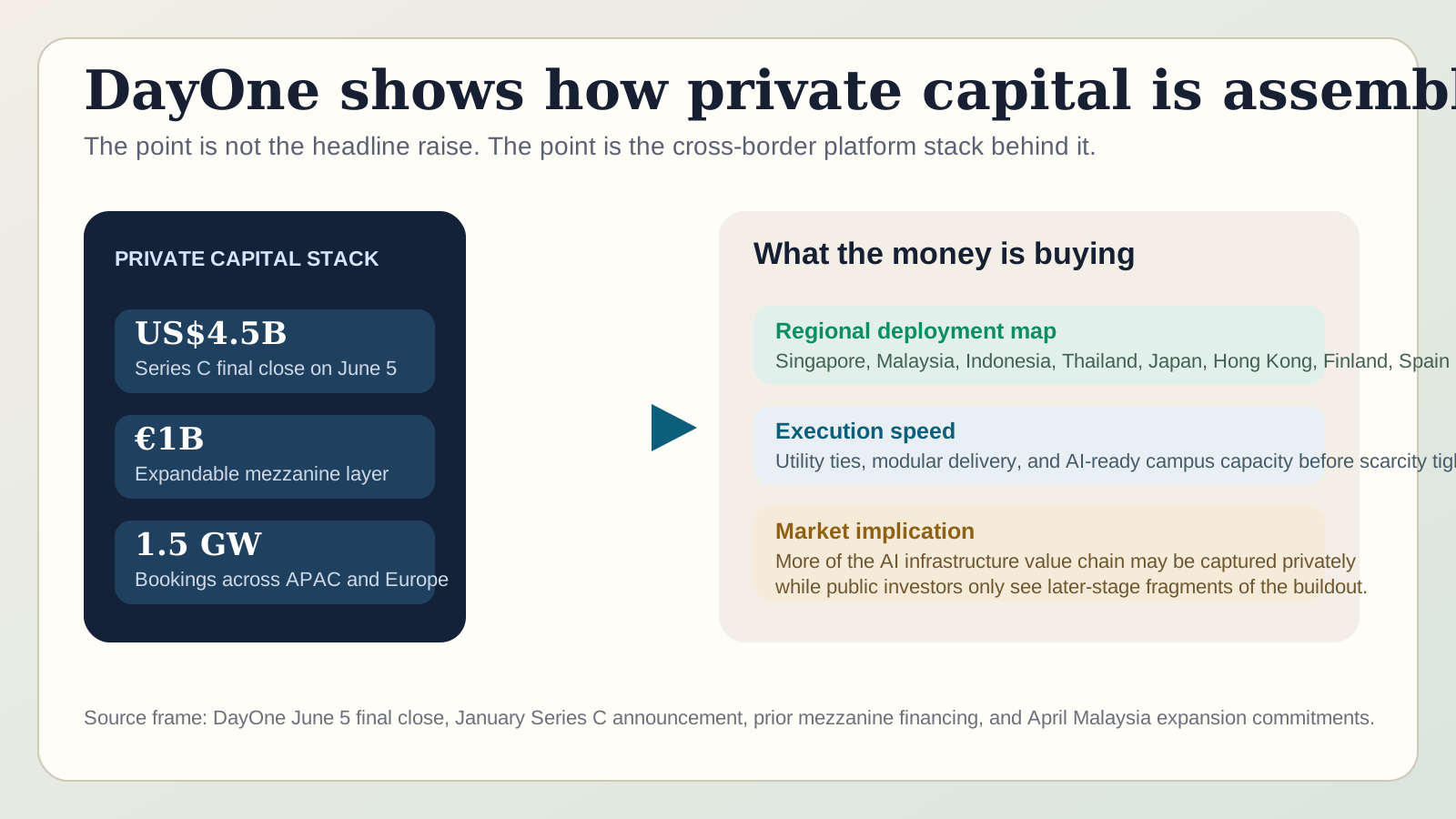
The official facts are straightforward. DayOne said it closed its Series C equity financing with total gross proceeds of US$4.5 billion, led by existing investors Coatue and Hillhouse, with additional participation from the Indonesia Investment Authority and Achi Capital Partners. The company also said it has secured more than 1.5 gigawatts of total bookings across Asia Pacific and Europe and expects the new capital to accelerate expansion in Singapore, Malaysia, Indonesia, Thailand, Japan, Hong Kong SAR, Finland, and Spain.
The useful DayOne read-through is not just that private capital is still interested. It is that AI-ready data-center scale is being financed as a cross-border platform race.
What makes this more than a funding headline is the way the capital stack has been built. In January, DayOne had already announced over US$2.0 billion of Series C financing agreements, priced at a 100% premium to the prior round, on top of US$1.9 billion from its 2024 Series A and B rounds. In December 2025, it also disclosed a Finland-linked mezzanine facility of up to €1 billion backed by Brookfield and a sovereign investor. That starts to look less like venture-style fundraising and more like a private version of infrastructure platform formation.
The capacity and geography matter too. DayOne’s own materials show that the company is not pitching a single market. It is building a corridor strategy across the SIJORI region, plus Finland, Japan, Thailand, Hong Kong, and other expansion markets. In April, it said Malaysia alone would account for more than half of the firm’s global headcount growth in 2026 and more than RM28 billion of cumulative investment by the end of the year. In other words, the money is being raised against a regional deployment map, not just a narrative about AI demand.
That is what separates this story from the site’s recent debt-sale and campus-financing coverage. The earlier pieces focused on hyperscaler bond markets, asset-backed GPU structures, or project-specific leases. DayOne is a different read-through. It shows capital trying to buy speed, optionality, and customer-facing capacity across multiple jurisdictions at once, before scarcity in land, power access, and delivery capability gets even tighter.
For operators and developers, the practical message is that scale advantages are getting harder to fake. A platform that can combine equity depth, debt flexibility, utility relationships, and a modular delivery model has a much better shot at winning hyperscaler demand than a project that only has land and a concept deck. The market is rewarding companies that can underwrite the full stack from financing to energization to regional expansion.
For investors, the stronger implication is that more of the AI infrastructure value chain may be captured privately before public markets can price it. If private platforms can secure capital at this scale while stacking booked demand and power-linked expansion, then listed names may only show fragments of the buildout. The real scarcity may sit earlier in the platform-assembly phase, where capital, geography, and execution capability are bundled together.
The Grid Report view is that this clears the publish bar because it answers a specific, high-intent search question: what does a serious private AI data-center capital stack look like in 2026? In DayOne’s case, it looks like large equity rounds layered on top of sovereign and infrastructure debt backing, then deployed against a multi-country capacity map that aims to lock in AI-ready growth before the market gets even more crowded.
Sources
DayOne Data Centers Limited, “DayOne Data Centers Announces Final Closing of its Series C Equity Financing at US$4.5 Billion,” published June 5, 2026: https://www.prnewswire.com/apac/news-releases/dayone-data-centers-announces-final-closing-of-its-series-c-equity-financing-at-us4-5-billion-302792424.html
DayOne Data Centers Limited, “DayOne Data Centers Announces Over US$2.0 Billion Series C Financing to Accelerate Global Digital Infrastructure Expansion,” published January 5, 2026: https://dayonedc.com/headliners/dayone-data-centers-announces-over-us2-0-billion-series-c-financing-to-accelerate-global-digital-infrastructure-expansion
DayOne Data Centers Limited, “DayOne Secures Up to €1 Billion Mezzanine Financing Facility to Accelerate Finland Platform and Global Expansion,” published December 4, 2025: https://dayonedc.com/en/headliners/dayone-secures-up-to-e1-billion-mezzanine-financing-facility-to-accelerate-finland-platform-and-global-expansion
DayOne Data Centers Limited, “DayOne Announces RM28+ Billion Commitment and Talent Initiatives in Malaysia at Inaugural Tech & AI Career Expo,” published April 1, 2026: https://dayonedc.com/headliners/dayone-announces-rm28-billion-commitment-and-talent-initiatives-in-malaysia-at-inaugural-tech-ai-career-expo
Nawaz Lalani
Nawaz Lalani is the creator of The Grid Report and writes about AI infrastructure, grid power demand, automation systems, and the market signals shaping the physical AI economy. His focus is translating technical and industrial shifts into practical coverage for operators, investors, builders, and teams making real deployment decisions.
B.S. in Geology from UT Arlington. Covers AI infrastructure, energy systems, grid constraints, automation workflows, and market signals.
Stories are built from primary sources, utility and infrastructure signals, company disclosures, filings, and operator-grade context. The goal is to explain what changed, why it matters now, and what it means for builders, investors, utilities, and teams making real deployment decisions.
Follow the lane, not just the headline.
The strongest value in The Grid Report comes from following how AI, infrastructure, power, automation, and markets connect over time.